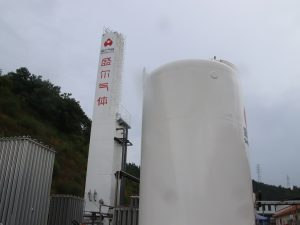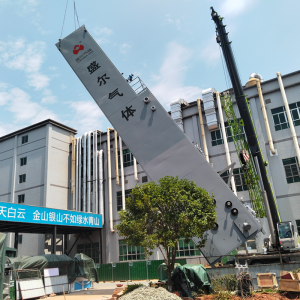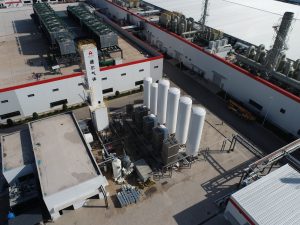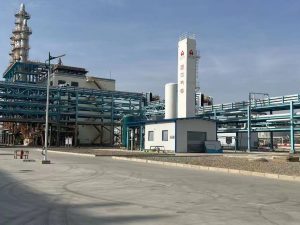
The utilisation of modular cryogenic air separation units (ASUs) presents a compelling solution for industries requiring high‑purity nitrogen and oxygen. A modular approach enables accelerated deployment, strategic scaling, and precise adaptation to varying production demands. In this article we examine the key engineering principles, modular design benefits, performance metrics, and application scenarios for such units, with a focus on high‑purity nitrogen and oxygen generation.
1. Principle of Modular Cryogenic Air Separation Units
A cryogenic air separation unit essentially uses the difference in boiling points of atmospheric air components to achieve separation. Atmospheric air is first compressed, then purified (removal of moisture, CO₂, hydrocarbons) and cooled to cryogenic temperatures via a series of heat exchangers. In the resulting distillation column(s), oxygen (boiling at –183 °C) and nitrogen (–196 °C) are separated thermally. Cryospain+1
In modular configurations the entire cold‑box, distillation train, and associated equipment are prefabricated or skid‑mounted, tested off‑site, and delivered to site for rapid integration. According to leading suppliers, such modular units deliver reliability approaching 100 %. 林德工程+1
2. Key Advantages of Modular Cryogenic Air Separation Units
2.1 Rapid deployment and reduced installation time
Prefabrication of modules—including plate‑fin heat exchangers, cold boxes, and control systems—reduces civil work and site coordination time. One vendor quote states “cold‑box sizes designed for road transport” and “shop‑tested containerised control system”. 林德资产
2.2 Scalability and flexibility
Modular units can be selected in families of capacities, for example nitrogen flows from 10,000 to 100,000 Nm³/h as standard in one portfolio. 林德工程 This enables users to match capacity to demand rather than oversizing a monolithic plant.
2.3 High purity and reliability
The modular concept supports high‑purity oxygen (≥99.5 %) and nitrogen (<1 ppm O₂) production, making it suitable for demanding applications. Siad Americas+1 The built‑in redundancy and modular backup system enhance availability.
3. Performance Metrics for Modular Cryogenic Air Separation Units
The following table summarises typical performance parameters for a modular cryogenic ASU configured for high‑purity nitrogen and oxygen:
| Parameter | Typical Value | Remarks |
|---|---|---|
| Oxygen product purity | ≥ 99.5 % O₂ | Suitable for metallurgical / chemical uses |
| Nitrogen product purity | ≥ 99.999 % N₂ | For semiconductor, electronics or inerting |
| Nitrogen flow capacity | 10,000 – 100,000 Nm³/h (modular range) | Typical of standard modular families 林德工程 |
| Oxygen flow capacity | 1,000 – 50,000 Nm³/h (modular range) | From supplier portfolio 林德工程 |
| Specific energy consumption (kWh/Nm³) | ~0.30–0.60 (site‑dependent) | Depends on load, configuration, ambient conditions |
| Start‑up time (modular) | Weeks rather than months | Prefab modules reduce schedule |
| Footprint reduction | ~30‑50 % vs traditional site‑built | Due to skid‑mounting and modular layout |
Note: The energy consumption figure is indicative. Actual installed kWh/Nm³ will depend on ambient temperature, plant load factor, compressor efficiency, cold‑box design and insulation level. Research indicates the modular approach can help lower lifecycle cost of ownership. 林德资产+1
4. Engineering Considerations in Modular Cryogenic Air Separation Units
4.1 Cold‑box and heat‑exchanger design
The heart of the unit lies in the cryogenic heat‑exchangers (commonly plate‑fin type) and distillation columns. Modular design must ensure minimal thermal losses, robust fabrication, and accessibility for maintenance.
4.2 Control, automation and remote monitoring
Given high‑purity demands and global service coverage, many modular units integrate PLC/SCADA systems and remote monitoring capability. Supplier literature notes “advanced PLC‑based plant control systems … remote monitoring and diagnostics” for ASUs. Siad Americas
4.3 Purity assurance and start‑up/shutdown strategy
High‑purity nitrogen (<1 ppm O₂) demands rigorous purification of feed air (molecular sieves, activated carbon, moisture removal) and stable distillation conditions. Start‑up and shutdown sequences should be carefully engineered to avoid contamination and preserve internals.
4.4 Integration into plant and industrial ecosystem
Modular units must match upstream (air‑compression, feed‑air pretreatment) and downstream (gas distribution, storage, vaporisers) systems. In mineral, steel, battery gigafactory or glass applications, effective integration is key to achieving the promised benefits.
5. Application Scenarios for Modular Cryogenic Air Separation Units
Industries that particularly benefit from modular cryogenic ASUs for high purity nitrogen and oxygen include:
- Steel mills and glass plants, where high‑purity oxygen enhances combustion or melting processes.
- Lithium‑battery gigafactories, where high‑purity nitrogen is used for inert atmospheric control during electrode formation.
- Semiconductor and electronics manufacturing, where ultra‑high‑purity nitrogen and inert gases are required.
- Petrochemical and chemical complexes requiring large tonnage gas supply but prefer rapid project schedules and modular deployment.
6. Why Choose a Modular Cryogenic Approach?
Traditional large‑scale ASUs are effective but often involve long engineering, procurement, and construction (EPC) schedules, higher civil costs, and lower flexibility. Modular cryogenic solutions offer:
- Shorter delivery timeline and faster on‑stream time
- Lower installation and commissioning risk
- Easier expansion via module addition
- Better fit for high‑purity, high‑volume applications
As noted in technology reviews, cryogenic air separation remains the process of choice when purity >99.5 % and large volumes are required, despite higher upfront investment compared to PSA. – Minnuo+1
7. Outlook and Final Thoughts
As demand continues to grow for high‑purity industrial gases—from battery manufacturing to advanced materials—modular cryogenic air separation units will increasingly serve as key components of on‑site generation strategies. Their combination of scalability, modularity and purity make them ideal for engineering teams seeking robust, deployable solutions. For technical engineers and researchers, attention to module layout, heat‑exchanger design, compressor integration, control architecture and lifecycle cost optimisation will determine success.
In summary, a modular cryogenic air separation unit designed for high‑purity nitrogen and oxygen generation offers a state‑of‑the‑art solution for demanding industrial environments. By merging proven cryogenic distillation principles with mo dular engineering, end‑users can achieve high performance, faster deployment and scalable growth.