Operating Principles of Cryogenic Air Separation Units
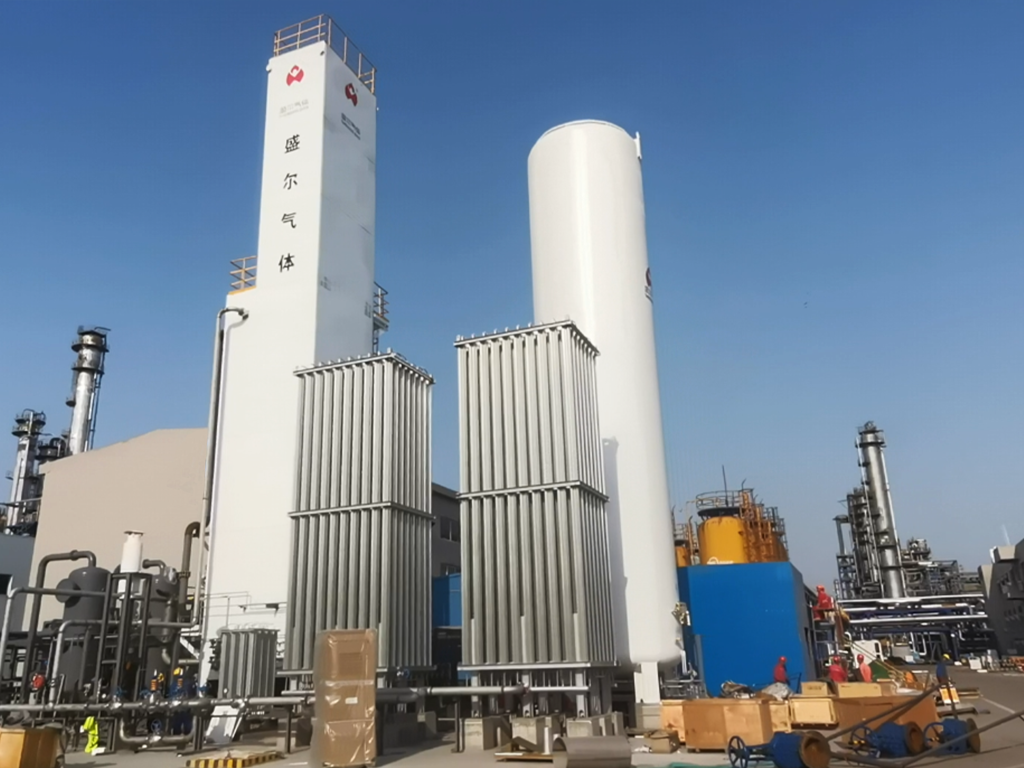
Cryogenic Air Separation Units are plants that separate atmospheric air into oxygen, nitrogen and argon by cooling it to cryogenic temperatures and distilling the liquid components. In a typical cryogenic process, compressed and purified air is cooled via heat exchangers and expansion turbines until it liquefies. Fractional distillation in tall columns then exploits the different boiling points (nitrogen –196 °C, argon –186 °C, oxygen –183 °C) to separate each gas.
- Air compression: Atmospheric air is drawn in and compressed (often to 5–8 bar) to prepare it for refrigeration.
- Purification: The compressed air is dried and scrubbed of carbon dioxide and hydrocarbons to prevent freeze-up in the cold equipment.
- Cryogenic cooling: The clean, pressurized air is cooled to very low temperatures (near –185 °C) using heat exchangers and turboexpanders, causing the major components to liquefy.
- Fractional distillation: The cold liquid air enters distillation columns. Because each component boils at a different temperature, nitrogen vapor rises to the top and liquid oxygen (with some argon) collects at the bottom. A side-stream is drawn off for argon extraction in a separate column.
- Product collection: High-purity gaseous nitrogen and oxygen (and liquid argon if produced) are withdrawn. Oxygen and argon are often collected as liquids (LOX, LAR) in insulated tanks, while the gaseous products are supplied at moderate pressure (around 1–3 bar).
Figure: Simplified flow diagram of a cryogenic ASU with heat exchangers, turbines, and distillation columns that produce separate oxygen, nitrogen, and argon streams. Cryogenic Air Separation Units can be very large in scale. Modern plants range from pilot-scale generators to multi-train complexes producing several thousand tons per day of oxygen. Although refrigeration demands substantial power (typically a few hundred kWh per ton of O₂), large ASUs operate continuously (often >99% uptime) and high efficiency at scale make them the technology of choice for bulk gas supply.
Production of Oxygen, Nitrogen, and Argon
Cryogenic Air Separation Units produce ultra-pure gases. Typical product purities are on the order of 99%+ for oxygen and 99.9%+ for nitrogen, with argon recovered at ~98–99% purity before final purification. Specifically:
- Oxygen (O₂): ASUs deliver oxygen at ≥99.5% purity in gas form; higher purities (≥99.9%) can be achieved with additional rectification. A portion of the oxygen is usually liquefied (boiling point –183 °C) as liquid oxygen (LOX) for storage or transportation.
- Nitrogen (N₂): Nitrogen purity can exceed 99.9%. Large plants usually produce liquid nitrogen (LIN) at –196 °C, which boils to high-purity N₂ gas as needed. High-purity nitrogen is used widely for inert atmospheres, process blanketing, and cryogenic cooling.
- Argon (Ar): Argon (≈0.9% of air) is extracted by a side column. Crude liquid argon (~98% Ar with 2% O₂) is purified catalytically or by additional distillation to >99.9% pure argon. The end product is stored as liquid argon (LAR) at –186 °C. Only cryogenic ASUs produce argon at industrial scales; adsorption or membrane systems do not recover this noble gas.
Below is a summary of the typical outputs from a cryogenic ASU:
| Product | Typical Purity | Product Form | Common Uses |
|---|---|---|---|
| Oxygen | ≥99.5% (gas), up to 99.9% | Gaseous or liquid (LOX) | Steelmaking (oxy-fuel burners, BOF), chemical oxidation (ethylene oxide, etc.), wastewater treatment |
| Nitrogen | ≥99.9% | Gaseous or liquid (LIN) | Inert gas (food/petrochemicals), metalworking (cutting, blanketing), semiconductor fab (purging) |
| Argon | ~99.9% | Liquid (LAR), then gas | Metal purging (aluminum, titanium), welding, electronics and glass manufacturing |
Capacity and Pressure Ranges
Cryogenic Air Separation Units are very flexible in scale but are most economical at large throughput. Modern ASUs range from small on-site generators (~10–100 tpd of O₂) up to multi-train complexes producing thousands of tons per day of oxygen. For example, industry-leading ASUs produce on the order of 100–5,000 tpd of O₂. Key operating parameters include:
- Air Compression: Feed air is compressed typically into the 5–10 bar(g) range before cooling. Some designs use multiple compressor stages and expanders to intercool and generate refrigeration.
- Column Pressure: The distillation columns usually operate at a few bar (often 2–5 bar) internally; this balances refrigeration needs with efficient separation. Some ASUs use intermediate-pressure columns to boost energy efficiency.
- Product Delivery: Final gas products are delivered at moderate pressure (≈1–3 bar) to pipelines or users. Liquids (LOX, LIN, LAR) are stored at near-atmospheric pressure in vacuum-insulated tanks.
- Energy Use: Cryogenic separation is energy-intensive. Typical power consumption is in the range of 200–300 kWh per metric ton of O₂, depending on unit size, purity requirements, and product mix. Large plants benefit from economies of scale and advanced heat exchanger designs to minimize power use.
Comparison with VPSA and Membrane Systems
Cryogenic Air Separation Units deliver the highest purities and capacities among air separation technologies, but alternatives exist for smaller-scale or flexible needs. Non-cryogenic methods like Pressure Swing Adsorption (PSA), Vacuum PSA (VPSA), and polymer membranes operate at or near ambient temperature. For example, a PSA oxygen generator typically produces O₂ at ~90–95% purity and N₂ up to ~99%; VPSA can raise O₂ purity to ~93–97% by using vacuum for desorption. However, PSA/VPSA units only yield gaseous oxygen and nitrogen (no liquefied products) and cannot produce argon or liquid products. Polymer membrane units selectively generate nitrogen (~90–95% purity) but cannot achieve high oxygen purity, making them suitable only for small-scale N₂ generation.
| Feature | Cryogenic ASU | VPSA (Vacuum PSA) | Membrane |
|---|---|---|---|
| Oxygen Purity | >99.5% (liquid O₂ possible) | ~93–97% (gas) | <40% (O₂ as byproduct) |
| Nitrogen Purity | >99.9% (liquid N₂ possible) | ~99% | ~90–95% (primary output) |
| Argon | Yes (liquid Ar) | No | No |
| Capacity (O₂) | ~100–5000 tpd | ~5–200 tpd | N₂ only, <50 tpd |
| Product Pressure | ~1–3 bar (gas) | ~1–5 bar (uses vacuum) | ~3–8 bar (feed pressure) |
| CAPEX & Footprint | High (large plant) | Moderate | Low (compact modules) |
Cryogenic ASUs excel when continuous, large-volume supply is required (e.g. steel mills, petrochemical complexes). VPSA/PSA and membrane systems offer benefits at smaller scales or when flexibility is important: they generally have lower capital cost, smaller footprint, and faster startup, but they cap out in purity and capacity. In practice, engineers select cryogenic plants for high-throughput, 24/7 operation, while adsorption or membrane units serve smaller or backup demands.
Industrial Applications
Cryogenic Air Separation Units underpin many industrial gas needs:
- Metallurgy: Steel plants rely on oxygen from Cryogenic Air Separation Units in basic oxygen furnaces (BOF) and electric-arc furnaces (EAF) to boost combustion and refine steel. Nitrogen and argon from ASUs are used as inert blanks in processes like casting or annealing, and argon is critical for aluminum and titanium production.
- Chemical Synthesis: Large refineries and chemical complexes use O₂ for oxidation processes (e.g. olefins, phenol, styrene production) and N₂ for ammonia/methanol synthesis (Haber–Bosch) and as purge/inert gas. Cryogenic ASUs meet the massive and continuous demand of these plants with the purity required.
- LNG and Energy: Liquefied natural gas (LNG) plants employ high-purity nitrogen from ASUs as a refrigerant in liquefaction cycles and for tank/pipeline inerting. Some integrated LNG/regasification sites also reuse cold energy between ASUs and liquefaction units. In power generation and waste-to-energy, ASU oxygen is used in oxy-fuel combustion to improve efficiency and reduce flue gas volume.
Conclusion
Cryogenic Air Separation Units remain the workhorse for large-scale industrial gas supply. By leveraging cryogenic refrigeration and distillation, they separate air into oxygen, nitrogen and argon at unmatched purity and volume. Their ability to produce liquid products (LOX, LIN, LAR) adds flexibility for storage and transport. While alternatives like PSA and membrane systems serve smaller or variable-demand scenarios, only cryogenic ASUs can efficiently meet the baseline needs of steel mills, petrochemical plants, LNG facilities and other heavy industries.