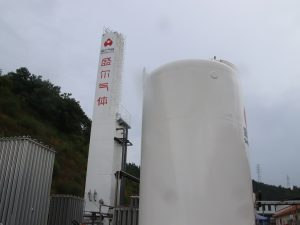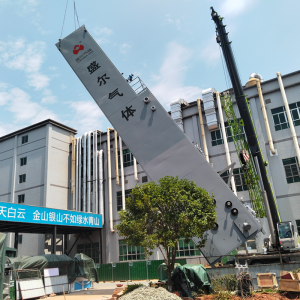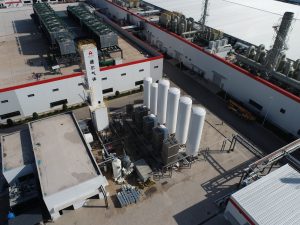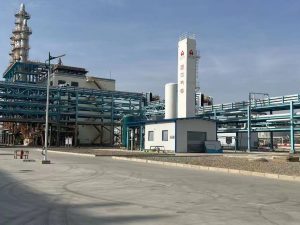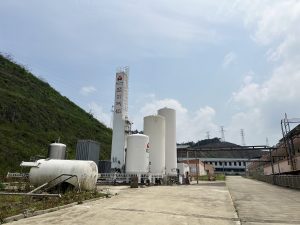
Cryogenic air separation is the industry-standard method for producing large volumes of high-purity oxygen, nitrogen, and argon. In a Cryogenic Air Separation Unit (ASU), ambient air is first compressed and purified. It is then cooled in a series of heat exchangers until components liquefy. The cold liquid air enters distillation columns: nitrogen (boiling point –196 °C) vaporizes and rises to the top, while liquid oxygen (–183 °C) settles lower. Argon, which boils between nitrogen and oxygen, is drawn off via an intermediate column. This fractional distillation yields extremely pure gases – typically ≥99% oxygen, ~99.999% nitrogen, and >99.9% argon. Each Cryogenic Air Separation Unit may include multiple columns and expanders to maximize efficiency. For example, large steel mills often install one or more ASUs on-site to supply the tens of thousands of tons of oxygen they require each year.
Cryogenic ASUs are built at various scales. Smaller packaged units might serve hospitals or chemical plants (producing only a few tons per day of oxygen), while mega-plants at integrated industrial complexes can deliver thousands of tons per day. In practice, a single large Cryogenic Air Separation Unit at a steel mill may produce well over 1,000 tons of O₂ every 24 hours. ASU installations are capital-intensive (often costing tens to hundreds of millions of dollars) and designed for continuous operation. Leading industrial-gas companies (Air Products, Linde/Praxair, Air Liquide, Messer, etc.) supply turnkey ASU systems. For perspective, Chart Industries and Universal Industrial Gases have each supplied hundreds of packaged Cryogenic Air Separation Units worldwide. In the U.S. today, the fleet of large ASUs numbers on the order of a hundred plants, reflecting the immense demand. These units typically run year-round in heavy industry, so reliability and efficiency are paramount. The U.S. ASU market is thus shaped by the needs of end-users in heavy industry and energy, as discussed below.
U.S. Market Demand: Current State and Forecast (2025–2035)
The U.S. Cryogenic Air Separation Unit (ASU) market has been supported by long-term industrial demand and strategic investments in energy and manufacturing.U.S. demand for cryogenically-produced oxygen, nitrogen, and argon is already very large and is expected to grow moderately through 2035. By the mid-2020s, U.S. industrial oxygen consumption exceeded 20 million tons per year, with roughly 70% of that going into steelmaking and petroleum refining. Other major uses include chemical manufacturing (ammonia, methanol, petrochemicals), food and beverage processing, glass and cement production, and electronics fabrication. The healthcare sector – hospitals and clinics – is also a significant consumer of oxygen (for patient support) and nitrogen (for medical-gas supplies), though on a smaller scale.
Analysts project that North American industrial-gas demand will grow in the mid-single digits annually over 2025–2035. The U.S. portion of that market should track overall industrial growth. In practical terms, this means existing ASU capacity will be largely replaced or incrementally expanded, rather than trebled. Aging ASUs will be upgraded with larger, more efficient units. New capacity additions will be targeted at growth sectors (outlined below). By 2035, U.S. oxygen and nitrogen output capacity from ASUs is expected to be noticeably higher than today, but the market will remain concentrated among a few key industries and suppliers.
Growth Drivers
Several sectors are driving the U.S. cryogenic ASU market from 2025–2035:
- Steel and Primary Metals: Steelmaking remains by far the largest driver of oxygen demand. U.S. steel mills (both blast-furnace/basic-oxygen and electric-arc furnaces with oxygen enrichment) require massive oxygen flows. Tens of millions of tons of liquid oxygen are consumed annually by U.S. steel production. Each integrated mill typically sources its oxygen from one or more on-site Cryogenic Air Separation Units. In practice, a large steel mill may operate an ASU producing well over 1,500 tons of O₂ per day, often with backups. As U.S. mills modernize and add electric furnaces (many of which use oxygen lances), demand stays high. A single mill runs its ASU essentially continuously, so reliability is critical. Because steelmaking uses such huge oxygen volumes, virtually every upgrade or new mill project includes building or expanding ASU capacity. In short, steel mills will keep ASUs busy through 2035, making this sector the core market.
- This trend ensures that the Cryogenic Air Separation Unit (ASU) will remain critical to the U.S. steel supply chain.
- Healthcare and Medical Gases: The medical sector is a significant but steadier driver. The COVID-19 pandemic exposed risks in hospital oxygen supply, leading many health systems to invest in backup plants or on-site liquid O₂ facilities. While panic-buying has faded, normal healthcare consumption remains large. Major hospitals and regional networks often have long-term contracts for liquid O₂ or even own cryogenic plants. For example, some university health systems operate their own Cryogenic Air Separation Units to serve multiple hospitals on campus. Even smaller hospitals often rely on periodic deliveries from large air-gas companies, but the preference for central ASUs remains for bulk supply. Medical-grade O₂ (≥99% purity) and N₂ (99.99% purity) are required.A Cryogenic Air Separation Unit (ASU) provides purity stability and uninterrupted liquid oxygen delivery, which portable or PSA systems cannot match for large hospitals. Thus, continued growth in healthcare infrastructure (new hospitals, clinics) will spur additional small ASUs, but much of this market is stable. Cryogenic ASUs are the standard for large-scale medical gas supply; they can deliver purities above what portable or PSA systems provide. In summary, medical oxygen demand will modestly grow with population and healthcare trends, supporting ASU installations for reliable supply.
- Oil, Gas and LNG: Expansion in U.S. natural gas processing,For LNG and petrochemical facilities, an on-site Cryogenic Air Separation Unit (ASU) ensures reliable nitrogen supply for cooling and safety operations. LNG export capacity, and petrochemical production also supports ASU growth. Liquefied natural gas (LNG) plants often use cryogenic nitrogen for refrigeration. Many new liquefaction trains incorporate ASUs to generate this N₂ on-site (a byproduct of O₂ production). Even in natural-gas processing and refining, oxygen and nitrogen are used (e.g. O₂ for oxy-combustion or partial oxidation; N₂ for inerting and purging). For example, a new LNG export terminal may add an ASU if existing supply is insufficient. Similarly, petrochemical hubs (e.g. Gulf Coast ammonia or ethylene plants) frequently co-locate ASUs. The tie to LNG and hydrocarbons is indirect, but significant: as more gas-processing plants and refineries are built or expanded, they either require their own ASUs or put pressure on the gas supply network, leading ASU providers to build more capacity. In effect, growth in the oil & gas sector – including LNG exports – drives demand for industrial gases, keeping ASUs busy.
- Hydrogen and Ammonia: Perhaps the fastest-growing driver is the buildout of hydrogen (and associated ammonia) facilities. Both “blue” hydrogen (from natural gas with carbon capture) and “green” hydrogen (from water electrolysis) require or produce large volumes of oxygen and nitrogen. Steam-methane reformers burn natural gas with pure oxygen, while electrolyzers produce hydrogen and oxygen. Planned U.S. projects now number in the tens of gigawatts, often in partnership with international firms. These projects inevitably include cryogenic ASUs. For example, the planned Air Liquide/Exxon hydrogen-ammonia complex in Baytown, Texas will install four new ASUs (totaling about 9,000 tons/day of O₂ capacity) to feed its low-carbon hydrogen and ammonia units. Similarly, Linde’s planned Blue Point ammonia plant in Louisiana will include a ~400 MW ASU (on the order of 400 tons/day O₂) for its 1.4 million tpy plant. In short, an accelerating hydrogen economy means each major new H₂/ammonia plant has a correspondingly large ASU project. Over the next decade, hydrogen/ammonia projects could add a gigawatt-scale demand for cryogenic O₂, dwarfing older uses. Each such ASU is one of the largest-capacity units being built in the country.As the hydrogen economy accelerates, nearly every major U.S. hydrogen or ammonia project will deploy at least one Cryogenic Air Separation Unit (ASU).
In addition to these main sectors, smaller markets like glass manufacturing, water treatment, and electronics (which need ultra-pure N₂/Ar) also use ASUs, but they contribute a minor share of volume. The key point is that U.S. ASU demand is highly concentrated: steel and energy projects together account for the bulk of growth.
Leading U.S. Companies and Projects
The U.S. ASU market is dominated by a few multinational industrial gas companies. Air Products, Linde (Praxair), Air Liquide, and Messer (with others like Universal Industrial Gases) collectively supply most of the ASUs. They often finance, build, and operate the units at customer sites under long-term contracts (turnkey build/own/operate model). For example, Air Products has been replacing older units with new high-capacity ASUs at its merchant sites (e.g. a new Cleveland, Ohio ASU coming online in 2025, and planned units in Georgia and North Carolina by 2026). Linde and Air Liquide similarly construct ASUs for large refinery, petrochemical, and steel customers. Equipment makers like Chart Industries and Mitsubishi Heavy Industries (formerly Nikkiso) design and fabricate the coldboxes, heat exchangers and expanders for these projects.
Several illustrative projects show this activity:
- Baytown, Texas: Air Liquide’s partnership with ExxonMobil involves four new on-site ASUs (approx. 9,000 tpd O₂) to feed a low-carbon hydrogen/ammonia complex. (This effectively doubles the region’s oxygen capacity.) The ASUs are central to producing hydrogen for fuel and chemicals at the site.
- Louisiana (Blue Point): The Blue Point ammonia project (CF Industries, JERA/Mitsui, etc.) will build a 1.4 million tpy low-carbon ammonia plant. Linde will construct a ~400 MW ASU (~400 tpd O₂) to supply oxygen and nitrogen for the facility. This ASU is one of the largest ever built in North America.
- Refinery/Chemical Expansions: Many existing chemical plants and refineries also upgrade ASUs. For instance, Air Liquide recently invested ~$200 million to expand ASU capacity and pipelines in Louisiana to serve Dow’s new ethylene project. Steel mill expansions often add or replace ASUs too. Universal Industrial Gases, Air Liquide, and others have supplied integrated ASUs to recent electric-arc furnace projects.
Each of these illustrates how ASU projects are tied to their host plant’s expansion. Because a Cryogenic Air Separation Unit is capital-intensive, new orders typically align with mega-projects. In practice, companies are continuously reinvesting in ASU infrastructure: upgrading aging units, adding spare capacity, and sometimes building entirely new plants.
Technical Comparison of ASUs
Cryogenic ASUs are tailored to the required scale and purity. Table 1 above already contrasts “Small”, “Medium”, and “Large” units. In addition, there are design variants: some use single-column (dephlegmator) cryo processes for moderate purity (<95% O₂), while most large ASUs use dual-column distillation to achieve ≥99.5% O₂ and 99.999% N₂. All ASUs achieve purities far above non-cryogenic methods. For example, even a compact ASU can produce medical-grade O₂ (≥99%), whereas PSA units top out near 95%.
In practical terms: small “skid” ASUs might produce 1–50 tons/day of O₂ and serve a hospital or small factory. Medium industrial ASUs produce 50–500 tpd and serve a mid-size refinery or chemicals plant. Large ASUs exceed 500 tpd and support integrated steel mills or multi-plant complexes. A single large U.S. ASU might produce 1,000+ tpd of O₂ along with hundreds of tons/day of N₂ and tens of tons of Ar.
Each ASU contains compressors, purification beds (to remove water/CO₂), main heat exchangers, and two (or more) distillation towers operating at different pressures. Oxygen can be drawn as either liquid or high-pressure gas, depending on the plant’s needs. Nitrogen is often supplied as liquid or gas as well. Because argon’s boiling point lies between oxygen and nitrogen, most industrial ASUs include an argon column to extract >99% pure liquid argon (used in electronics and welding).
Table 1 above summarizes typical capacity and purity by category. Note that capacity in practice refers to the O₂ output per day (liquid tonnage). Nitrogen and argon flow-rates scale with that. Cryogenic ASUs also vary in energy efficiency: state-of-the-art units may use < 200 kWh of power per ton of O₂, whereas older plants might use > 250 kWh/t. Energy use is a key factor in ASU economics, so new installations often prioritize efficiency (turboexpanders, better reflux ratios, etc.).
Outlook (2025–2035)
Over 2025–2035, the U.S. Cryogenic Air Separation Unit (ASU) market will expand steadily due to industrial modernization and clean-energy transitions.Looking ahead to 2035, the U.S. Cryogenic Air Separation Unit market is expected to grow steadily. Oxygen demand from steelmaking is likely to remain near current levels or rise modestly, as steel producers modernize and add electric furnaces (which often use oxygen for faster melts). Chemical and refining demand for O₂/N₂ will follow the trends in manufacturing and energy. The healthcare sector will likely see slow growth, with existing hospitals maintaining ASUs or supply contracts.
The fastest growth area will almost certainly be low-carbon fuels. Large hydrogen and ammonia projects planned in the late 2020s and early 2030s will each deploy very large ASUs, effectively expanding demand. If U.S. policy continues to encourage hydrogen use (for transportation or industry), more ASUs may be ordered than in a business-as-usual scenario. Similarly, any increases in LNG or petrochemical exports would boost ASU capacity, though recent LNG projects have often been built with existing supply.
On the supply side, major gas companies will continue replacing old ASUs with newer, more efficient units. We expect older ASUs in places like Texas, Louisiana, Illinois/Indiana, and Ohio to be upgraded or replaced. Technological improvements (better compressors, digital controls, waste-heat recovery, and hybrid cryogenic/PSA configurations) will reduce operating costs and improve flexibility. However, the fundamental advantage of cryogenic ASUs – very large volume and high purity – means they will remain the preferred solution for bulk gas supply. In fact, by 2035 it is estimated the U.S. will have on the order of a hundred large ASU plants operating, representing capital investments well into the billions overall.
In summary, Cryogenic Air Separation Units will remain essential infrastructure for U.S. industry through 2025–2035. Steelmaking will continue to consume the bulk of oxygen output, while reliable medical oxygen supply, expanding LNG/petrochemical capacity, and a booming hydrogen/ammonia sector will keep demand for liquid O₂, N₂, and Ar high. Major industrial gas suppliers and equipment manufacturers are already positioning for this future – building new ASUs, expanding pipelines, and improving efficiency – to ensure a secure, high-purity gas supply for all these end users in the decade to come.