Introduction
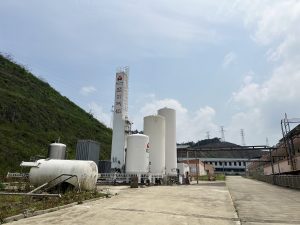
Cryogenic Air Separation Units (ASUs) are industrial systems used for the production of high-purity oxygen and nitrogen from air. These plants employ ultra-low temperature (cryogenic) distillation to separate air into its primary constituents, taking advantage of the different boiling points of gases like nitrogen and oxygen. A cryogenic air separation unit for oxygen and nitrogen production is a cornerstone technology in industries that demand large volumes of these gases in high purity. It remains the most efficient method for producing oxygen and nitrogen at industrial scale, far outperforming non-cryogenic techniques in achievable purity and output volume.
In a typical cryogenic ASU, atmospheric air is first compressed, purified, and then cooled to extremely low temperatures until it liquefies. The liquefied air is subsequently distilled in specialized rectification columns to separate oxygen and nitrogen. The entire process involves complex heat exchange and refrigeration cycles housed in an insulated cold box. This article will explore the principle behind cryogenic air separation, detail the core system components and process flow, present key technical parameters in a table, and discuss the applications and operational considerations of cryogenic ASUs.
Principle of Cryogenic Air Separation
The principle of cryogenic air separation is based on fractional distillation at cryogenic temperatures. Air is a mixture primarily of nitrogen (78%) and oxygen (21%), with argon and other trace gases making up the rest. These components have different boiling points: at 1 atmosphere pressure, nitrogen boils at ≈ –196 °C, oxygen at ≈ –183 °C, and argon at ≈ –186 °C. By cooling air to around these temperatures, it can be liquefied and then separated by distillation because each component will condense or vaporize at different points in a distillation column. The cryogenic ASU process thus leverages the innate volatility differences of liquid nitrogen and liquid oxygen to produce streams of each at high purity.
To achieve such low temperatures, cryogenic ASUs incorporate a refrigeration cycle using the Joule–Thomson effect and turboexpanders. First, the air is compressed, which adds heat; this heat is removed through coolers. The high-pressure air is then expanded in an expansion turbine or across an orifice, causing a drop in temperature (as the air does work during expansion). Through repeated heat exchange and expansion stages, the air is cooled to below its liquefaction point. The equipment is arranged so that cold exhaust streams continually precool incoming gas in a counter-flow heat exchanger, minimizing energy waste. All cold components are housed in a vacuum-insulated cold box to prevent heat ingress from the environment. By the end of the cooling process, the air is partially liquefied and can be fed into the distillation columns. Inside the columns, continuous distillation (rectification) occurs: nitrogen (the more volatile component) concentrates as vapor rising to the top, while oxygen (less volatile) concentrates as liquid at the bottom. The result is production of high-purity oxygen (often 99+%) at the bottom of the low-pressure column and high-purity nitrogen (often 99.999% or <5 ppm O₂) as gas from the top of the high-pressure column. This cryogenic distillation method is energy-intensive, but it remains the only practical way to attain the purity levels required for many applications.
Core System Components and Process Flow
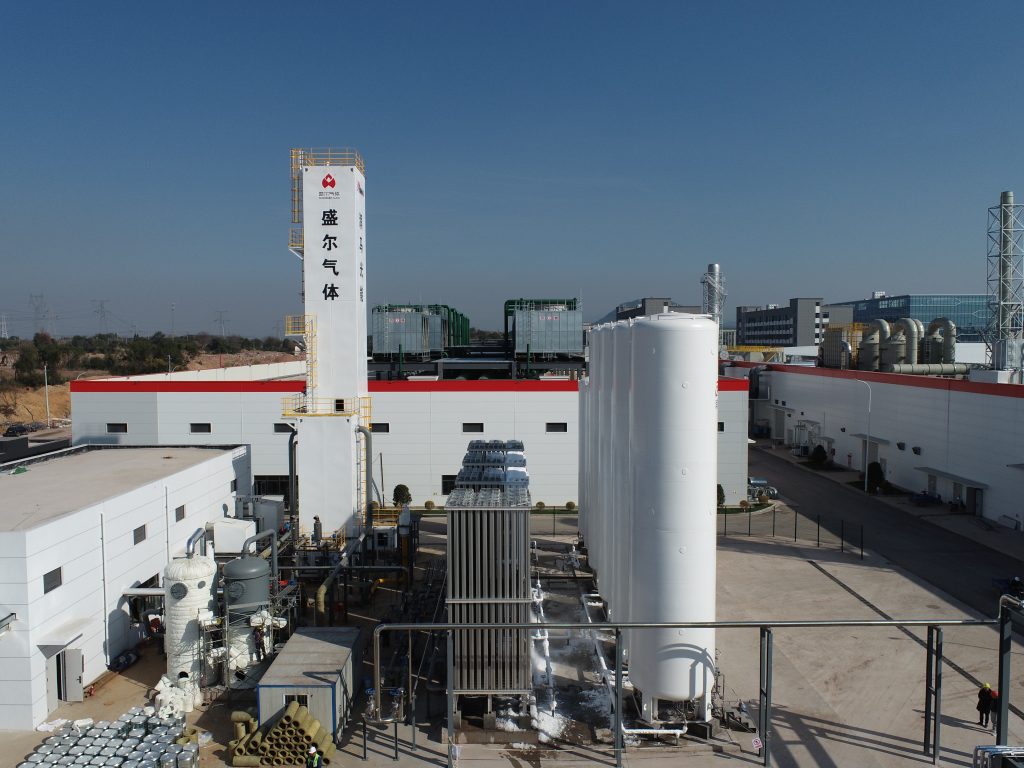
A cryogenic air separation unit is comprised of several integrated subsystems, each performing a specific function in the overall process flow. The process can be broken down into a series of key stages, from air intake to product storage. The following steps outline the core components and operation of a typical cryogenic ASU:
- Air Intake and Compression: Ambient air is drawn in through an intake filter to remove dust and debris. The filtered air is then compressed by a main air compressor, typically a multi-stage centrifugal or rotary compressor driven by an electric motor. Intercoolers between compression stages remove the heat of compression and condense out some moisture. By the final stage, the air is compressed to a pressure of about 5–10 bar (72–150 psi), and cooled to near ambient temperature. This pressurization provides the driving force for downstream separation and also initiates the refrigeration cycle for cooling.
- Pre-Purification (Molecular Sieve Adsorption): After compression, the process air passes through a prepurifier unit (PPU) to remove impurities that would freeze or cause hazards at cryogenic temperatures. The PPU typically consists of a chiller and a pair of molecular sieve adsorber vessels. First, the air is cooled to around 5 °C (40–55 °F) in a direct-contact cooler or chiller, knocking out most remaining water vapor. Next, the chilled air flows through one of the desiccant-filled adsorption beds, which trap residual moisture, carbon dioxide, and hydrocarbons. Removing CO₂ and H₂O is critical to prevent dry-ice formation or ice blockages in the cold box. Hydrocarbon removal is also important for safety, as enriched oxygen in the distillation column could otherwise pose a risk of explosion. The adsorber beds operate in an alternating cycle: while one bed is online purifying the air, the other is being regenerated. Regeneration is done by heating and purging the saturated bed with warm dry waste gas (primarily the nitrogen-rich exhaust from the process). The beds switch roles every few hours, ensuring a continuous flow of clean, dry air into the cold box.
- Cryogenic Cooling and Heat Exchange: The purified, pressurized air is then routed into the cold box, which contains the main heat exchangers and cryogenic equipment. In the primary heat exchanger (often a brazed aluminum plate-fin heat exchanger), the high-pressure air is cooled in counter-flow against the outgoing product and waste streams that are returning from the cold distillation process. As the high-pressure air relinquishes heat, it approaches cryogenic temperatures. To reach liquefaction, a portion of the air is expanded to produce refrigeration: typically a turboexpander (expansion turbine) is used to let some of the air expand from high pressure down to nearly atmospheric pressure. This expansion does work (often driving a booster compressor or generator) and causes a significant drop in gas temperature. The expanded exhaust emerges extremely cold (well below -150 °C) and is fed back into the heat exchanger, providing additional cooling to the incoming air stream. Through this staged heat exchange and expansion cooling, the process air is brought down to roughly -170 °C to -180 °C, and a portion of it condenses into liquid. By the time the air stream exits the heat exchanger, it is a mix of liquid oxygen-enriched air and cold nitrogen-rich vapor, ready for separation in the distillation columns. All components in this section are insulated to reduce thermal losses, and the cold box is often filled with perlite or wrapped in vacuum panels to maintain the low temperatures efficiently.
- Distillation in Rectification Columns: The heart of the ASU is the cryogenic distillation unit where separation of oxygen and nitrogen (and argon) occurs. The cooled two-phase air mixture from the heat exchanger is fed into a two-column distillation system (sometimes called a double-column). This typically consists of a High-Pressure (HP) column operating at the intake air pressure (around 5–6 bar) and a Low-Pressure (LP) column operating at about 1.2 bar (just above atmospheric). The columns are configured in series with a thermal link: the condenser at the top of the HP column is integrated with the reboiler at the bottom of the LP column in a common heat exchanger. In the HP column, the incoming air begins to separate: nitrogen (having a lower boiling point) becomes the overhead product and is condensed to liquid at the top by the cold temperatures, while oxygen-enriched liquid collects at the bottom. This oxygen-rich liquid (sometimes called “rich liquid”) is then transferred to the LP column for further refinement. In the LP column, which operates at lower pressure, the separation achieves high purity. Oxygen, being less volatile, concentrates at the bottom of the LP column as a liquid product (often 99+% purity), while nitrogen rises to the top and exits as high-purity gaseous nitrogen. The integrated reboiler-condenser between the columns allows latent heat exchange: as the HP column’s nitrogen vapors condense to liquid (providing reflux for the HP column), they boil the oxygen-rich liquid in the LP column, driving the oxygen up the LP column for rectification. This clever heat integration eliminates the need for external reboilers or condensers and improves energy efficiency by closely coupling the two columns. Many ASUs also include an argon side arm column to recover argon, since argon accumulates at an intermediate point in the LP column (where the concentration of argon is highest, between the oxygen-rich bottom and nitrogen-rich top). A slipstream from that point is fed to a crude argon column which, through additional distillation stages, yields high-purity argon (typically 99.9% or greater) as a separate product. The distillation columns and associated piping are all housed within the cold box. Inside the columns, modern designs often use structured packing or sieve trays to facilitate contact between rising vapors and descending liquid, enabling efficient mass transfer and separation. The result of this rectification process is that the mixture of air is split into nearly pure component streams: oxygen, nitrogen, and (if configured) argon.
- Product Extraction and Warming: Once separation is achieved in the columns, the desired product streams are extracted. Gaseous nitrogen is drawn from the top of the high-pressure column (or in some designs from the top of the low-pressure column after further purification) and gaseous oxygen is drawn from the bottom of the low-pressure column (often after passing through an evaporator section in the column). These cold product gases are routed out of the cold box through the main heat exchanger, where they serve to cool incoming air as they warm up. By the time the product gases exit the cold box, they have been heated back to near ambient temperature (recovering the refrigeration energy back into the system). This heat exchange also ensures that the oxygen and nitrogen gas delivered to downstream processes or pipelines is at a usable temperature. In some ASUs, liquid products are withdrawn: for example, liquid oxygen (LOX) might be taken from the bottom of the LP column, and liquid nitrogen (LIN) from the top of the HP column (or from a liquid nitrogen storage in the cold box). Liquid argon, if produced, is also collected. These liquids can be directly sent to insulated storage tanks. In plants designed for gas output, the oxygen may be pumped as a liquid and vaporized through heat exchangers to supply high-pressure gaseous oxygen, or compressors may be used to pressurize the product gas after it warms up.
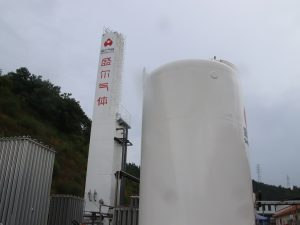
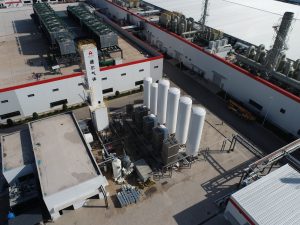
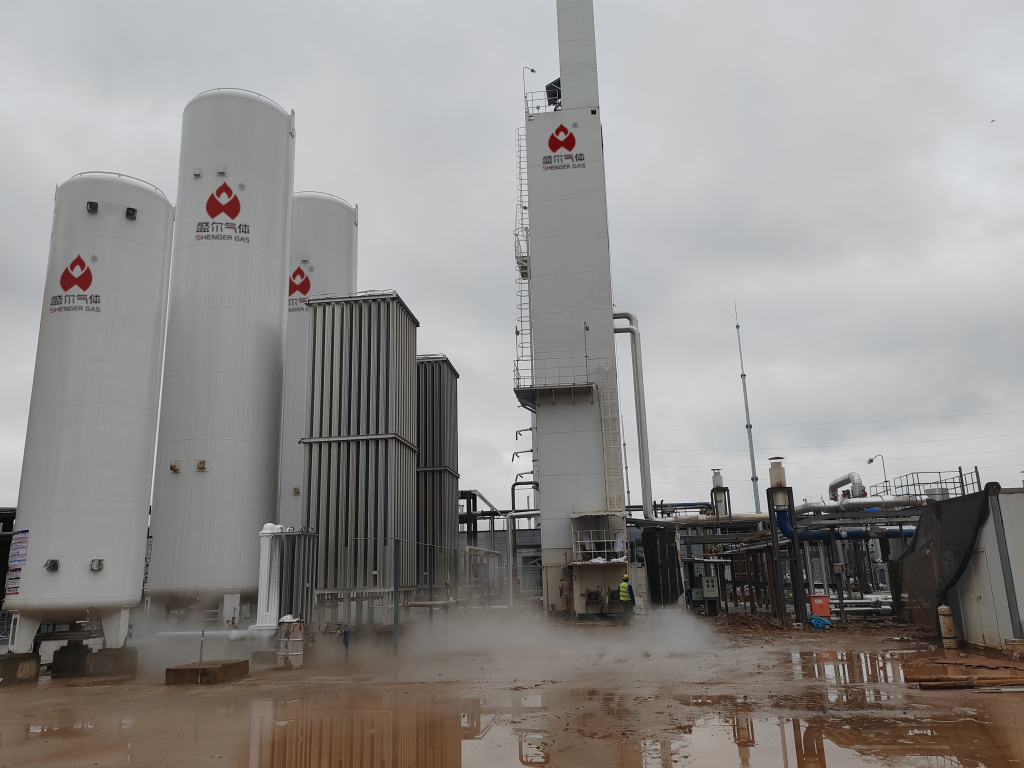
- Storage and Product Handling: For liquid products, cryogenic storage tanks are used to hold and manage the oxygen and nitrogen before distribution. These tanks are vacuum-insulated double-walled vessels (typically an inner stainless steel vessel within a carbon steel outer vessel) that minimize heat transfer and keep the liquids at their boiling point with minimal evaporation loss. Liquid oxygen is usually stored at around -183 °C, and liquid nitrogen at around -196 °C, at pressures of roughly 10 to 20 bar (depending on the storage design and delivery pressure requirements). The storage system includes safety valves to vent excess boil-off gas and may have pressure-building coils (vaporizers) to maintain delivery pressure. From the tanks, the cryogenic liquids can be pumped and evaporated via ambient or steam-heated vaporizers to supply gaseous oxygen or nitrogen to end users at the required pressure. For large industrial facilities located adjacent to the ASU, the product gases can be sent directly via pipelines (bypassing the need for long-term storage). For merchant liquid production, the LOX and LIN are loaded into insulated road tankers or rail cars for transport. Throughout this stage, careful monitoring and control systems are in place to handle the cryogenic fluids safely. The ASU is equipped with instrumentation to supervise levels, pressures, and temperatures in the tanks and the cold box, ensuring safe and reliable operation.
Technical Table of System Parameters or Components
The table below summarizes the key components of a cryogenic air separation unit and their functions, along with typical operating characteristics:
| Component | Description and Function |
|---|---|
| Main Air Compressor | Multi-stage compressor (with intercoolers) that raises atmospheric air to ~5–10 bar. Reduces air volume and provides the pressure needed for downstream cooling and distillation. Intercoolers remove compression heat and condense out water. |
| Molecular Sieve Prepurifier | Dual-bed adsorption system (often with activated alumina & zeolite) used to remove H₂O, CO₂, and hydrocarbons from compressed air. Prevents ice and dry-ice formation in cold equipment and avoids flammable conditions. Beds alternate between adsorption and regeneration using heated waste nitrogen gas. |
| Plate-Fin Heat Exchanger | A brazed aluminum heat exchanger that precools the high-pressure air against returning cold product and waste streams. Achieves near-counterflow exchange, cooling air to ~-170°C before it enters the distillation columns. Efficient heat integration maximizes energy recovery within the cold box. |
| Expansion Turbine (Expander) | Cryogenic turboexpander that expands a portion of the pressurized air (or nitrogen) to produce refrigeration. The expansion cools the gas via the Joule–Thomson effect, generating the cold temperatures required to liquefy air. Often the expander work is recovered by driving a booster compressor or generator, improving overall efficiency. |
| Distillation Columns (HP & LP) | Two-stage rectification columns operating at different pressures (e.g. ~6 bar and ~1.2 bar). The high-pressure column performs the initial separation (producing nitrogen-rich vapor and oxygen-enriched liquid), while the low-pressure column refines the oxygen product to high purity and produces gaseous nitrogen. An integrated reboiler-condenser links the columns thermally. Many systems include an argon side column for argon extraction. |
| Cryogenic Storage Tanks | Vacuum-insulated storage vessels for liquid oxygen and liquid nitrogen. They maintain cryogenic liquids at low temperature with minimal boil-off. Typical tanks operate at 10–20 bar; they supply product via built-in vaporizers or pumps. These tanks allow product buffering, transportation (via tanker filling), or reserve supply for users. |
Table: Major components of a cryogenic ASU and their roles in oxygen/nitrogen production.
Applications and Considerations
Cryogenic air separation units for oxygen and nitrogen production play a vital role in numerous industries. They also come with specific design and operational considerations due to their complexity and the hazardous materials involved. Below, we outline the primary applications of ASUs and some key considerations in their operation:
Applications
- Steel Manufacturing: High-purity oxygen is used in basic oxygen furnaces and electric arc furnaces to boost combustion and remove impurities in steelmaking. Large steel mills often have on-site ASUs to supply many hundreds of tons of O₂ per day for this purpose. Nitrogen is also used in steel and metal production for inerting and stirring of molten metal.
- Chemical and Refining Industries: Nitrogen and oxygen from ASUs are critical for chemical production. Nitrogen is utilized as an inert gas for blanketing storage tanks, purging reactors and pipelines, and as a carrier gas to prevent oxidation. Oxygen is used for processes like gasification of coal or heavy oil, ethylene oxide production, sulfur recovery units, and other oxidation reactions. Ammonia plants use large quantities of nitrogen (from air separation) to synthesize ammonia (Haber process).
- Healthcare and Medical Gas Supply: Hospitals and healthcare facilities rely on cryogenic ASUs for a consistent supply of medical-grade oxygen. Liquid oxygen produced at an ASU is transported via tanker and stored in a bulk tank at hospitals, then vaporized on-site for patient use. The high purity (often 99.5% O₂) and reliability of supply are essential for life support, anesthesia, and respiratory therapy. Nitrogen is also used in medical applications, for example in cryosurgery or for preserving biological samples (in liquid form).
- Food Processing and Preservation: Liquid nitrogen from ASUs is widely used for flash freezing foods, achieving rapid freezing that preserves food quality by forming very small ice crystals. Food companies use LIN freezers to process items like meats, fruits, and prepared meals. Nitrogen gas is also used to purge and package foods (to displace oxygen and extend shelf life). Liquid oxygen is less commonly used in food, but both LOX and LIN can be used in controlled atmosphere storage for fruits and grains.
- Aerospace and Electronics: The aerospace industry requires large volumes of liquid oxygen as rocket propellant oxidizer (for example, in space launch vehicles) and gaseous nitrogen for purging and pressurizing fuel systems. Semiconductor fabrication plants use ultra-high purity nitrogen (99.999%+) for creating inert atmospheres in production processes. These high-tech applications demand the extreme purities that only cryogenic distillation can economically provide.
Considerations
- Energy Consumption: Cryogenic ASUs are energy-intensive, primarily due to the power required for air compression and refrigeration. Large units (producing thousands of tons per day of O₂/N₂) may consume tens of megawatts of electric power. Efficiency is a key design factor – modern plants use advanced compressors, heat exchangers, and expansion turbines to recover and reuse cold energy, thereby lowering the specific power (kWh per unit of gas produced). Optimizing energy use directly impacts operating cost and is often the difference in competitiveness between ASU designs.
- Operational Continuity: For both efficiency and equipment longevity, cryogenic ASUs are generally designed to run continuously 24/7. They are not well-suited to frequent start-stop operation because cooling down the cold box and achieving steady-state distillation can take many hours. As a result, ASUs supplying gases to industrial facilities are expected to have high on-stream factors (often >98% uptime). Redundancies (like backup compressors or spare adsorption beds) and robust control systems are built in to maintain supply even during equipment switchovers (for example, when regenerating molecular sieves or during routine maintenance).
- Safety Measures: Safety is paramount in oxygen and cryogenic systems. High-purity oxygen greatly accelerates combustion, so all equipment that contacts enriched oxygen must be scrupulously cleaned of oils or contaminants (oxygen-compatible materials and “oxygen cleaning” procedures are used to prevent any ignitions). The ASU design avoids any sources of ignition in oxygen-rich areas, and flow velocities are controlled to prevent static discharge. Cryogenic liquids pose risks of extreme cold burns and asphyxiation (if they vaporize and displace air), so storage tanks and pipelines are equipped with pressure relief valves, gas detectors, and proper ventilation. Operators receive specialized training for handling cryogenic fluids, and facilities are designed with safety distances and insulation to protect personnel.
- Product Purity and Quality: Cryogenic distillation reliably produces very high purity oxygen and nitrogen, but quality control is still important. Instruments continuously monitor product purity (e.g. measuring trace O₂ in nitrogen product and vice versa). If purity specifications are not met (due to an upset or shifting conditions in the column), the product may be automatically diverted to waste until acceptable levels are restored. Additionally, argon (if produced) must be kept free of oxygen contamination to meet grade specifications, which is achieved by maintaining the argon column reflux ratios and using high-efficiency packing.
- Scale and Economics: Cryogenic ASUs involve significant capital investment and are economically justified for medium to large production rates. Small-scale needs (say, a few tons per day of oxygen or nitrogen) are often better served by alternate technologies like Pressure Swing Adsorption (PSA) or membrane generators, which have lower upfront cost and can be cycled on/off easily. However, for high volume oxygen and nitrogen production, cryogenic units become more cost-effective, and they have the added benefit of producing liquid products and rare gases (argon, krypton, xenon) as a bonus. When planning an ASU project, considerations include proximity to power sources (to supply the large electricity demand), integration with host facilities (for example, using waste nitrogen for cooling water chilling, or using waste heat from compressors), and future expansion needs (many ASUs are designed with the ability to boost capacity or add liquefaction units if demand grows).
Conclusion
Cryogenic air separation units remain the benchmark technology for oxygen and nitrogen production at industrial scale, delivering the volume and purity required by modern industry. Through a finely tuned process of compression, cryogenic cooling, and multistage distillation, an ASU can continuously produce streams of high-purity oxygen and nitrogen to support critical operations in steelmaking, chemicals, healthcare, electronics, and more. While energy-intensive, ongoing innovations in process integration and machinery are improving efficiency and reducing operating costs. In essence, the cryogenic air separation unit for oxygen and nitrogen production is a marvel of engineering – an integration of thermodynamics and equipment design that reliably turns air into valuable products. As global demand for industrial gases grows and new applications emerge (such as clean energy technologies and space exploration), cryogenic ASUs will continue to evolve, remaining a cornerstone of the industrial gas supply chain for years to come.