Introduction
Cryogenic Air Separation for Nitrogen Production is the leading industrial process used to generate high-purity nitrogen gas in large quantities. This technology harnesses extremely low temperatures to liquefy air and then separates its components based on their boiling points. In the United States, cryogenic air separation plants (also known as Air Separation Units, ASUs) are integral to supplying nitrogen for sectors such as petrochemicals, metal manufacturing, electronics, food processing, and healthcare. The method offers unmatched purity (often 99.999% N₂) and volume output compared to alternative nitrogen generation techniques. Despite its energy intensity and complex equipment, cryogenic air separation remains the de facto standard when ultra-high purity or massive scale nitrogen production is required, cementing the importance of Cryogenic Air Separation for Nitrogen Production in modern industry.
Understanding the Principles of Cryogenic Air Separation for Nitrogen Production
The fundamental principle behind cryogenic air separation is that each constituent gas in air has a unique boiling point. Nitrogen boils at a much lower temperature (-196°C, or -321°F at atmospheric pressure) than oxygen (-183°C, or -297°F). By cooling air to cryogenic temperatures (well below -150°C) until it liquefies, the separation process can leverage these boiling point differences. Cryogenic distillation then allows nitrogen to be boiled off and isolated from liquid oxygen and other components. Cryogenic Air Separation for Nitrogen Production essentially operates as a fractional distillation of liquefied air. As the air mixture vaporizes and re-condenses on distillation trays or packing inside a column, nitrogen (the more volatile component) concentrates in the rising vapor, while oxygen (and argon) concentrates in the descending liquid. By carefully controlling temperature and pressure in the distillation columns, the process yields a high-purity nitrogen stream. This low-temperature distillation approach is energy-intensive due to the refrigeration required, but it is unrivaled in achieving high purity and recovery efficiency for nitrogen.
Modern cryogenic ASUs maintain the cold distillation process within an insulated cold box to minimize heat leakage. All the refrigeration is generated internally, typically by expanding a portion of the compressed gas (via the Joule–Thomson effect or a turbo-expander) to produce the required low temperatures. The close integration of heat exchangers and distillation columns in a cryogenic plant ensures efficient heat recovery — cold product and waste streams are used to pre-cool incoming air, significantly improving overall energy efficiency. This careful heat integration is key to making Cryogenic Air Separation for Nitrogen Production economically viable on an industrial scale, despite the large power draw of compressors and refrigeration equipment.
Key Process Steps in Cryogenic Air Separation for Nitrogen Production
Producing nitrogen via cryogenic air separation involves several major steps, each carried out by specialized equipment in an integrated loop. Below are the primary stages of the process:
- Air Compression: Ambient air is first drawn into the ASU through large intake filters and compressed to a high pressure (typically ~5–8 bar, or 75–120 psig). Multi-stage air compressors with intercooling are used to manage the heat of compression. This pressurization is vital because it provides the driving force for downstream separation and also facilitates refrigeration (since expanding high-pressure gas later will generate cooling). By the end of this stage, the air is at a much higher pressure and most of the water vapor it contained has condensed out in the intercoolers. This first stage effectively initiates the Cryogenic Air Separation for Nitrogen Production process.
- Pre-Cooling and Purification: The compressed air next passes through a precooling unit and purification system. In precooling, a chiller or heat exchanger cools the air to near ambient temperature (around 5–10°C) to condense out additional moisture. The air then flows into a Pre-Purification Unit (PPU), usually consisting of twin molecular sieve adsorber vessels. These sieve beds remove residual water vapor, carbon dioxide, and hydrocarbons from the air stream. Removing these impurities is critical — if even a few ppm of CO₂ or H₂O remained, they would freeze solid in the cryogenic equipment and cause blockages. The PPU beds operate in cycles (one adsorbing while the other regenerates using warm, dry waste gas) to ensure a continuous supply of clean, dry air into the cold box.
- Cryogenic Cooling and Liquefaction: After purification, the dry, high-pressure air enters the cryogenic cold box where it is progressively cooled to subzero temperatures. The air is routed through a series of brazed aluminum plate-fin heat exchangers that bring its temperature down to roughly -170°C to -185°C by transferring heat to the returning cold product and waste streams. As the air cools to this cryogenic range, a significant portion condenses into liquid. To reach the lowest temperatures needed for complete liquefaction, the process employs an expansion turbine (turbo-expander). A portion of the pressurized air (or sometimes a nitrogen-rich stream) is expanded through this turbine, which does external work (often driving a generator or helping drive the main compressor) and in doing so drops the gas temperature dramatically. The expander provides the extra refrigeration that the heat exchangers alone cannot achieve. By the end of this cooling stage, the incoming air is converted into a mixture of liquid air and cold vapor at cryogenic conditions.
- Fractional Distillation (Separation): Most cryogenic ASUs use a double distillation column system. The liquefied air first enters a high-pressure column (around 5–6 bar) where it begins to separate: nitrogen-rich vapor rises to the top while oxygen-enriched liquid collects at the bottom. This nitrogen-rich vapor (still containing small O₂ and Ar impurities) then flows into a second low-pressure column (near 1.2 bar) for final purification. The two columns are thermally coupled by a reboiler-condenser unit, which boils the O₂-rich liquid from the low-pressure column bottom and condenses N₂ vapor from the high-pressure column top. Through continuous reflux and boil-up in these columns, the rising vapor becomes nearly pure nitrogen. By the top of the low-pressure column, high-purity nitrogen gas (often 99.9% to 99.999%) is obtained and withdrawn, while an oxygen-rich liquid remains at the bottom (containing most of the O₂ and argon). Some nitrogen plants that only need moderate purity can operate with a single column, but for ultra-high purity and efficient recovery, the double-column process is standard. (If argon production is required, an additional side column can be added to extract argon without contaminating the main nitrogen and oxygen products.)
- Product Withdrawal and Warming: The nitrogen product is drawn from the top of the low-pressure column as a cold gas, now essentially pure. Before delivery, this gaseous nitrogen (GAN) typically passes back through the main heat exchangers, where it absorbs heat from incoming air. By reclaiming this refrigeration, the cold nitrogen gas warms up to ambient temperature (while cooling the next batch of air). The now room-temperature nitrogen gas can then be sent to a storage vessel or directly to a pipeline for distribution. Many plants also divert a portion of the nitrogen to be stored as liquid nitrogen (LIN) in insulated cryogenic tanks if liquid product is needed for transport or special applications. Similarly, the oxygen byproduct from the bottom of the low-pressure column can be drawn off as liquid oxygen (if there is use for it) or vented if not needed. Typically, any argon that accumulates is either extracted via an argon sidearm column for purification or left in the oxygen-rich liquid. Finally, the waste gas (mostly residual nitrogen with trace oxygen/argon) from the process is released (often after being used for regenerating the PPU), completing the Cryogenic Air Separation for Nitrogen Production cycle.
This sequence of steps shows how Cryogenic Air Separation for Nitrogen Production transforms ordinary air into high-purity nitrogen. The entire process is highly optimized, with continuous heat integration and recycling of cold energy to maximize efficiency. It is worth noting that cryogenic plants are generally operated continuously; they can take many hours to cool down from ambient and start producing on-spec products, so they are not suited to frequent shutdowns or rapid load changes.
Key Equipment and Process Components
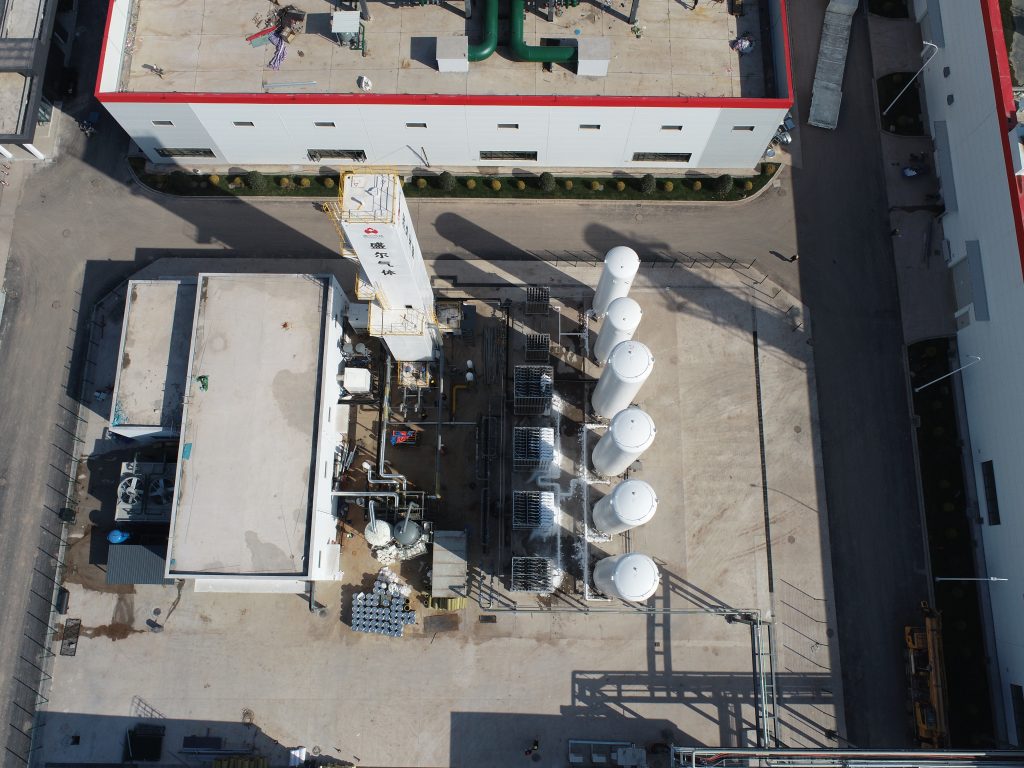
A cryogenic air separation plant relies on several key pieces of equipment working in unison, each handling a specific part of the cycle:
- Main Air Compressor: A multi-stage (centrifugal or axial) compressor that elevates atmospheric air to the required high pressure (around 6–7 bar). It often accounts for the largest share of the plant’s power consumption. Intercoolers between stages condense out moisture and reduce the air temperature for more efficient compression.
- Pre-Purification Unit (PPU): Comprises the precooler and molecular sieve adsorber system. It removes moisture, CO₂, and other contaminants to ppm levels, preventing freeze-ups in the cold box. The PPU ensures the air entering the cryogenic distillation section is clean and dry.
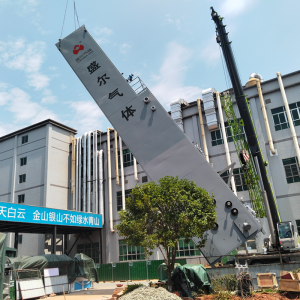
- Cold Box & Heat Exchangers: The cold box is a large insulated enclosure housing the brazed-aluminum heat exchangers and distillation columns. The heat exchangers cool the incoming air by transferring its heat to the cold exiting product and waste streams. This close heat exchange recovers refrigeration and brings the pressurized air feed close to its liquefaction temperature with minimal energy loss.
- Turbo-Expander: A cryogenic expansion turbine that generates additional refrigeration by expanding a portion of the high-pressure flow (air or nitrogen). As the gas expands, its temperature drops significantly. The expander often also helps recover energy by driving equipment (like an electric generator or booster compressor), improving overall efficiency.
- Distillation Columns: Tall, cylindrical columns (usually two in a nitrogen ASU) where the actual separation of liquefied air occurs via fractional distillation. The high-pressure column performs the initial separation at ~5–6 bar, producing nitrogen-rich vapor and oxygen-rich liquid. The low-pressure column (near 1 atm) refines the separation to produce high-purity nitrogen gas and oxygen liquid. These columns are interconnected by a reboiler-condenser which facilitates heat transfer between them. An optional argon column may be added to extract high-purity argon as a separate product.
- Reboiler-Condenser Unit: A heat exchanger at the interface of the two main columns that boils oxygen-rich liquid from the low-pressure column while condensing nitrogen vapor from the high-pressure column. This integrated unit drives simultaneous distillation in both columns and is key to energy-efficient operation of the double-column system.
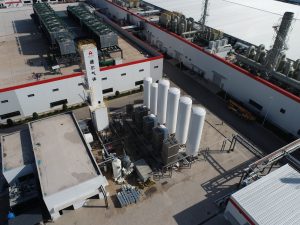
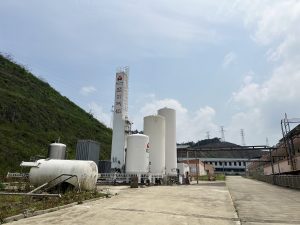
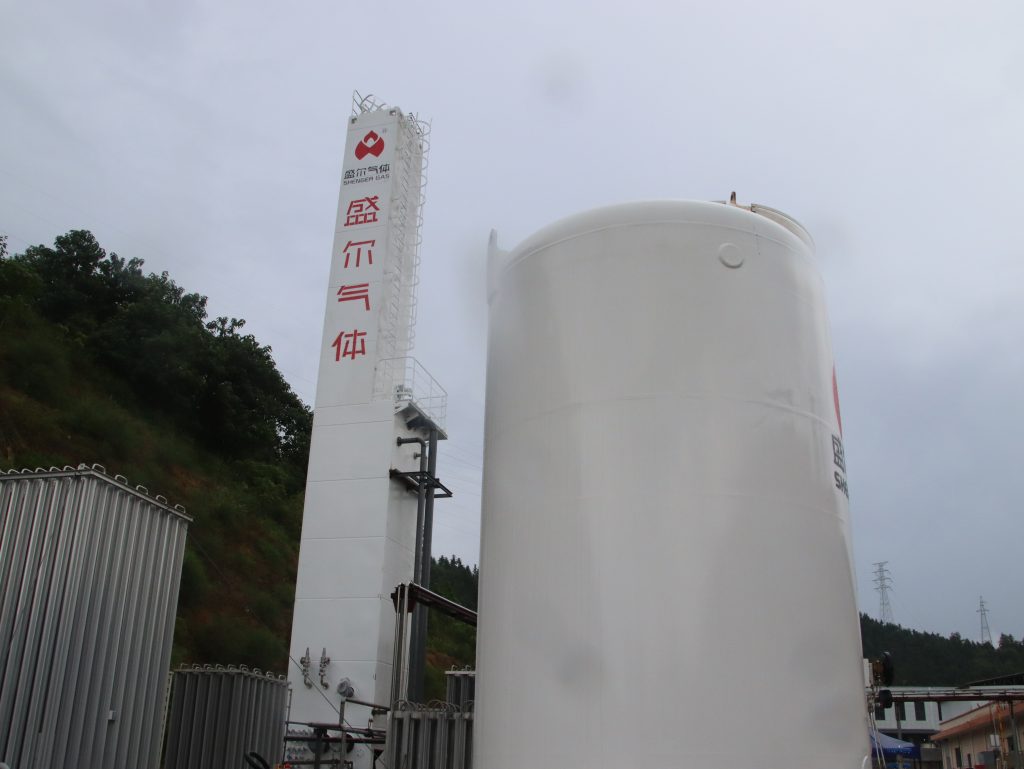
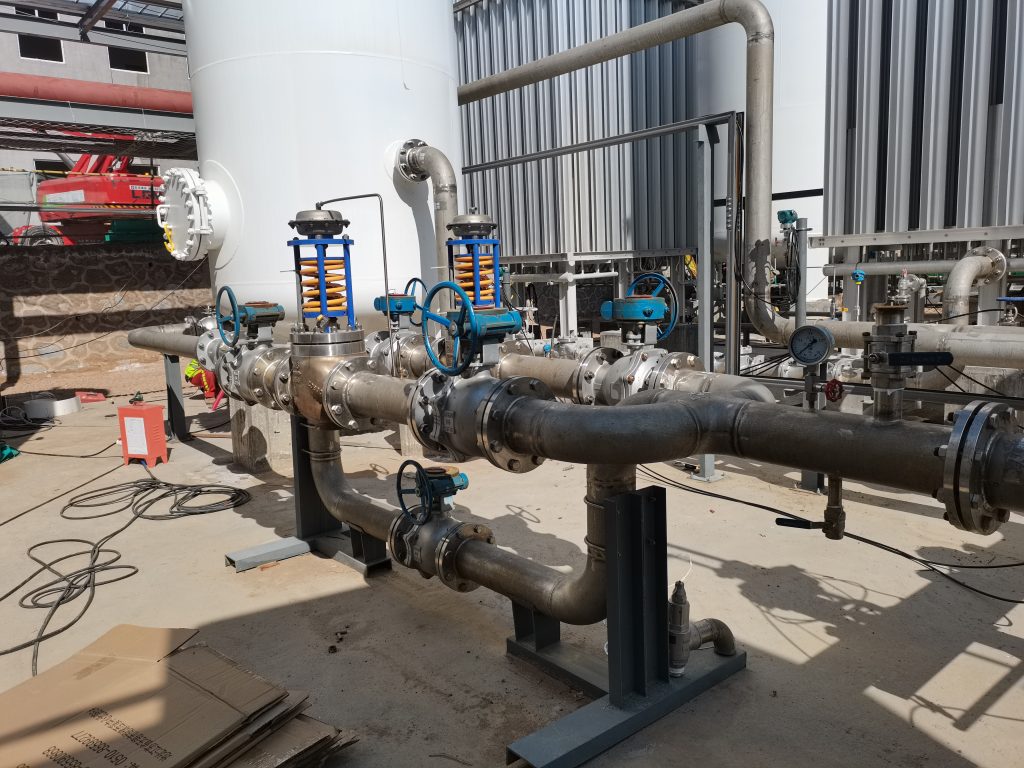
- Product Storage and Delivery: Infrastructure to handle the final products. Insulated cryogenic storage tanks hold liquid nitrogen (and oxygen, if produced), and ambient vaporizers can convert stored liquid to gas on demand. For gaseous product delivery, high-pressure cryogenic pumps may send liquid nitrogen to vaporizers to produce high-pressure gas, or post-separation compressors may compress gaseous nitrogen to the required delivery pressure. These systems ensure the nitrogen product is supplied to end users at the desired pressure, temperature, and phase.
All of these components must function in harmony. The seamless operation of compressors, purifiers, heat exchangers, and columns under tight control allows the ASU to produce a continuous stream of nitrogen product meeting strict purity specifications. This integrated design is what makes Cryogenic Air Separation for Nitrogen Production feasible and reliable for industrial use.
Typical Operating Parameters for Nitrogen Production
The table below summarizes key process parameters and conditions typical for Cryogenic Air Separation for Nitrogen Production systems:
| Parameter | Typical Value / Range |
|---|---|
| Feed Air Composition (approx.) | 78% N₂, 21% O₂, ~1% Ar (by volume) |
| Main Air Compressor Discharge | ~6 bar (≈85–90 psig) |
| High-Pressure Column Pressure | ~5–6 bar |
| Low-Pressure Column Pressure | ~1.2 bar (near atmospheric) |
| Cold Distillation Temperatures | ~ -175°C to -190°C in the columns |
| Nitrogen Product Purity | 99.9% – 99.999% (up to 5.0–6.0 “N” grade) |
| Nitrogen Delivery Form | Gas at ambient temperature (GAN), or liquid (LIN) at ~ -196°C |
| Typical Plant Capacity | Hundreds to thousands of tons N₂ per day (scalable) |
| Specific Energy Consumption | ~0.4 – 0.6 kWh per Nm³ of N₂ produced (gas output) |
| Startup Time (Cool-down) | Several hours to 1 day (for large plants) |
(Nm³ = Normal cubic meter at standard conditions. “N” grade refers to the number of nines in purity; e.g., 5.0 N is 99.999%.)
These values can vary depending on the plant size, design optimizations, and desired product specifications. Large, modern facilities tend to be more energy-efficient per unit of gas produced than smaller or older designs due to advances in machinery and process integration.
Advantages and Applications of Cryogenic Air Separation for Nitrogen Production
Cryogenic Air Separation for Nitrogen Production is capital-intensive and requires significant power input, but it offers several key advantages for producing nitrogen:
- Ultra-High Purity: The cryogenic process can routinely achieve nitrogen purities with oxygen content in only the low ppm (parts per million) or even ppb range. This level of purity (often 99.999% or higher) is essential for sensitive applications such as semiconductor fabrication, pharmaceutical manufacturing, and other processes where even trace oxygen can cause issues.
- Large Production Volumes: Cryogenic ASUs can supply tens of thousands of cubic meters of nitrogen per hour, or hundreds of tons per day. This makes them suitable for supporting large industrial complexes (e.g. refineries, petrochemical plants, steel mills) via pipeline networks, as well as filling a high volume of transportable liquid nitrogen containers for wider distribution. The economy of scale means the cost per unit of nitrogen can be very low for large plants.
- Co-Production of Other Gases: A cryogenic plant can be configured to produce oxygen and argon (and even rarer gases like neon, krypton, xenon) as valuable co-products alongside nitrogen. This flexibility maximizes the utility of air as a raw material. For example, a single ASU can simultaneously deliver high-purity nitrogen for inerting, oxygen for combustion or medical use, and argon for specialty welding or industrial processes.
- Reliability and Efficiency at Scale: Modern cryogenic air separation units are highly reliable, often running for years with minimal downtime. They are usually designed with redundancy and robust safety systems due to the critical nature of their output. At very high output scales, cryogenic distillation becomes more energy-efficient (per volume of gas) than smaller non-cryogenic systems, making it the most economical choice for bulk supply in the long run.
The nitrogen produced via cryogenic separation is indispensable across a wide range of industries. In chemicals and petroleum refining, gaseous nitrogen is used to inert tanks and reactors, purge lines, and prevent oxidation during processing. The electronics and semiconductor sector requires ultra-pure nitrogen for creating controlled atmospheres during chip manufacturing and materials processing. Food processors use liquid nitrogen for flash freezing foods and to maintain oxygen-free packaging environments that extend shelf life. Metal manufacturers rely on nitrogen in heat-treating furnaces and to shield reactive metals from air. Hospitals and laboratories use nitrogen for medical device operation, cryopreservation of biological samples, and as a carrier gas in analytical instruments. In all these cases, large-scale Cryogenic Air Separation for Nitrogen Production ensures a dependable supply of nitrogen gas or liquid with the required quality.
While smaller-scale or lower-purity needs can be met with non-cryogenic nitrogen generators (e.g., PSA or membrane systems), these alternatives cannot match the ultra-high purity or large-volume capability of Cryogenic Air Separation for Nitrogen Production.
Conclusion
Cryogenic Air Separation for Nitrogen Production stands as a cornerstone of the industrial gases industry, enabling the secure supply of nitrogen in the purities and quantities that modern industries require. By exploiting the thermodynamic properties of air at extremely low temperatures, cryogenic ASUs can deliver nitrogen gas with purity levels up to 99.999% and in volumes of thousands of tons per day. The process is characterized by complex but well-proven engineering — from powerful compressors and ultra-cold distillation columns to sophisticated heat exchange and control systems. While energy consumption is significant, ongoing improvements in efficiency and plant design continue to optimize performance.
For researchers and technical professionals, understanding this process is crucial because it influences everything from the economics of production to the quality of end products in various applications. In the United States and worldwide, the technology of Cryogenic Air Separation for Nitrogen Production underpins operations in manufacturing, healthcare, technology, and energy. As emerging technologies drive up the demand for high-purity gases (for example, in biotechnology, aerospace, or renewable energy applications), cryogenic air separation technology is continually evolving to meet these needs more efficiently. Cryogenic Air Separation for Nitrogen Production remains the gold standard for nitrogen production when the requirements call for exceptional purity, large volume, and reliability — fueling a wide array of industrial innovations and processes that rely on this inert gas. Looking ahead, Cryogenic Air Separation for Nitrogen Production will continue to be indispensable wherever large volumes of ultra-pure nitrogen are required.