Introduction
Cryogenic ASUs (air separation units) are integral to large-scale industrial operations, providing massive quantities of oxygen and nitrogen for processes in steel manufacturing and chemical production. In steel mills, cryogenic ASUs supply high-purity oxygen for blast furnaces and basic oxygen furnaces, as well as nitrogen for inerting and purging. Chemical plants likewise rely on these units to deliver oxygen for oxidation reactions (e.g. gasification or partial oxidation) and nitrogen for creating inert atmospheres. Modern cryogenic distillation technology enables these gases to be produced in large volumes – a single ASU can exceed 3,000–5,000 tons of O₂ per day in some steel complexes.
Operating these units is highly energy-intensive. Cryogenic ASUs can account for roughly 15–20% of a steel plant’s total energy consumption. Compressing and cooling the huge air flow required for cryogenic distillation consumes enormous amounts of electricity – a 1,000 TPD oxygen ASU typically draws on the order of several megawatts of power continuously. As a result, optimizing column configuration and operating pressures is critical to improving efficiency and reducing operating costs. By fine-tuning pressures and distillation column designs, engineers aim to minimize energy usage while maximizing oxygen/nitrogen recovery and purity. This article explores how column design (single vs. dual vs. multi-column setups) and pressure optimization strategies influence the performance of Cryogenic ASUs in large-scale applications. Key topics include the role of column design, thermodynamic considerations for pressure selection, impacts on product purity and recovery, energy efficiency trade-offs, and practical design limits – all geared toward high-volume ASUs used in steel and chemical industries.
Column Design in Cryogenic ASUs: Single, Dual, and Multi-Column Systems
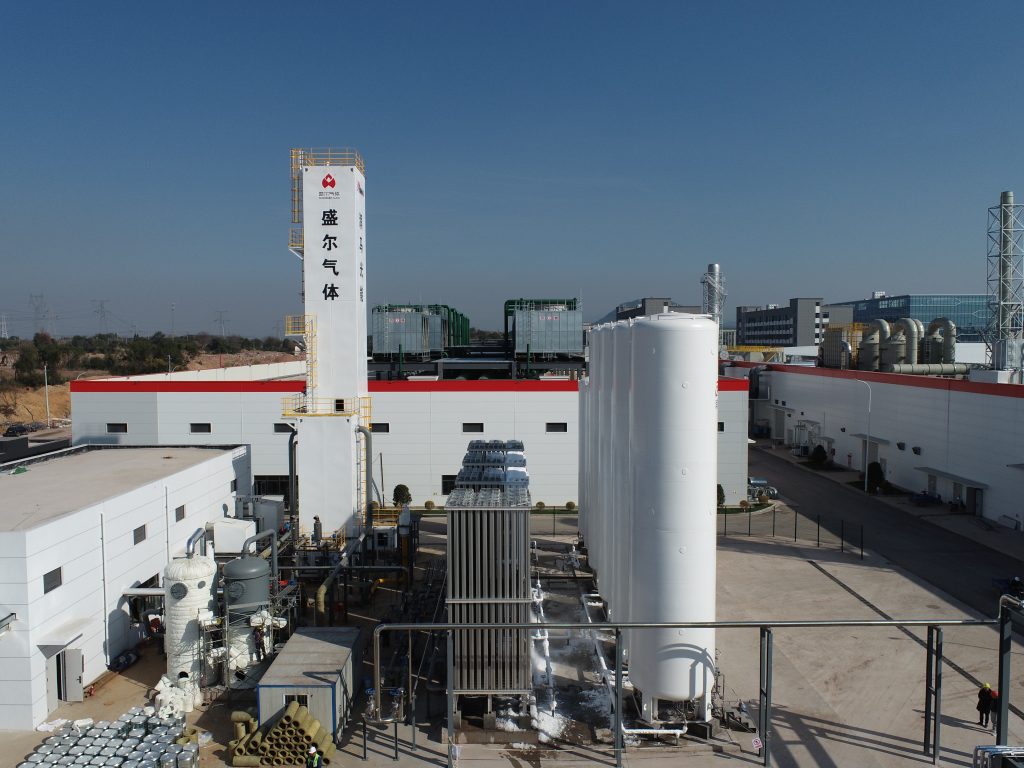
The foundational component of a cryogenic ASU is the distillation column (or set of columns) where liquefied air is separated into its components by boiling point. Early air separation units employed a single distillation column operating at low pressure (near atmospheric). In such a single-column setup, air is liquefied and fed into one column; nitrogen, being more volatile, rises and is drawn off as the top product, while oxygen-enriched liquid collects at the bottom. However, a single column cannot easily achieve high purities for both products. Without an external reflux of pure nitrogen liquid, the column’s overhead nitrogen still contains residual oxygen (historically on the order of 5–10% O₂), limiting oxygen recovery and purity. In other words, a one-column ASU could only produce moderately enriched oxygen and nitrogen – often inadequate for industrial needs where high-purity oxygen (≥95%) and nitrogen (≥99%) are required.
The breakthrough came with the dual-column (double column) process, introduced by Carl von Linde in 1910. A double-column ASU uses two distillation columns in series at different pressures – typically a high-pressure column coupled with a low-pressure column – integrated via a common condenser-reboiler. In the high-pressure (HP) column (often operating around 5–8 bar), air is separated into an oxygen-rich liquid at the bottom (roughly 35–40% O₂) and nitrogen-rich vapor at the top. That nitrogen vapor is condensed by cooling against the boiling oxygen-rich liquid from the low-pressure column in a shared heat exchanger. The resulting condensed liquid nitrogen is fed as reflux to the second, low-pressure (LP) column (operating near ~1.0–1.3 bar). In the LP column, this additional reflux enables deep purification: high-purity oxygen (~99% O₂) is obtained at the bottom, while high-purity nitrogen (~99.9% N₂) is drawn from the top. The two columns thus work in tandem – the high-pressure column performs a rough separation (and provides abundant cold liquid nitrogen), and the low-pressure column refines the products to commercial purity. This dual-column configuration revolutionized air separation by allowing simultaneous production of both pure O₂ and pure N₂ with high recovery, something a single column could not accomplish.
Large industrial ASUs today build on the double-column core, often adding additional columns for argon or other rare gases. Argon is present in air (~0.9%) and has a boiling point (–185.8 °C) between those of oxygen (–183 °C) and nitrogen (–196 °C). In the double-column process, argon accumulates in the intermediate stages of the low-pressure column (since it neither goes out with the top nitrogen nor completely with the bottom oxygen). To capture argon and prevent it from diluting the oxygen product, a side-stream is drawn from the low-pressure column’s middle into a third column – the argon distillation column. This argon column operates at low pressure and is fed with an argon-rich vapor (typically containing ~10% O₂ / 90% Ar from the main column). Through further distillation it yields crude liquid argon (which can be refined to ≥99.999% in a subsequent purifier) and returns an oxygen-enriched stream back to the main column. Incorporating an argon column enables production of very high-purity oxygen (≈99.5% O₂ or above) by removing argon as a separate product, while also recovering argon as a valuable commodity. Some large ASUs even include more than three columns – for example, additional columns to capture neon/helium or to produce extra liquid products – but the typical multi-column industrial ASU comprises a high-pressure column, a low-pressure column, and one (or two) additional columns for argon. The exact column configuration is tailored to the desired products and purities: for instance, a steel plant’s ASU usually includes an argon column to supply argon for metallurgical processes, whereas an ASU dedicated to producing only gaseous nitrogen might omit argon recovery and use a simpler two-column cycle. Regardless of the specifics, the interplay of multiple columns at different pressures is fundamental to achieving both high purity and energy efficiency in cryogenic air separation.
Pressure Optimization: Thermodynamic Considerations
The operating pressure of the distillation columns is a central factor in ASU design because it directly affects the thermodynamics of separation and the energy required. Distillation works by exploiting the difference in boiling points between nitrogen and oxygen – a difference which is pressure-dependent. Lower column pressures increase the relative volatility of the N₂/O₂ mixture, meaning nitrogen and oxygen “separate” more readily at lower pressure (the vapor-liquid equilibrium favors a larger composition difference between vapor and liquid phases at each stage). This tends to reduce the number of theoretical stages needed for a given separation. However, low-pressure operation also means very low temperatures are required to liquefy and boil the gases. For example, at 1 atm pressure, nitrogen boils at –196 °C and oxygen at –183 °C; providing reflux at such low temperatures is challenging unless there is an internal source of refrigeration. In a single-column ASU, there is no convenient source of cold liquid at those temperatures, which is why single columns historically could not achieve high purity – they lacked sufficient refrigeration and reflux to drive the separation.
Using multiple pressure levels (as in the classic double-column design) is essentially a way to optimize this thermodynamic trade-off. Running the first column at elevated pressure raises the condensation temperature of nitrogen (for instance, at ~6 bar, N₂ condenses around –170 °C instead of –196 °C). This higher temperature allows the nitrogen vapor from the high-pressure column to be condensed by the boiling oxygen in the low-pressure column. The low-pressure column, on the other hand, benefits from the improved separation efficiency that comes with near-atmospheric operation – oxygen and nitrogen have a larger relative volatility at ~1 bar, so higher purity is achievable with fewer stages. In essence, the high-pressure column sacrifices some ease of separation (due to the higher pressure and closer boiling points) in order to provide the necessary cold reflux to the low-pressure column, which then finalizes the separation under optimal low-pressure conditions. The net result is a far more energy-efficient process than any single-column scheme, since the work done to compress the air is reused to provide cooling (via nitrogen condensation) rather than being wasted.
There is an optimal range of operating pressures that minimizes the total work input (mainly the air compressor load and the expander/reboiler duty) for a given product output. If the high-pressure column’s pressure is set too low, the temperature difference between the high-pressure nitrogen condensation and low-pressure oxygen boiling becomes too small to drive heat transfer in the inter-column condenser – the system then requires extra refrigeration from external sources (e.g. diverting more air through an expansion turbine) to achieve sufficient liquefaction. This imposes an additional energy penalty and can also lead to more oxygen being wasted in the cold production process (because any expanded/vented stream carries away some O₂). Conversely, if the high-pressure is set excessively high, the main air compressor must do far more work compressing the air than is thermodynamically necessary for separation. Beyond a certain point, raising pressure yields little gain in separation but sharply increases power consumption due to the higher compression ratio. In practice, designers determine an optimal high-pressure operating point that balances these effects. This pressure is often just high enough to ensure adequate condensation of nitrogen against the low-pressure column (with only a small temperature “pinch” in the condenser) and no higher. For many large cryogenic ASUs, this optimal high-pressure is on the order of 6–8 bar (with the low-pressure column around 1.1–1.3 bar). Within that window, the total specific energy consumption for producing oxygen/nitrogen is near a minimum. Studies have shown, for example, that operating a double-column ASU at roughly 0.75 MPa (≈7.5 bar) on the high-pressure side and ~0.11 MPa (≈1.1 bar) on the low-pressure side yields very low exergy losses – essentially confirming that traditional designs hit close to the thermodynamic “sweet spot” for pressure selection.
This idea of a pressure optimization curve is often visualized by plotting the ASU’s power consumption against the high-pressure column operating pressure. The curve is typically U-shaped: at very low pressures, power consumption is high (insufficient internal reflux leads to more waste refrigeration and lost product), then it drops to a minimum at an intermediate pressure, and rises again at high pressures (due to excessive compressor work). The adoption of the dual-column architecture itself sprang from this optimization logic – it became clear that no single-column design at one pressure could achieve both high purity and low energy consumption. By splitting the air separation across two pressure levels, early designers found a way to approach the ideal separation work much more closely. In short, the choice of column pressures and the column configuration are interdependent: selecting the right pressures enables effective heat integration and separation, and this drove the evolution from single- to multi-column ASUs. Today, pressure tuning remains a key aspect of ASU design, even as modern units include more advanced cycles and equipment.
Impacts on Oxygen and Nitrogen Recovery & Purity
Optimal column configurations and pressures are ultimately judged by their impact on product recovery and purity. Cryogenic ASUs are typically designed to recover as much oxygen and nitrogen from the intake air as possible while meeting stringent purity targets. The shift from single-column to dual-column operation brought a massive improvement in oxygen recovery. In a single-column ASU, a significant portion of the oxygen inevitably leaves with the nitrogen-rich overhead gas (since without sufficient reflux, the top vapor contains appreciable O₂). This could limit oxygen recovery to around 90% or even less. By contrast, a well-designed double-column ASU can capture virtually all of the oxygen in the feed air. The high-pressure column’s condensation reflux knocks most oxygen out of the nitrogen stream, and the low-pressure column then strips out the remainder, resulting in a waste nitrogen stream that is typically 99.9% N₂ with only trace O₂. Overall oxygen recoveries in modern large ASUs often exceed 98–99%. In practical terms, this means almost every molecule of oxygen in the inlet air ends up in the product oxygen stream.
Product purities are likewise enhanced by multi-column designs. For nitrogen, the introduction of the second column means the top product from the low-pressure column is extremely pure – usually 99.9%+ N₂ (more than sufficient for industrial and even electronic-grade uses). This is a stark contrast to a single-column output, where the nitrogen might only be ~90–95% pure because it contains considerable oxygen. On the oxygen side, a basic two-column ASU without argon extraction can produce roughly 95–97% pure O₂. The limitation here arises from argon: since argon’s boiling point lies between O₂ and N₂, it is not separated in the double-column system and thus remains with the oxygen-rich liquid. In a two-column cycle with no argon removal, the bottom product of the low-pressure column will be oxygen with a few percent argon (often about 93–95% O₂, the rest Ar and a bit of N₂). For many steel and chemical processes, this 95% O₂ is acceptable – in fact, some “energy-saving” ASU designs intentionally allow the oxygen product to be lower purity (90–95%) to reduce power consumption, if the downstream process can tolerate argon.
To produce ultra-high purity oxygen (typically 99.5% O₂ or above) and simultaneously capture argon, ASUs add the dedicated argon column as described earlier. With argon extraction, the main low-pressure column can deliver liquid oxygen essentially free of argon, which is then evaporated to 99.5–99.8% O₂ for product. (The remaining 0.2–0.5% is mostly argon, plus a trace of nitrogen.) The trade-off is that adding an argon column and its condensers/reboilers slightly increases the complexity and energy consumption of the plant. There is additional boil-up and condensation happening in the argon column, which draws refrigeration and can reduce the overall oxygen recovery a tiny amount (since a small fraction of O₂ may be lost in the argon-rich waste stream). Nonetheless, the ability to produce >99.5% pure oxygen is often mandatory (for example, in steelmaking via basic oxygen furnaces), and the argon byproduct is economically valuable. A well-optimized ASU with an argon column can recover 70% or more of the argon in the air as product, while still delivering oxygen at 99.5% purity. The energy penalty for argon recovery is usually considered worthwhile for the gain in product value and oxygen purity. In summary, pressure-optimized, multi-column ASUs achieve near-total oxygen recovery from air and produce high-purity products. Designers can choose to trade off purity vs. power depending on requirements – for instance, sacrificing a few percentage points of O₂ purity to save energy if 95% O₂ is sufficient – but most large installations supplying oxygen to combustion or chemical reactors target the highest purity feasible and include the necessary column configurations to achieve it.
Energy Efficiency Trade-Offs and Optimization
Energy efficiency is a paramount concern in large cryogenic ASUs – even a few percentage points improvement can save enormous amounts of electricity over an ASU’s operating life. The relationship between column pressure, configuration, and energy use must therefore be carefully managed. As discussed above, raising the high-pressure column to an optimal level dramatically reduces the refrigeration duty compared to an improperly low-pressure scenario. On the other hand, pushing pressures beyond the optimum causes the compressors to consume extra power for little separation benefit. Operators must balance these factors to minimize the specific power consumption in cryogenic ASUs.
To put things in perspective, a state-of-the-art cryogenic ASU might consume on the order of 0.20–0.25 kWh of electricity per kilogram of O₂ produced (at ~95–99% purity). This translates to roughly 200–250 kWh per metric ton of O₂. In other terms, a 3000 TPD oxygen plant could draw around 250–300 MW·h of electrical energy per day. The exact figure depends on product purity and delivery pressure: producing 99.9% O₂, for instance, requires more reflux and reboil duty than producing 95% O₂, so the higher-purity case will demand additional power. Similarly, if oxygen must be delivered at elevated pressure (for example, 30 bar for a gasifier), additional energy is required to compress or pump the product.
Key: Low-pressure operation (5 bar in this example) undermines oxygen recovery slightly and requires more refrigeration, raising energy per ton of O₂ – because the high-pressure column isn’t providing enough condensing duty, extra cold must be generated via the expander or other means. The optimized ~8 bar case achieves essentially full O₂ recovery with minimal excess refrigeration, yielding the lowest specific energy. Very high pressure (10 bar) does not improve recovery or purity (those are already maximized) but forces the compressors to work harder – increasing specific energy consumption. This demonstrates the classic pressure trade-off: too low or too high both incur penalties, whereas an intermediate pressure minimizes energy demand.
From the above, it’s evident that “more pressure” is not always better for efficiency – there is an optimum. ASU designers strive to operate at that sweet spot. They achieve this not only by selecting appropriate column pressures, but also by leveraging efficient process equipment and cycle configurations. Cryogenic ASUs today use turboexpanders (cryogenic turbines) rather than simple Joule-Thomson valves for generating refrigeration, because expansion turbines recover work from the expanding gas and reduce net power consumption. Furthermore, heat exchange networks in the ASU are carefully engineered to approach temperature crossovers as closely as possible, minimizing wasted energy. The main heat exchanger and the multi-stream condenser/reboiler units are designed with small temperature differentials (pinch points) so that very little of the compression energy is dissipated as unusable heat.
There are also strategic design choices to reduce energy usage depending on the required product pressure. For example, if a downstream process needs high-pressure oxygen (say 30–60 bar for an oxy-combustion system or gasifier), it would be extremely inefficient to run the entire distillation at that pressure. Instead, a common technique is to produce liquid oxygen at ~1 bar in the ASU and then pump this liquid O₂ to the desired high pressure using a cryogenic liquid pump, vaporizing it to gas afterward. Pumping a liquid requires only a tiny fraction of the energy that compressing a gas does – this “internal compression” method dramatically cuts the overall power consumption for high-pressure oxygen supply. The alternative (external compression of the gaseous product) is used only when moderate pressures are needed or in backup systems, as it is far less efficient. By incorporating liquid O₂ pumps and keeping the core distillation at optimal low pressures, modern ASUs can meet high-pressure delivery requirements without sacrificing thermodynamic efficiency.
In summary, achieving good energy efficiency in a cryogenic ASU comes down to judicious optimization of pressures and configuration. Every design decision – from adding an argon column to choosing the number of expanders – is evaluated for its impact on the overall energy balance. The best designs recover and reuse as much cold as possible within the process and avoid any unnecessary compression. Ongoing innovations, such as more extensive heat-integration between columns (e.g. internally heat-integrated distillation columns) and improved expander technology, continue to push efficiency closer to theoretical limits. Nevertheless, even the standard dual-column ASU design in use today is the result of decades of refinement aimed at approaching the minimum work of separation as closely as practicable.
Practical Design Limits and Case-Specific Optimization
While the principles of column configuration and pressure optimization provide a general framework, real-world implementations must also consider practical limits and be tailored to specific use-cases. Cryogenic ASUs cannot be designed in a vacuum; factors such as mechanical constraints, safety, and operational flexibility impose boundaries on the theoretical ideals discussed above. One important limitation is mechanical: distillation columns are pressure vessels, so higher operating pressures demand much thicker vessel walls (to contain the internal pressure) and thus higher material cost and fabrication difficulty. Beyond roughly 8–10 bar, constructing a large-diameter column in steel becomes impractical or extremely expensive. Additionally, air components approach their critical points at elevated pressures (the critical point of N₂ is ~34 bar, O₂ ~50 bar), and distillation relies on condensing vapors to liquids. If one tried to operate a column near or above the critical pressure of the mixture, the distinction between liquid and vapor phases would disappear, and separation would collapse. For these reasons, ASUs are never run at extreme pressures – if very high product pressure is needed, the design uses the aforementioned liquid pumping or secondary compression on the product, rather than pushing the entire cold box to high pressure. On the low end, the column pressure cannot go much below atmospheric pressure; creating a vacuum distillation for air would greatly increase volumetric flow (due to low density) and invite air leakage, not to mention requiring even colder temperatures that are beyond practical refrigeration limits. Thus, the typical operating pressures we’ve discussed (roughly 5–8 bar for the HP column and ~1 bar for the LP column) also align with pragmatic engineering limits.
Another factor influencing design is the specific industry and process requirements. For example, steel plants usually require oxygen at roughly atmospheric pressure (for blowing into furnaces at slight over-pressure) but in enormous quantities, and they often want argon as a co-product for metallurgy. ASUs for steel mills are therefore built for very large oxygen throughput, high purity, and argon recovery, but not necessarily for high delivery pressure. These units are typically optimized for continuous, steady operation at or near full capacity, since steel production is continuous. In fact, many steel plants run their ASUs at a constant rate and produce surplus liquid oxygen or nitrogen during periods of lower demand – because throttling a cryogenic ASU up and down significantly is slow and inefficient. (Cryogenic ASUs generally have a minimum turndown of about 50–60% of design capacity; below that, the column system can become unstable, potentially causing the columns to dump their liquid inventory and trip the plant.) To handle transient peaks in oxygen demand (say, during a blast furnace blow or a BOF charge), steel mill ASUs often incorporate buffer storage: excess O₂ is liquefied and stored in tanks when demand is low, ready to be gasified and supplied when demand spikes. The optimization for a steel plant ASU therefore centers on high reliability, maximum oxygen production, and efficiency at the base load, with argon recovery included – whereas the ability to rapidly swing production rates is less important (any needed flexibility is usually provided by the liquid backup system).
In contrast, chemical plants or gasification facilities might require oxygen at medium or high pressure for feeding reactors (for example, an ammonia plant’s reformer, an ethylene oxide reactor, or an IGCC gasifier). As noted, an ASU can accommodate this by producing liquid oxygen at low pressure and then pumping it to the required pressure, or by integrating an oxygen compressor if necessary. These facilities may also value integration and responsiveness. For instance, in some gas-to-liquids or power generation complexes, the ASU is integrated with a gas turbine – the gas turbine’s air compressor may supply a portion of the ASU feed air, and in return nitrogen from the ASU is used for turbine inlet dilution or other purposes. Such integrated designs can improve overall process efficiency but require the ASU to be designed for close coupling with another system (which can influence choices like operating pressure and control philosophy). Case-specific optimization extends to deciding how many and what type of product streams to produce. Some ASUs are designed to produce liquid products (liquid O₂, N₂, Ar) in addition to gaseous outputs, which provides flexibility for backup supply or external sales. Including additional liquefaction capacity will increase energy consumption, so the decision to do so depends on reliability and business needs. In summary, the ASU serving a chemical plant might trade a bit more complexity (extra compressors, pumps, integration with other units) in exchange for meeting that plant’s unique pressure and flexibility requirements, whereas an ASU for a steel plant might be kept as straightforward as possible but built on a massive scale for efficiency.
Finally, there are operational and safety constraints that influence ASU design across all industries. Air feed must be thoroughly purified before entering the cold box – moisture, CO₂, and hydrocarbons are removed to ppm levels to prevent freezing or dangerous reactions. Oxygen-rich environments at cryogenic temperatures can be prone to hazardous rapid oxidation; thus, materials of construction (stainless steels, aluminum alloys) and cleanliness standards are rigorously chosen to avoid ignition sources. These considerations impose certain limits (for example, the need for an adsorbent pre-purifier unit means the air feed pressure is typically at least 5–6 bar to allow efficient purification and throughput). While such factors do not directly dictate the column configuration or internal pressures, they form the boundary conditions within which the ASU must be optimized. A design that looks great thermodynamically still has to be vetted against real-world constraints like “Can we fabricate this column?” or “Do we have adequate safety margins if an upset occurs?”
In summary, designing cryogenic ASUs for specific applications involves marrying the general thermodynamic principles with the realities of each situation. The fundamental goals remain the same – maximize recovery and purity at minimum energy cost – but the exact solution (number of columns, operating pressures, auxiliary systems, control strategies) will be tuned differently for a giant oxygen plant at a steelworks versus a smaller, high-pressure ASU at a chemicals complex. By understanding the interplay of thermodynamics and practical constraints, engineers can configure the columns and pressures to best fit each scenario, ensuring each cryogenic ASU delivers the required performance reliably and safely.
Conclusion
Cryogenic ASUs will continue to be the workhorses for producing industrial gases at massive scales. The combination of optimized column configurations and carefully chosen operating pressures allows these plants to achieve high product purity and recovery with ever-improving energy efficiency. As demand grows and processes evolve (for example, the push for lower-carbon steelmaking or more efficient chemical production), ASU technology is advancing in parallel – but the core principles remain the same. By mastering the interplay between thermodynamics and engineering constraints, designers can ensure that Cryogenic ASUs deliver reliable, energy-efficient performance tailored to the needs of any large-scale application.