Cryogenic air separation is the core industrial process used to produce high-purity oxygen, nitrogen, and argon at large scale. As a proven technology, cryogenic air separation supports continuous gas supply for steel, chemical, and energy industries, where bulk oxygen and nitrogen are essential for production efficiency and product quality. The process compresses and purifies ambient air, then cools it to cryogenic temperatures (-185°C and below) to liquefy and fractionally distill its components. Modern cryogenic air separation units (ASUs) operate continuously at very large scale, delivering hundreds to thousands of normal cubic meters per hour of gas. Industrial applications of cryogenic air separation in steelmaking, chemical manufacturing, and energy generation are especially critical, since these sectors require bulk pure gases for high-temperature and oxidation processes. The following sections review how cryogenic ASUs are integrated into each sector, highlighting typical process requirements, gas purities, flows, and energy usage.
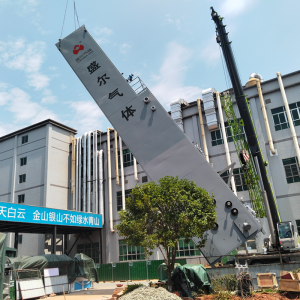
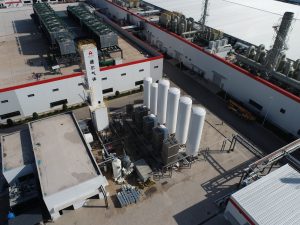
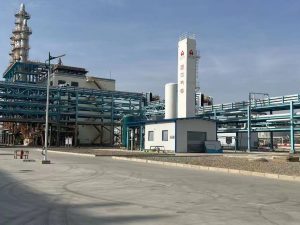
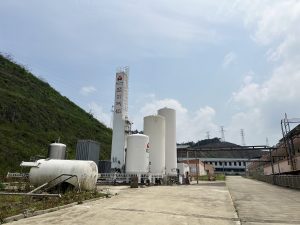
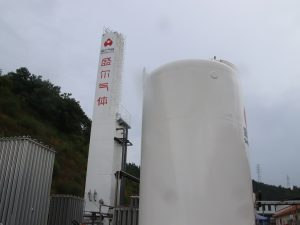
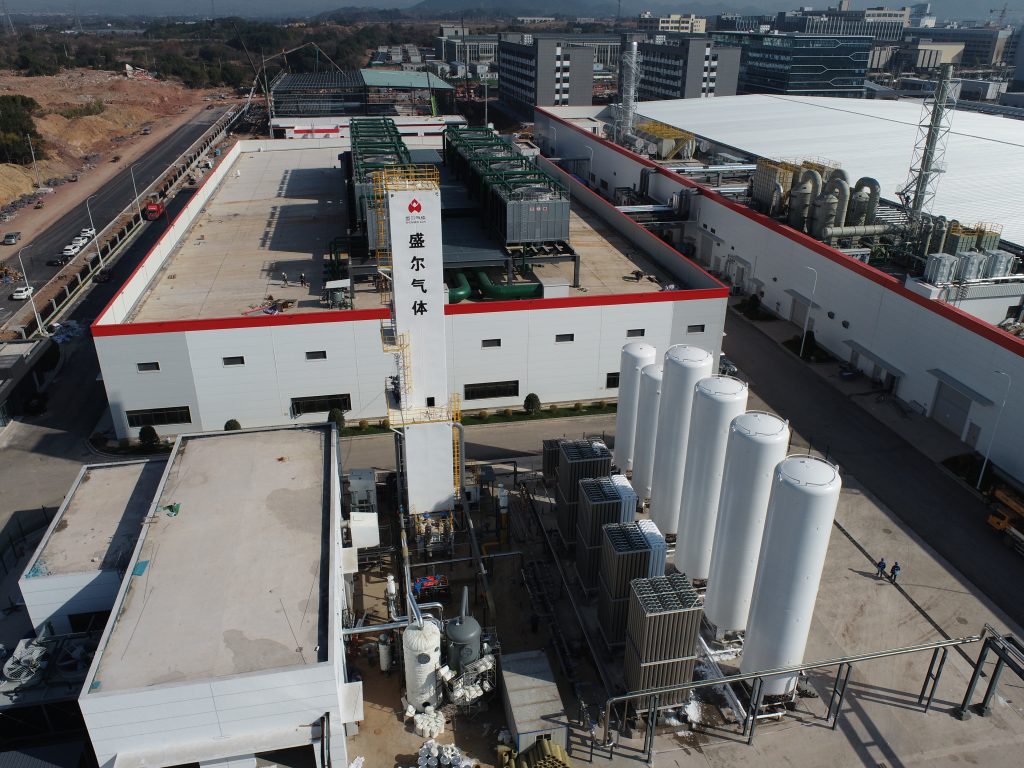
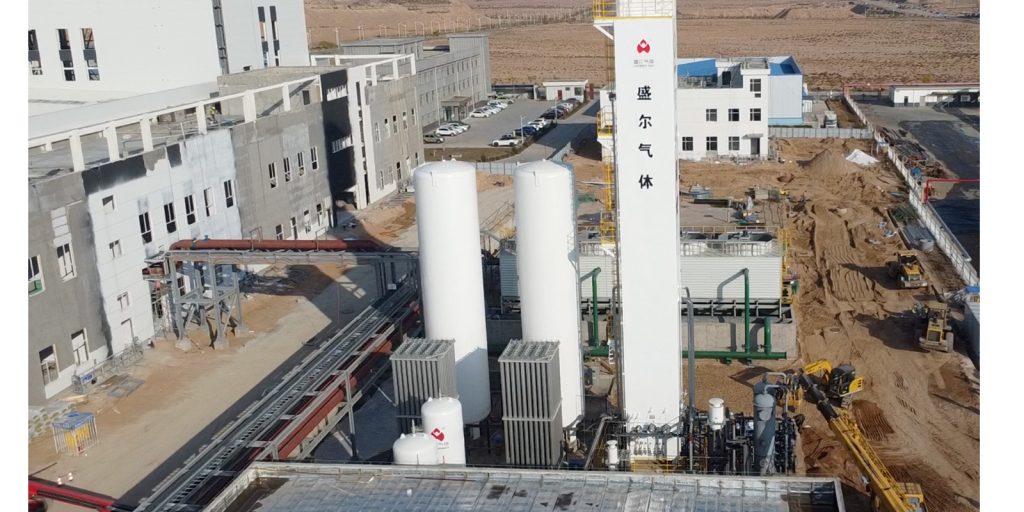
Cryogenic distillation columns in a large-scale air separation plant. Such towers operate at low temperature to separate air into oxygen, nitrogen, and argon. A modern ASU cools and condenses compressed air in multistage heat exchangers and distillation columns. Oxygen (boiling point –183°C) is collected near the bottom of the column at ≥99.5% purity, while nitrogen (–196°C) is drawn off at the top at ~99.9% purity; argon (~1% of air) is recovered in a side column at ~95% purity. Typical ASUs achieve specific energy consumptions on the order of 0.4–0.6 kWh per Nm³ of O₂ (≈400–600 kWh per ton of O₂) when operating at scale. These plants often operate 24/7 and can require several to tens of megawatts of power. Despite the energy demand, large cryogenic ASUs deliver unmatched flexibility and purity: a single large ASU can supply multiple users (blast furnaces, reactors, turbines, etc.) from one integrated unit.
Industrial Applications of Cryogenic Air Separation in Steel Production
In integrated steel mills, cryogenic air separation units serve as the central source of oxygen, nitrogen, and argon for ironmaking and steelmaking processes. The primary applications include:
- Blast Furnace Enrichment: Oxygen from the ASU is mixed into the hot blast air fed to blast furnaces. Enriching the blast to ~30–40% O₂ raises flame temperatures and combustion efficiency. This reduces coke consumption and increases production. Cryogenic oxygen (≥99% pure) allows higher enrichment levels than simple oxygen-enrichment burners. For example, a large blast furnace may inject several thousand Nm³/h of ASU oxygen into its tuyeres during peak operation.
- Basic Oxygen Furnace (Converter) Blowing: The Basic Oxygen Furnace (BOF) process relies on high-pressure, high-purity O₂ to refine molten iron into steel. In each converter charge (lasting ~15–20 minutes), about 20,000–40,000 Nm³ of oxygen at ≥99% purity is blown through a water-cooled lance into the melt. This rapid oxygen jet oxidizes impurities (carbon, silicon, phosphorus) and provides the energy to melt scrap, yielding steel. Such massive, short-duration flows (on the order of thousands of Nm³ per hour) are only feasible with a central cryogenic ASU and booster compressors. (PSA or membrane generators cannot meet the volume and purity demands of a BOF blow.)
- Continuous Casting and Secondary Metallurgy: After refining, liquid steel is cast into slabs or blooms. Argon (~95% purity) from the ASU is injected through the submerged entry nozzle during continuous casting to stir the steel and float out non-metallic inclusions. This “argon bubbling” produces cleaner steel and prevents nozzle clogging. Nitrogen (≈99% pure) from the ASU may be used as a backup inert gas or for secondary refining (e.g. argon-oxygen decarburization). In all cases, the high-purity inert gases come from the same cryogenic ASU.
- Heat Treatment and Inerting: Post-casting, slabs and products often undergo annealing, tempering, and heat treatment. These processes require inert atmospheres to avoid scaling. ASU nitrogen (99%+) blankets furnaces and quench tanks, preventing oxidation of hot steel. For example, a coil annealing furnace may operate in a pure N₂ atmosphere. Nitrogen is also used to inert pipelines, ladles, and tanks for safety. (In smaller mills, a local PSA N₂ generator might suffice, but large integrated mills typically use ASU N₂.)
In total, a steel mill’s ASU might produce tens of thousands of Nm³/h of O₂ and N₂. Such units are energy-in·tensive (often 10–15% of the mill’s power load), so mills incorporate heat recovery and careful integration. However, the flexibility and purity of a cryogenic ASU justify its use: integrated mills may run multiple ASU trains in parallel, providing redundancy and the ability to meet peak demand.In modern steelmaking, cryogenic air separation ensures stable delivery of both gaseous oxygen and nitrogen at pipeline pressure. The unmatched purity and volume flexibility make cryogenic ASUs the only reliable choice for integrated steel mills operating around the clock.In modern steelmaking, cryogenic air separation ensures stable delivery of both gaseous oxygen and nitrogen at pipeline pressure. The unmatched purity and volume flexibility make cryogenic ASUs the only reliable choice for integrated steel mills operating around the clock.
Industrial Applications of Cryogenic Air Separation in Chemical Manufacturing
Chemical and petrochemical plants require large quantities of oxygen and inert gas for synthesis and processing. Cryogenic ASUs meet these needs in several ways:
- Syngas and Hydrogen Production: Ammonia, methanol, and refinery hydrogen plants use oxygen to partially oxidize feedstocks. Autothermal reformers (ATRs) and partial-oxidation (POX) reactors consume ASU oxygen (≥99.5%) to gasify natural gas, naphtha, or refinery off-gas into synthesis gas (H₂+CO). For example, an ammonia plant’s reformer might draw hundreds to thousands of Nm³/h of oxygen from the ASU, typically at pressures of 20–30 bar. The resulting syngas is then used for ammonia or methanol synthesis. Cryogenic ASUs also integrate with downstream hydrogen recovery; after gasification, cryogenic cooling and distillation can further purify H₂ by removing CO₂ and light gases to produce ultra-pure hydrogen for fuel cells or petrochemicals.
- Oxidation and Oxidate Production: Several chemical products are made by catalytic oxidation. Ethylene oxide (EO) production is a prime example: ethylene is reacted with oxygen over a silver catalyst at elevated pressure (1.5–3 MPa) to form EO.For these continuous high-pressure oxidation units, cryogenic air separation provides precisely metered oxygen and dry inert nitrogen to maintain reactor stability and maximize conversion efficiency.
- Hydrogen Recovery and Purification: In petroleum refining and petrochemical cracking, hydrogen-rich off-gases are generated. Some facilities use cryogenic distillation to separate and recover this H₂. Cryogenic H₂ recovery units can produce hydrogen at ≥99.99% purity, co-producing methane/ethane as fuel. This approach is often more economical at large scale than PSA for ultra-pure H₂. For instance, a naphtha reforming unit may employ a cryogenic column to concentrate hydrogen from purge streams.
- Inerting, Purging, and Blanketing: Nitrogen from the ASU (≥99%) is indispensable for plant safety and materials handling. N₂ is used to inert reactors, columns, and storage tanks to prevent fires or explosions. In process control, N₂ provides instrument air and pressure balancing. Bulk liquid N₂ may be used to purge process lines or cold-trap systems in solvent recovery. Large polymer and bulk chemical plants blanket flammable liquids with N₂ to prevent air ingress. The cryogenic ASU’s N₂ often replaces multiple small-scale N₂ generators, simplifying supply.
- Argon and Specialty Gases: Although argon is co-produced (≈0.3–0.5% of air), its volume is much smaller. Some petrochemical processes use argon (for example, as an inert carrier or for special polymer grades), but typically ASU argon is liquefied and sold on the merchant market. Rare gases (Neon, Krypton, Xenon) can also be captured in minor quantities, but these are niche products.
Key points: In chemical plants, cryogenic ASUs are designed around continuous, high-volume processes. They typically deliver oxygen and nitrogen at pipeline pressures (~5–10 bar) to match downstream equipment. An ASU serving a large petrochemical complex might produce from a few hundred up to tens of thousands of Nm³/h of O₂, with N₂ in the tens of thousands to hundreds of thousands of Nm³/h. Engineers pay close attention to energy integration (e.g. using spent cold from the ASU to cool process streams) to minimize the ~0.4–0.6 kWh/Nm³ O₂ power usage. Despite high capital and power costs, cryogenic ASUs enable precise control of feed chemistry in core processes and support the production of bulk chemicals.
Industrial Applications of Cryogenic Air Separation in the Energy Sector
The energy sector increasingly depends on cryogenic air separation for low-carbon power technologies:
- Gasification for Power (IGCC): Integrated Gasification Combined Cycle plants use oxygen-blown gasifiers to convert coal, petroleum coke, or biomass into syngas for power generation. Cryogenic ASUs supply the pure O₂ needed in these gasifiers (typically ≥99%). The syngas is then cleaned and burned in a combined cycle turbine. Large IGCC projects often require ASUs with oxygen outputs comparable to steel or petrochemical facilities (on the order of 5,000–20,000+ Nm³/h), since continuous power generation demands steady high flow.
- Oxy-Fuel Combustion: New power cycles burn fuel in pure or oxygen-enriched streams to facilitate carbon capture. For example, the Allam cycle (a high-efficiency natural gas power cycle) uses almost 100% oxygen from a cryogenic ASU to combust natural gas. The exhaust is mainly CO₂ and H₂O, making CO₂ capture nearly trivial. Oxy-coal or oxy-gas boilers (for hydrogen production or steam generation) also rely on ASU oxygen. These applications demand very large ASUs; for instance, an Allam-cycle turbine might need on the order of hundreds of tons of O₂ per day. Note that the ASU is typically the single largest energy consumer in an oxy-fuel plant (on the order of 200–400 kWh per ton O₂, depending on integration). Engineers often pair ASUs with oxygen storage or flexible operation modes to handle load changes, because cryogenic units are least efficient when cycled.
- Oxygen-Enhanced Combustion: Even conventional power plants sometimes use partial O₂ enrichment. ASUs can provide boosted O₂ to burners, increasing flame temperature and efficiency (though this is less common than full oxy-fuel systems). In some industrial furnaces, ASU oxygen replaces air to reduce flue gas volume and NOx emissions.
- Nitrogen in Energy Applications: While most emphasis is on oxygen, cryogenic N₂ also sees energy-sector use. For example, liquid nitrogen storage has been proposed for grid energy storage (liquid air energy storage, LAES). In closed-loop gas turbines, supercritical nitrogen has been suggested as a working fluid. More conventionally, N₂ is used for inerting and maintenance in power plants (e.g. blanketing oil storage, purging pipes). Some remote power or LNG facilities use ASU nitrogen to pressurize equipment or as a backup fuel in low-oxygen scenarios.
Operational considerations: Energy-sector ASUs tend to be very large and cost-driven by efficiency. They often incorporate high-efficiency turbo-expanders and advanced heat exchangers to lower the ~0.4 kWh/Nm³ base consumption. Large-capacity ASUs can approach 0.4 kWh/Nm³ O₂ (≈400 kWh/ton). These units typically run continuously at ~5–7 bar output (pipeline pressure) to feed process equipment. However, ASUs have limited flexibility: they require steady operation (turn-down below ~60% output risks liquid dumping) and have long startup times (hours to days). Therefore, plants that use ASU O₂ for power must either have steady baseloads (e.g. continuous syngas production) or supplement with flexible oxygen sources for transient needs. Despite these challenges, cryogenic ASUs remain the only viable source of multi-thousand-ton-per-day pure oxygen required by many clean energy technologies.
Technical Specifications of Cryogenic ASUs in Industry
The following table summarizes typical cryogenic ASU outputs and energy usage for different industrial sectors. Actual values vary by plant size and design, but the ranges illustrate common practice:
| Sector/Application | Primary Product | Product Purity | Typical O₂ Output (Nm³/h) | Energy Use (kWh per ton O₂) |
|---|---|---|---|---|
| Integrated Steel Mill | O₂ (for BF/BOF) | ≥99.5% | ~10,000–25,000 | ~400–500 |
| N₂ (inerting) | ~99% | (same ASU; co-produced) | (see O₂) | |
| Chemical/Petrochemical | O₂ (ATRs, EO) | ≥99.5% | ~3,000–10,000 | ~400–500 |
| N₂ (blanketing) | ~99% | (co-produced) | (see O₂) | |
| Energy (IGCC/Oxy-fuel) | O₂ (gasification, boiler) | ≥99% | ~5,000–20,000 | ~450–600 (higher for smaller units) |
Table: Typical cryogenic ASU parameters by industry. Purities refer to gaseous product; O₂ output ranges are order-of-magnitude.
In all cases, high pressure (5–10 bar) delivery is standard for pipeline networks. Argon (~95% purity) is usually co-produced at ~1% of air throughput (not tabulated above), and any rare gases are recovered in trace amounts. Energy consumption improves with scale: very large ASUs can reach ~0.4 kWh/Nm³ (≈400 kWh/ton O₂) by using advanced expansion cycles and heat integration.
Conclusion
Cryogenic air separation remains a foundational technology in heavy industry, enabling high-purity oxygen and nitrogen supply for steel production, petrochemical synthesis, and clean energy innovations. In the steel sector, it enables the massive oxygen and inert gas demands of blast furnaces, converters, and casting lines. In the chemical/petrochemical sector, it underpins syngas and synthesis routes, from ammonia to ethylene oxide, by providing pure O₂ and dry N₂ for reactors and processes. In energy applications, cryogenic ASUs are central to emerging low-carbon power schemes—supplying O₂ for gasification and oxy-combustion and enabling high-efficiency cycles like the Allam cycle. Across all these sectors, cryogenic ASUs deliver unmatched gas purity and continuity, at the cost of significant energy use. Ongoing innovations (e.g. single-column designs, improved turbo-expanders, integration with grid dynamics) seek to enhance efficiency and flexibility.
Overall, the industrial applications of cryogenic air separation continue to expand with global demand for oxygen-intensive processes and decarbonization goals. For researchers and engineers, understanding these applications—along with ASU design tradeoffs—is essential for designing next-generation plants. By harnessing cryogenic distillation, industries achieve the high-purity gas streams that drive today’s steelmaking, chemical production, and advanced power systems.