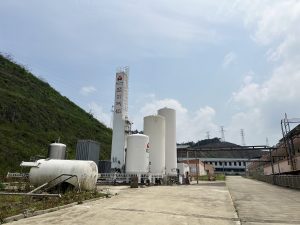
Cryogenic Air Separation is the process of separating atmospheric air into its primary components (oxygen, nitrogen, and argon) by cooling the air to cryogenic temperatures and using fractional distillation. This process relies on the differences in boiling points of the constituents, enabling each component to be drawn off at its characteristic temperature. The result is high-purity products: ASUs can typically achieve oxygen and nitrogen purities ranging from 99.0% up to 99.999%, depending on the number of distillation stages.
Large cryogenic ASUs operate continuously, compressing air to 5–10 bar and using multi-stage refrigeration to reach temperatures below –180°C. These systems can deliver hundreds of tons per day of oxygen, nitrogen, and argon, serving industries from steelmaking to semiconductors and healthcare. Compared to alternative methods, Cryogenic Air Separation is the preferred approach for bulk production of ultra-pure gases because it can simultaneously provide large volumes and high purity. The combination of compression, cryogenic cooling, and fractional distillation allows modern ASUs to meet the high demands of industrial gas supply without compromising gas quality.
Principles of Cryogenic Air Separation
The core principle of cryogenic air separation is fractional distillation of liquefied air. Ambient air is first compressed to a high pressure (typically 5–10 bar gauge) to increase efficiency. Impurities such as water vapor, carbon dioxide, and hydrocarbons are removed using adsorbers (e.g. molecular sieves) to prevent freezing in the cryogenic equipment. The purified air then enters an integrated heat exchanger, where it is progressively cooled against outgoing cold product streams. This countercurrent heat exchange brings the air temperature down to near the liquefaction point of oxygen and nitrogen, typically below –150°C.
When the compressed air is chilled below the boiling point of nitrogen (–196°C) but above that of oxygen (–183°C), partial liquefaction occurs. An oxygen-rich liquid forms while the remaining gas is nitrogen-rich. This temperature reduction is achieved using the Joule–Thomson effect and expansion turbines. Modern ASUs often utilize turboexpanders: these devices expand a portion of high-pressure air or nitrogen, providing the refrigeration needed while recovering work. In this way, the expansion turbines both cool the gas to cryogenic temperatures and assist in driving the compressors, improving overall energy efficiency. In summary, Cryogenic Air Separation exploits the thermodynamic properties of air gases under high pressure and very low temperature to enable separation by boiling point.
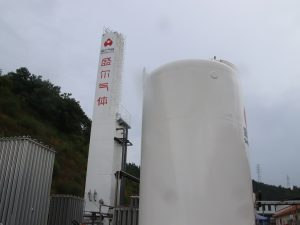
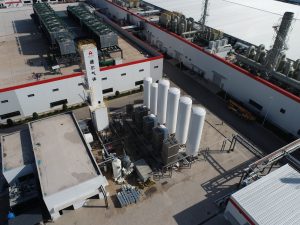
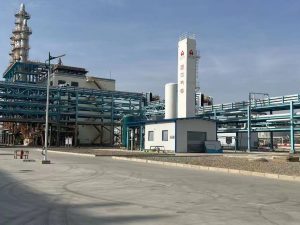
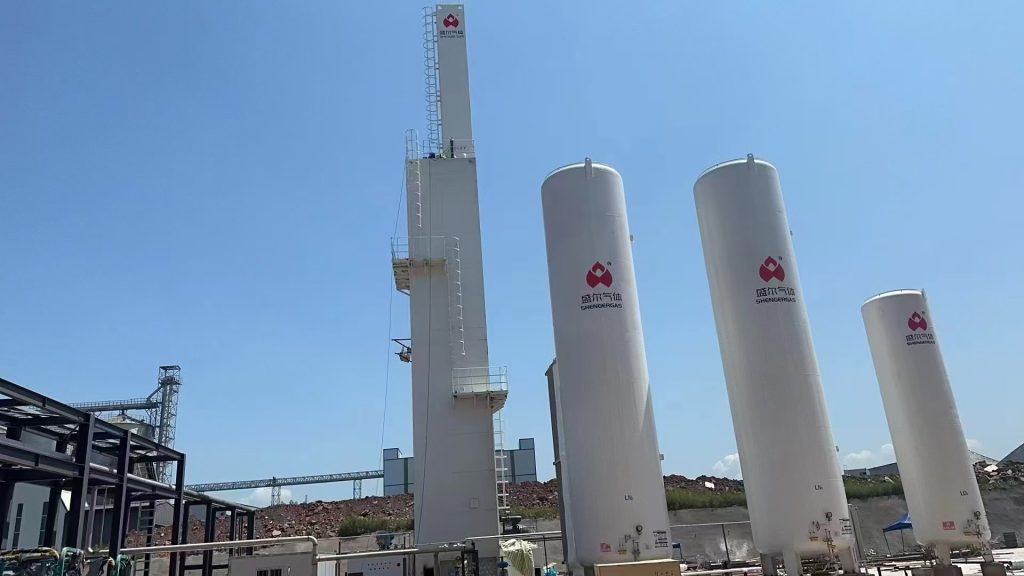
A modern industrial cryogenic air separation plant. Such facilities use multistage compressors, heat exchangers, and tall distillation columns to fractionate air into oxygen, nitrogen, and argon. The main distillation columns often exceed tens of meters in height, reflecting the many theoretical stages required for high-purity separation.
Cryogenic Air Separation Process
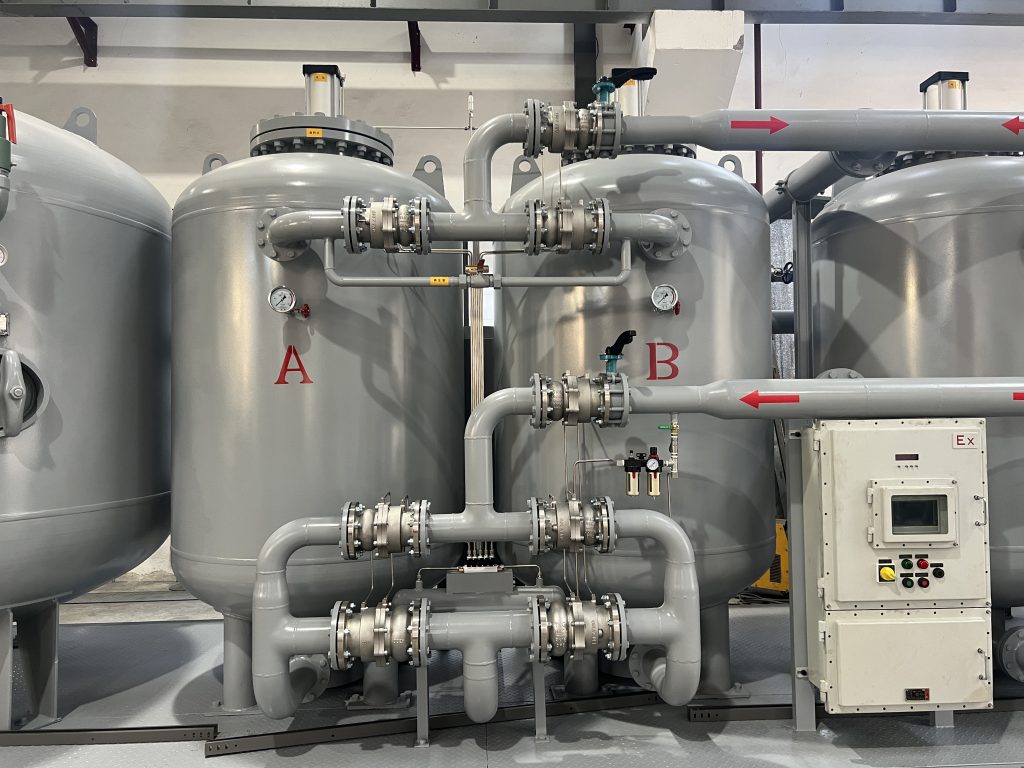
A typical cryogenic Air Separation Unit (ASU) can be divided into several stages. First, ambient air is drawn in through filters and then compressed using multistage compressors to about 5–10 bar. Intercoolers between compressor stages remove the heat of compression. The high-pressure air then passes through molecular sieve beds, which scrub out H₂O, CO₂, and hydrocarbons. Removing these impurities is critical to prevent freezing in the cold section and to ensure that the final oxygen and nitrogen products meet purity specifications.
Next, the purified, high-pressure air enters the main cryogenic heat exchanger (usually a plate-fin exchanger). In the exchanger, the warm compressed air is cooled countercurrently against cold product streams (liquid oxygen, liquid nitrogen, etc.) and cold waste gas. By the end of this step, the air temperature has dropped from near ambient to roughly –150°C, and a portion of the oxygen content has liquefied. The remaining gas (now enriched in nitrogen) remains mostly in vapor form.
The cold, partially liquid air mixture is then fed to distillation columns under cryogenic conditions. In the high-pressure (HP) distillation column (operating around 6–8 bar), the liquid-vapor mixture separates by boiling point. Nitrogen, having a lower boiling point, tends to exit as a vapor at the column top, while an oxygen-rich liquid accumulates at the bottom. This HP column uses a condenser or reboiler to return heat and assist separation: often, an expanded oxygen-rich stream provides the refrigeration to condense a part of the nitrogen. The top product from the HP column is high-purity nitrogen (when needed), and the bottom stream is oxygen-rich liquid that feeds the next stage.
In the low-pressure (LP) distillation column (operating around 1.2–1.3 bar abs), the oxygen-rich liquid from the HP column is further distilled. The LP column produces very pure oxygen at its bottom (liquid) and a nitrogen-rich waste gas at the top. If argon is being recovered, an auxiliary argon column is fed from a side draw of the LP column. The argon column operates at similar pressure and isolates argon from the oxygen stream, yielding high-purity argon. Finally, the separated gases (liquid or gaseous O₂, N₂, Ar) are warmed to near ambient temperature in the heat exchanger and sent to storage or pipeline. In some configurations, gaseous products are compressed to pipeline pressure after warming.
The table below summarizes the main process stages, with approximate pressures, temperature ranges, and functions:
| Stage / Component | Pressure (bar) | Temperature Range (°C) | Function / Description |
|---|---|---|---|
| Air Intake & Filtration | ~1 (ambient) | ~15–25 (ambient) | Filters out dust and moisture from incoming air |
| Multistage Compression & Intercooling | 5–10 (gauge) | 40–100 (post-compression) | Raises air pressure; intercooling removes compression heat |
| Purification (Molecular Sieves) | 5–10 (gauge) | ~15–25 (ambient) | Removes H₂O, CO₂, and trace impurities to protect cryogenic equipment |
| Main Cryogenic Heat Exchanger | 5–10 (gauge) → 1.3 (abs) | Ambient to ~–150 | Countercurrent heat exchange cools and partially liquefies the compressed air |
| Expansion (Turboexpander / JT Valve) | 5–10 (gauge) → 1–1.3 (abs) | ~–150 to –170 | Provides additional refrigeration by expanding a portion of high-pressure air |
| High-Pressure Distillation Column | ~6–8 (gauge) | Top ~–195; Bottom ~–130 | Separates nitrogen (top gas) from oxygen-rich liquid (bottom) |
| Low-Pressure Distillation Column | 1–1.3 (abs) | Top ~–196; Bottom ~–183 | Produces high-purity O₂ (bottom liquid) and N₂ (top gas) |
| Argon Recovery (Auxiliary Column) | ~1–2 (abs) | ~–190 (liquid draw) | Extracts and refines argon from the oxygen-rich stream |
| Product Warming & Storage | Ambient | Ambient | Warming product gases to ambient temperature for delivery |
Each stage is carefully controlled to maintain the required temperature and pressure gradients. The efficiency of the ASU depends on minimizing temperature differences (using highly efficient plate-fin exchangers) and recovering as much cold energy as possible. For example, the oxygen and nitrogen product streams typically provide the refrigeration needed for initial cooling, while expansion turbines supply additional cooling to reach the lowest separation temperatures.

Industrial Applications of Cryogenic Air Separation
Cryogenic air separation underpins a wide range of industrial and medical applications by providing large volumes of high-purity gases. Notable uses include:
- Steel and Metallurgy: Oxygen from ASUs is used in basic oxygen furnaces (BOF) to promote combustion of carbon in iron, and in electric arc furnaces. High-purity nitrogen and argon provide inert atmospheres for metal heat treatment and welding, improving steel quality.
- Chemical and Petrochemical: Pure oxygen is essential for processes like ethylene oxide or methanol production and for feedstock gasification. In ammonia synthesis (Haber process), high-purity nitrogen is fed as a reactant, and inert nitrogen gas is used for system purge and pressure maintenance.
- Energy and Environment: ASUs supply oxygen for oxy-fuel combustion in power plants and waste incinerators, which allows cleaner combustion with reduced NOₓ. Nitrogen is used in oil and gas operations for pipeline purging, reservoir pressurization, and safety blanketing of storage tanks. High-volume oxygen is also used for coal and biomass gasification to produce syngas.
- Healthcare and Life Sciences: Medical-grade oxygen (produced by ASUs) is supplied to hospitals and clinics worldwide. Liquid oxygen and nitrogen are used for cryogenic storage (e.g. cryopreservation of biological samples) and as coolants in MRI machines or superconducting equipment. Hospitals rely on on-site ASUs or bulk deliveries to meet the constant demand for oxygen therapy.
- Electronics and Semiconductor: Semiconductor fabrication requires ultra-high-purity nitrogen and argon for chip manufacturing. Cryogenic ASUs produce these gases free of contaminants (e.g. <1 ppb of moisture and hydrocarbons), ensuring the clean environments needed for wafer processing and plasma etching.
- Food and Beverage: Although carbon dioxide is often supplied via alternative cryogenic processes, nitrogen from ASUs is extensively used for food packaging, cryogenic freezing, and as a protective atmosphere in food and beverage processing. Inert nitrogen atmospheres extend shelf life of packaged goods and prevent oxidation.
- Aerospace and Defense: Liquid oxygen is a primary oxidizer for rocket propulsion. Large-scale launch facilities are supported by ASUs that supply LOX and gaseous oxygen. Cryogenic nitrogen is used in aircraft fuel tank inerting and in missile systems. By producing very cold, pure gases, ASUs enable many aerospace applications that demand reliable cryogenic supply.
These applications leverage the continuous and reliable output of cryogenic ASUs. The versatility of cryogenic air separation also allows integration into industrial complexes: for example, steel mills and chemical plants often install on-site ASUs to avoid long-distance transport of bulk gases. In large industrial settings, the waste nitrogen from an ASU can be recycled for plant purging or additional refrigeration, improving overall efficiency. Technological advances—such as improved insulation, mixed-refrigerant precooling, and optimized control systems—continue to enhance ASU performance and reduce power consumption.
Conclusion
It is the dominant industrial method for obtaining high-purity oxygen, nitrogen, and argon on a large scale. The thermodynamic principles underlying Cryogenic Air Separation—compression, cryogenic cooling, and fractional distillation—remain the same as when the process was first developed by Linde in 1895, even though modern plants use state-of-the-art equipment. Successful ASU design requires careful matching of pressure and temperature between columns and heat exchangers, and the integration of expansion refrigeration with efficient heat exchange.
As demand for industrial gases grows, this cryogenic process technology continues to evolve. Engineers implement increasingly sophisticated cycle configurations (such as mixed refrigerant circuits or turbine-driven compressors) and advanced materials to improve capacity and energy efficiency. Regardless of scale, cryogenic air separation remains a key enabling technology: by reliably supplying very high-purity gases, it supports critical operations in metallurgy, chemicals, healthcare, electronics, and beyond, sustaining the needs of heavy industry and advanced applications in the global economy.