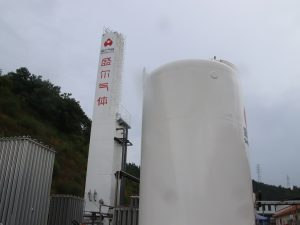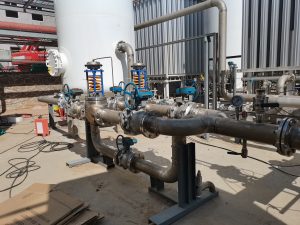
Cryogenic air separation is the dominant industrial method for producing high-purity oxygen, nitrogen, and argon by liquefying and distilling atmospheric air. In this process, ambient air (≈78% N₂, 21% O₂, 1% Ar) is first compressed and purified, then cooled to cryogenic temperatures so its components condense. Fractional distillation exploits the different boiling points – nitrogen boils at –196 °C and oxygen at –183 °C (argon –186 °C) – to separate them. A modern air separation unit (ASU) typically compresses air to about 5–10 bar by multistage turbo-compressors with intercoolers. Impurities (moisture, CO₂, hydrocarbons) are removed in molecular sieve beds at near-ambient temperature to prevent freezing in the cold box. The purified air then enters a multi-stream cryogenic heat exchanger where it is progressively cooled (often using plate-fin heat exchangers) by exchanging heat with returning product streams and by expansion through turbo-expanders or Joule–Thomson valves. Part of the feed is expanded in an expander to produce the refrigeration needed to reach about –170 °C.
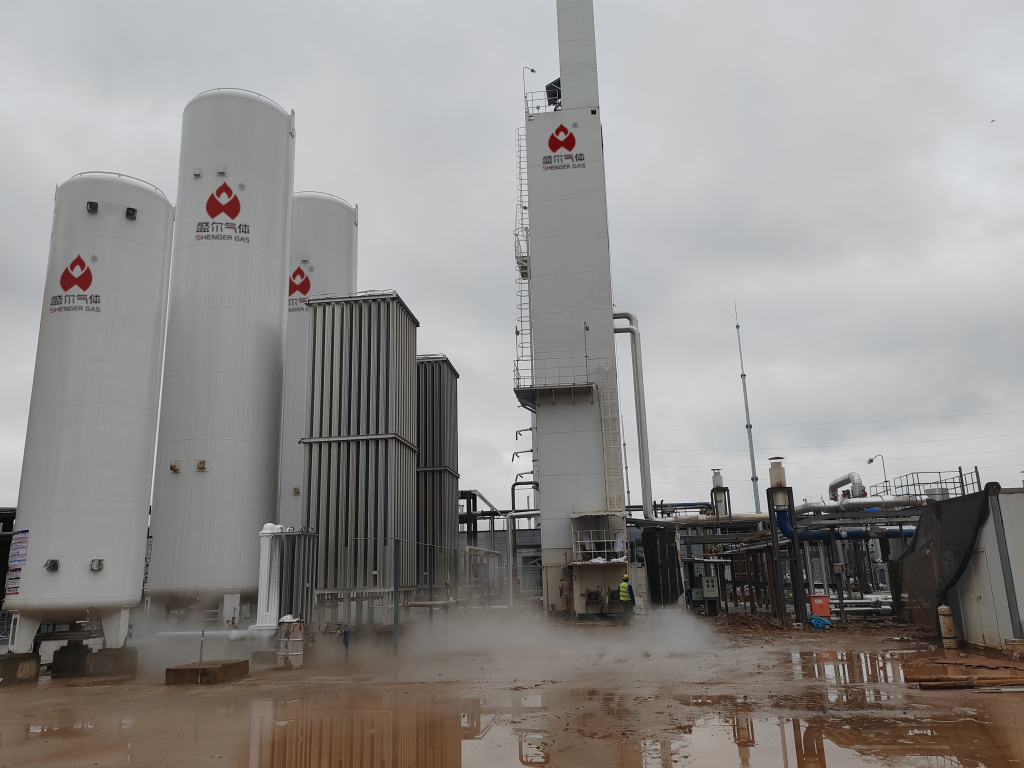
Once liquefied, the cold mixture of liquid and vapor is fed into distillation columns. In a typical double-column ASU, a high-pressure (HP) column operates at ~5–6 bar, and a low-pressure (LP) column at ~1.2–1.4 bar. In the HP column, rising nitrogen vapor leaves at the top while oxygen-rich liquid collects at the bottom. The HP column’s overhead nitrogen is partly condensed (often by an internal condenser/reboiler linking to the LP column) and returned as reflux, while its oxygen-rich liquid is transferred to the LP column. In the LP column, this liquid boils, enriching oxygen at the sump and yielding additional nitrogen vapor at the top. A side draw of oxygen-rich liquid can be routed to a third argon column if argon recovery is required (argon’s boiling point lies between O₂ and N₂). The argon column produces ~98–99% pure argon, with residual oxygen returned to the LP column.
Typical product purities are very high: cryogenic ASUs routinely achieve O₂ purity in the 99.5–99.9% range and N₂ purity of 99.9% or higher. (For example, liquid O₂ from the LP column is ~99.8–99.9% pure in large plants.) When electronics or specialty gases are needed, even higher purities (99.999%+) can be attained by additional stages. All product streams – gaseous nitrogen, gaseous (or liquefied) oxygen, and possibly liquefied argon – are then warmed in the exchanger to ambient conditions before use.
| Operating Parameter | Typical Value/Range |
|---|---|
| Feed air composition (dry) | N₂ ~78%, O₂ ~21%, Ar ~1% |
| Feed air pressure after compression | ~5–10 bar (gauge) |
| High-pressure column pressure | ~5.0–6.0 bar (abs) |
| Low-pressure column pressure | ~1.2–1.4 bar (abs) |
| N₂ boiling point (at 1 atm) | –196 °C |
| O₂ boiling point (at 1 atm) | –183 °C |
| Column top temperature (N₂ condensing) | ~–185 °C to –193 °C (at operating pressure) |
| Column bottom temperature (O₂ boiling) | ~–180 °C (approx. O₂ boiling) |
| Oxygen product purity | 95–99.9% (typ. 99.5–99.9%) |
| Nitrogen product purity | ~99.5–99.999% (typically 99.9%+) |
| Argon product purity (if recovered) | ~98–99% (one column) or up to 99.9% (multi-column) |
| Specific energy consumption | ~250–500 kWh/ton O₂ (modern plants) |
| Typical plant O₂ capacity | 50–5000 tons/day (single train; see text) |
Energy Efficiency in Cryogenic Air Separation. Cryogenic distillation is inherently energy-intensive: the ideal reversible work to separate oxygen from air is only about 51 kWh per ton of O₂, but practical ASUs consume roughly 5–10× that. Modern large ASUs typically use ~0.3–0.4 kWh per normal m³ of O₂ (~250–300 kWh/ton). Smaller or older units may be as high as 0.5–0.6 kWh/Nm³ (~400–500 kWh/ton). A 1000‑ton/day O₂ plant often draws on the order of 20–25 MW electric power. This energy is expended in compressors, cooling (via expanders and heat loss), and internal compression of product streams. Equipment design — including multi-stream plate-fin heat exchangers, efficient turbo-expanders, and column packing — aims to minimize refrigeration duty and pressure drops. For example, using structured packing in columns can significantly lower pressure drop and power use compared to traditional trays. Internal liquid pumps (“cryopumps”) often boost oxygen or nitrogen for product pressurization, recovering some energy and aiding column reflux. Despite optimization, the overall exergetic efficiency remains modest: typical ASUs operate at only about 10–20% of the theoretical ideal (51 kWh/ton).
Design Principles of Cryogenic Air Separation: A cryogenic ASU is a tightly integrated system. Key components include multi-stage compressors, knock-out pots/direct-contact coolers, twin coldbox heat exchangers, and twin distillation columns (plus argon column if needed). Engineers must balance pressure levels, reflux ratios, and heat exchanger approach temperatures to meet purity and recovery targets with minimum power. Higher column pressures can raise throughput and recovery but increase compression work, while lower pressures reduce refrigeration needs. Efficient heat exchanger design (often with brazed aluminum plate-fin units) is crucial; ΔT’s of only 1–2 K between hot and cold streams are typical. Insulation and vacuum-jacketed piping prevent heat ingress. Material selection emphasizes high-alloy steels resistant to oxygen embrittlement and leak-tight seals to handle cryogenic liquids. Safety is paramount: all components exposed to oxygen-enriched streams must be cleaned and compatible to avoid fire hazards. Instruments and controls monitor composition and temperature; advanced control strategies allow smooth startup/shutdown and load-following by adjusting reflux and feed split. Modularity is common for large plants: multiple parallel “trains” (e.g. two 1000‑ton/day units instead of one 2000‑ton/day) provide redundancy and operational flexibility.
Cryogenic ASUs are built in various configurations. Single-column designs (with internal reflux condenser) exist for small (∼50–200 tons/day O₂) skid-mounted plants, but larger installations almost always use double-column units. A typical double-column ASU (no argon column) supplies O₂ from the bottom of the LP column (as liquid or pumped liquid, ~99.5–99.9% purity) and N₂ from the HP column top (as gas, >99.9% purity). If argon is recovered, a third column achieves ~98–99% Ar, often boosted to 99.9% by a fourth column. Modern innovations include using parallel expander stages, energy recovery turbines, and low-LMTD heat integration to push efficiency. Pinch-analysis and iterative flowsheet optimization help engineers approach the thermodynamic limits while ensuring robust operation.
Industrial applications: The primary outputs — high-purity oxygen and nitrogen — serve critical roles across heavy industry. In the U.S. steel sector, cryogenic O₂ injectors replace air in blast and basic oxygen furnaces, raising flame temperature, accelerating reactions, and reducing fuel use. Nitrogen from ASUs is used for inerting, purging, and secondary metallurgical processes. Petrochemical and refining plants rely on ASU oxygen for partial oxidation, gasification, and furnace combustion, improving efficiency and lowering emissions. High-purity ASU nitrogen (99.9%+) is used to blanket reactors, pressurize pipelines, and meet the ultra-dry N₂ requirements of ammonia synthesis or LNG production. The glass and electronics industries demand ultra-clean N₂ and argon; for example, semiconductor fabs use cryogenic ASUs to supply 99.999% N₂ for wafer processing and rare gases (Ar, Kr, Xe) for lithography and plasma etching. Medical and environmental applications (e.g. lab-grade O₂, water treatment oxygenation) also source oxygen from large ASUs.
In summary, the cryogenic air separation process explained for industrial oxygen and nitrogen production is a mature yet sophisticated technology. It exploits simple thermodynamics in a highly engineered process: compressing, purifying, cooling, and distilling air at low temperature. Designers must integrate multistage compression, high-efficiency heat exchangers, and multicolumn distillation to maximize purity and recovery while minimizing energy. Typical operating pressures (≈6 bar and 1.3 bar) and temperatures (–196 °C to –183 °C) are governed by the boiling points of the gases. Resulting products are extremely pure (often ≥99.5% O₂, ≥99.9% N₂) and meet the stringent demands of industries like steelmaking, chemicals, and electronics. Despite its energy intensity (hundreds of kWh per ton of O₂), cryogenic air separation remains indispensable for large-scale gas supply. Ongoing advances in heat exchanger design, control strategies, and integration (e.g. combining ASUs with renewable power) continue to improve the efficiency and flexibility of this fundamental process.