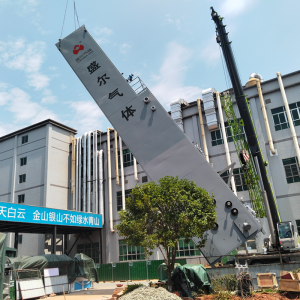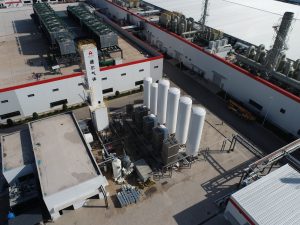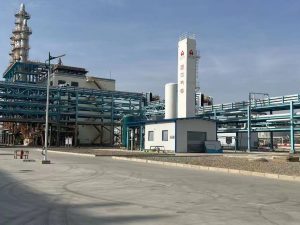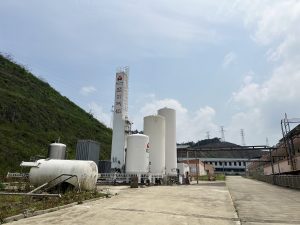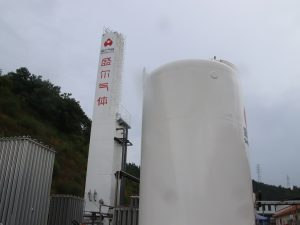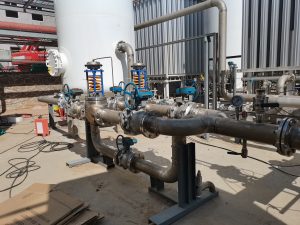
Cryogenic Air Separation for Industrial Oxygen Production is a well-established technique for generating large quantities of high-purity oxygen from atmospheric air. The process involves compressing ambient air, removing impurities, and cooling the air below its liquefaction point in a cryogenic heat exchanger. The chilled air mixture is then fed into distillation columns, where components separate by boiling point. This yields a pure oxygen product (typically ≥99.0% purity) as well as co-produced nitrogen and argon.
Process Principles
The core principle of cryogenic separation is fractional distillation under low-temperature conditions. Air components (78% N₂, 21% O₂, 0.9% Ar) have distinct boiling points (N₂ −196°C, O₂ −183°C, Ar −186°C). Compressed air is cooled to around −170°C to −185°C to partially liquefy it. The feed is split into liquid and vapor streams and fed to distillation columns. Typically a dual-column cascade is used: a high-pressure (HP) column (∼5–6 bar) and a low-pressure (LP) column (∼1.2–1.3 bar). The columns are thermally linked so that condensing nitrogen in one column provides reboil for oxygen in the other, maximizing efficiency.
In practice, most impurities (water, CO₂) are removed from the compressed air before cryogenic cooling. Moisture and carbon dioxide freeze at low temperature, so the air is passed through molecular sieves or cold traps at room temperature to remove them. The purified air is then precooled by exchanging heat with the returning cryogenic products in a plate-fin heat exchanger (cold box). A portion of the high-pressure air is expanded through a turbo-expander to provide refrigeration, bringing part of the stream to about –170°C or colder.
Distillation Columns
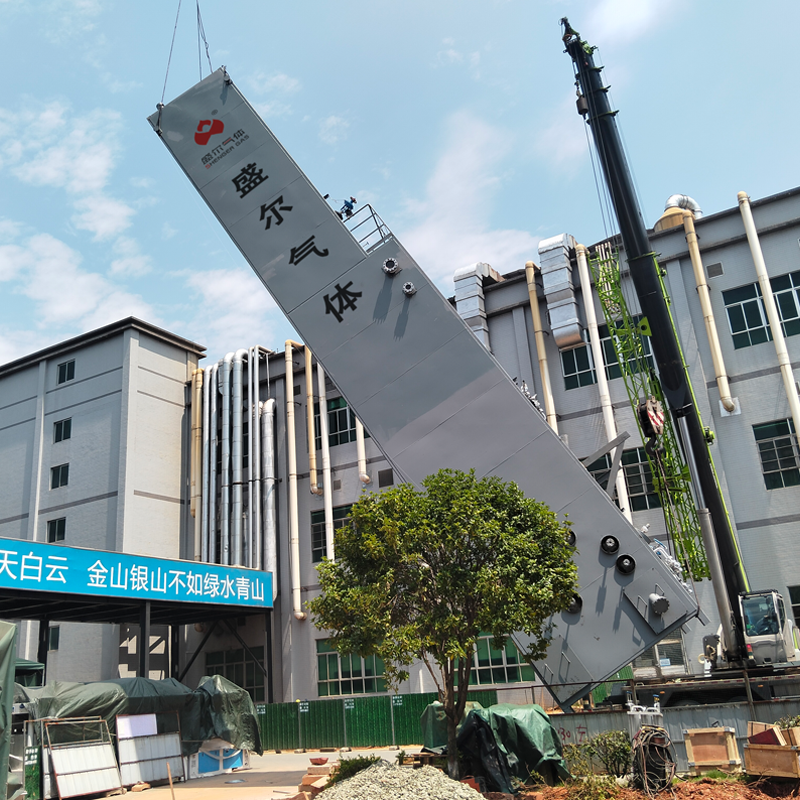
In Cryogenic Air Separation for Industrial Oxygen Production, two distillation columns operate in series: a high-pressure column and a low-pressure column. In the high-pressure column (∼5–6 bar absolute), the partially liquefied feed flows downward. Nitrogen (with the lower boiling point) preferentially vaporizes and rises to the top, while the oxygen-enriched liquid collects at the bottom. The top product is nearly pure nitrogen vapor (∼99.9% N₂), and its condenser provides reflux for the low-pressure column. The bottom liquid (∼40–60% O₂) is pumped to the LP column.
The low-pressure column (∼1.2 bar) receives the oxygen-rich liquid from the HP column. Here the remaining nitrogen is boiled off overhead (achieving ~99.999% N₂ purity), and the bottom of the LP column produces a high-purity liquid oxygen product (typically 95–99.5% O₂, depending on design). The reflux of liquid oxygen is returned to the LP column. This dual-column configuration (with the HP condenser acting as the LP reboiler) achieves very high oxygen recovery and purity.
If argon is recovered, a side draw from the middle of the LP column (where argon concentration is highest) feeds an auxiliary argon column. Crude argon (~97% Ar) is then refined (often via catalytic hydrogenation or tall-column distillation) to >99.99% Ar. If argon is not extracted, about 0.9% of the feed (argon) remains mixed in the oxygen product.
Key Process Steps
- Compression and Purification: Ambient air is compressed to ~5–7 bar (gauge) in multistage compressors with intercooling. The compressed air is filtered and passed through molecular sieve beds to remove moisture (H₂O) and carbon dioxide (CO₂).
- Heat Exchange (Cold Box): The purified air is cooled in a brazed-plate heat exchanger (cold box) by counter-flow against the outgoing cold product streams. Large turbo-expanders are used to reduce a portion of the air pressure, providing refrigeration down to approximately –175°C.
- High-Pressure Distillation (HP Column): Partially liquefied air enters the HP column (∼5–6 bar). Nitrogen-rich vapor leaves the top; oxygen-rich liquid leaves the bottom.
- Low-Pressure Distillation (LP Column): The oxygen-rich liquid from the HP column feeds the LP column (∼1.2–1.3 bar). The remaining nitrogen is removed overhead; high-purity liquid oxygen is produced at the bottom.
- Argon Recovery (Optional): A side-draw from the LP column at the argon-rich section feeds an argon column, producing crude argon (~97% Ar), which can be refined to >99.99%.
- Product Handling: Liquid oxygen (LOX) is typically pumped and vaporized for delivery as high-pressure gas or stored as a liquid. Nitrogen is delivered as gas (or liquid nitrogen, LIN) by vaporizing the liquid stream. Argon (if produced) is stored as liquid or pressurized gas.
Performance and Efficiency
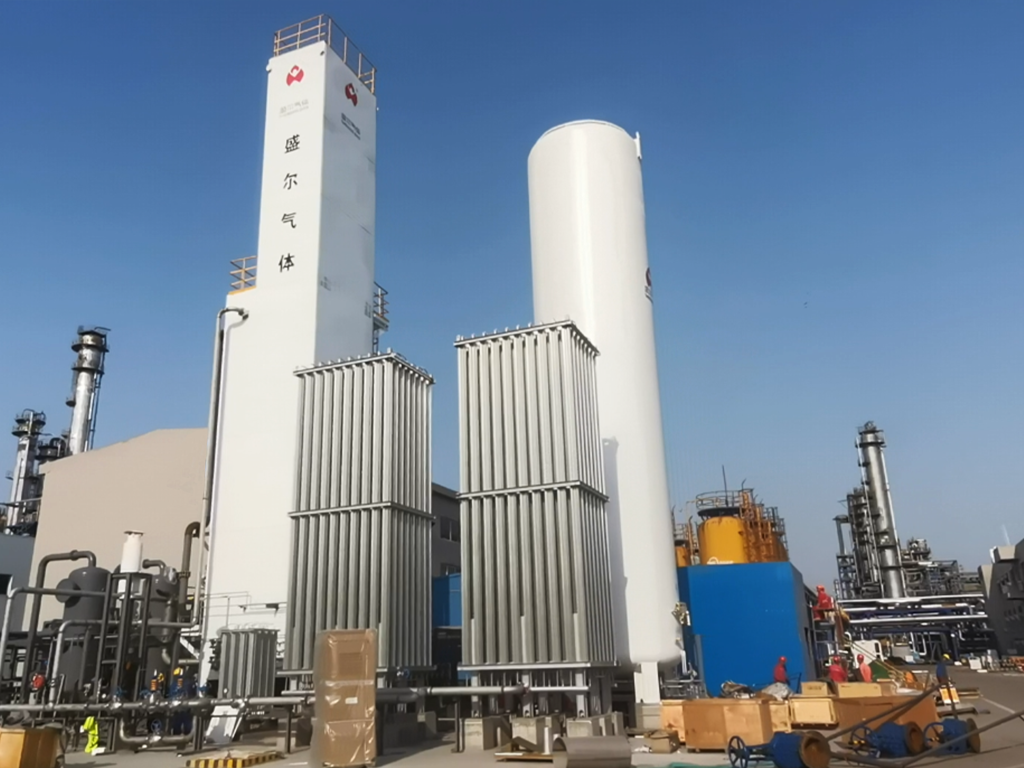
Cryogenic air separation units (ASUs) dedicated to oxygen production achieve very high purity and recovery in continuous operation. Cryogenic air separation units (ASUs) dedicated to oxygen production achieve very high purity and recovery. The O₂ product is usually ≥99.0% pure (often 99.5% or higher for industrial-grade oxygen). Co-produced nitrogen and argon also reach high purities (about 99.9% N₂ and ~97% Ar after the column). Typical oxygen recovery (ratio of O₂ product to O₂ in feed air) can exceed 90% in well-optimized units.
Cryogenic Air Separation for Industrial Oxygen Production is energy-intensive: large-scale ASUs typically require on the order of 150–250 kWh of electricity per tonne of O₂ produced. Actual energy use depends on factors like column pressure ratio, product purities, and heat exchanger efficiency. The ideal thermodynamic minimum energy for separating oxygen is on the order of 40–50 kWh/tonne O₂, so real plants operate at roughly 3–5 times the theoretical minimum. Modern designs minimize losses with efficient turbomachinery and integrated heat exchangers.
For example, Cryogenic Air Separation for Industrial Oxygen Production designs often incorporate multiple expansion turbines and high-effectiveness plate-fin exchangers to approach the thermodynamic limit. Process control tuning further improves efficiency: ASUs run at steady full load for best economy, with fine adjustments of reflux and purge flows to balance purity and power. Some modern units offer limited load-following to exploit off-peak or renewable power, but most operate continuously at near-design capacity for maximum efficiency.
| Parameter | Typical Value/Range |
|---|---|
| O₂ purity (product) | 95–99.5% (v/v) |
| N₂ purity (product) | 99.9–99.999% (v/v) |
| Argon purity (crude/final) | ∼97% (raw) → >99.99% |
| HP column pressure | ~5–6 bar (abs) |
| LP column pressure | ~1.2–1.3 bar (abs) |
| Cold box minimum temperature | ~–185 °C |
| Electricity use (per tonne O₂) | ~150–250 kWh/tonne O₂ |
| Production capacity (O₂) | ~100–3000 tonne/day |
For Cryogenic Air Separation for Industrial Oxygen Production, typical plant capacities range from tens to thousands of tonnes of O₂ per day. ASUs become economically attractive at large scale (often above ~200 tonne/day) because scale improves thermodynamic efficiency and product recovery. Very small-scale oxygen needs (<50 tonne/day) are often met by PSA or other methods because the capital and refrigeration of cryogenics are not justified.
Industrial Practice and Trends
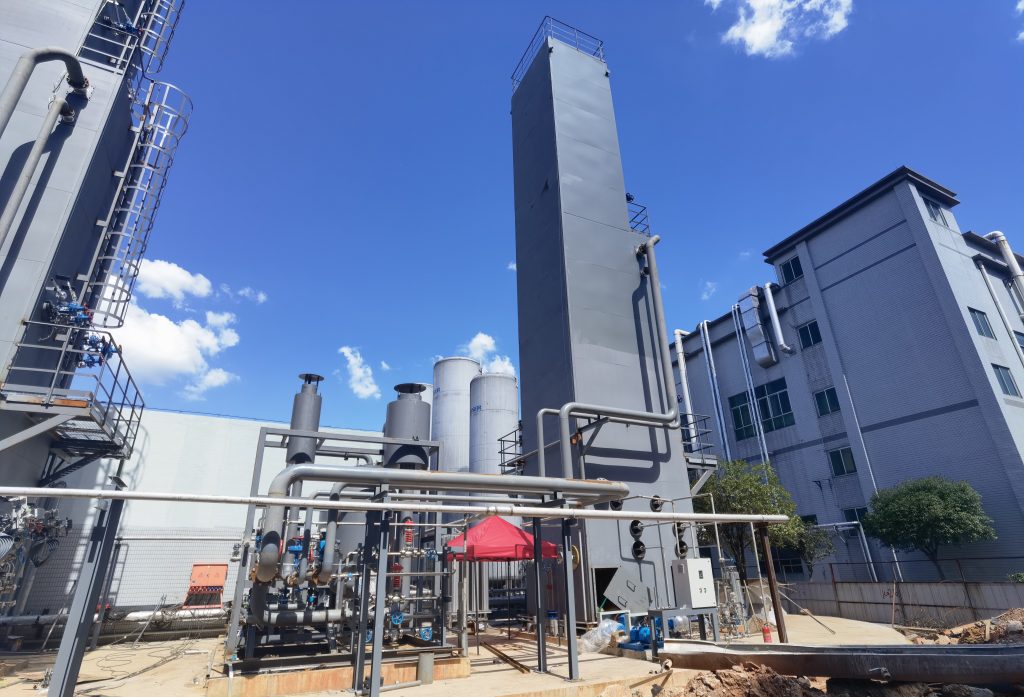
In Cryogenic Air Separation for Industrial Oxygen Production, major industrial gas companies (Linde, Air Liquide, Air Products, etc.) supply turnkey ASUs worldwide. Modern ASUs are packaged around modular cold boxes and controlled by advanced automation, with continuous uptime often >98%. General engineering trends include larger brazed-plate heat exchangers, multi-stage expanders, and high-efficiency electric drives for the compressors. In Cryogenic plants, some systems use parallel cold boxes or multiple distillation trains to boost capacity and redundancy.
There is ongoing interest in hybrid and flexible approaches. For example, combining membrane or VPSA pre-purification before liquefaction can reduce compressor power. Flexible operation of ASUs to match renewable electricity availability is also being explored. However, for very high-volume or ultra-pure oxygen (≥99.5%), cryogenic air separation remains the default industrial solution for bulk O₂ supply.
Advantages and Challenges
Cryogenic Air Separation for Industrial Oxygen Production can produce extremely pure oxygen (≥99.5% purity) in very large quantities, while simultaneously yielding high-purity nitrogen and argon as co-products. The technology is mature and reliable; modern ASUs routinely achieve ≥98–99% uptime in continuous service. This reliability, high purity, and scale make cryogenic ASUs ideal for demanding industrial gas supply.
For Cryogenic Air Separation for Industrial Oxygen Production, the equipment and energy demands are substantial. Very large multistage compressors, brazed-plate heat exchangers, and turbo-expanders are required, and electrical power consumption is high (typically 150–250 kWh per tonne of O₂). Capital cost is also significant (on the order of several hundred dollars per tonne-per-day of O₂ capacity). Consequently, cryogenic ASUs are generally not economical at small scales (below ~50–100 tpd) or for intermittent operation without storage. Nonetheless, for continuous high-demand oxygen production, Cryogenic Air Separation for Industrial Oxygen Production remains the preferred solution, as the advantages of high-volume, high-purity output usually outweigh these costs.
Conclusion
Cryogenic Air Separation for Industrial Oxygen Production is a well-established, high-throughput process for extracting oxygen from air. Modern ASUs compress and purify air, then distill it at cryogenic temperatures to yield large flows of high-purity oxygen (hundreds of tonnes per day at ≥99% purity). Despite the substantial energy and capital investment, cryogenic ASUs remain the reference method for large-scale oxygen supply. As demand for ultra-pure industrial gases grows, optimized cryogenic separation continues to play a key role in meeting that demand efficiently.