Introduction
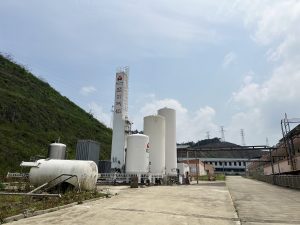
Industrial oxygen is not a specialty chemical; it is infrastructure. Steelmakers use it to intensify decarburization, gasifiers use it to control syngas chemistry, and many oxidation routes depend on it for yield and selectivity. When the required flow is continuous and high—hundreds to tens of thousands of normal cubic meters per hour—the most established route is Cryogenic Air Separation for Oxygen Production. The method is mature, but it remains technically demanding because its efficiency and stability are set by integration details: pressure ratios, heat-exchanger approaches, pressure drops, and column control margins.
For researchers and plant engineers, a cryogenic air separation unit (ASU) is best understood as a coupled system. Compression work, refrigeration generation, heat recovery, and rectification must remain in balance under real disturbances such as ambient swings, feed quality changes, and plant turndown. This article follows the physical process from ambient air to oxygen product, then focuses on efficiency drivers, operating windows, and the application boundaries that keep Cryogenic Air Separation for Oxygen Production central to industrial supply.
Process Blocks: Intake, Compression, and Air Purification
A modern ASU begins with filtration at the air intake and multi-stage compression with intercooling. Intercoolers reduce discharge temperature, limit moisture carryover, and lower compressor work for a given pressure ratio. After compression, the air passes through a pre-purification unit (often a molecular sieve system) that removes water vapor and carbon dioxide. This step is essential: H₂O and CO₂ would freeze in the cold box and progressively block flow channels in the main heat exchanger.
In Cryogenic Air Separation for Oxygen Production, purification quality directly affects reliability. Engineers typically track adsorber switching behavior, breakthrough margins, and pressure-drop trends, because small degradations in the pre-purification unit can translate into outsized risk once the process reaches cryogenic temperature.
Cold Box and Refrigeration in Cryogenic Air Separation for Oxygen Production
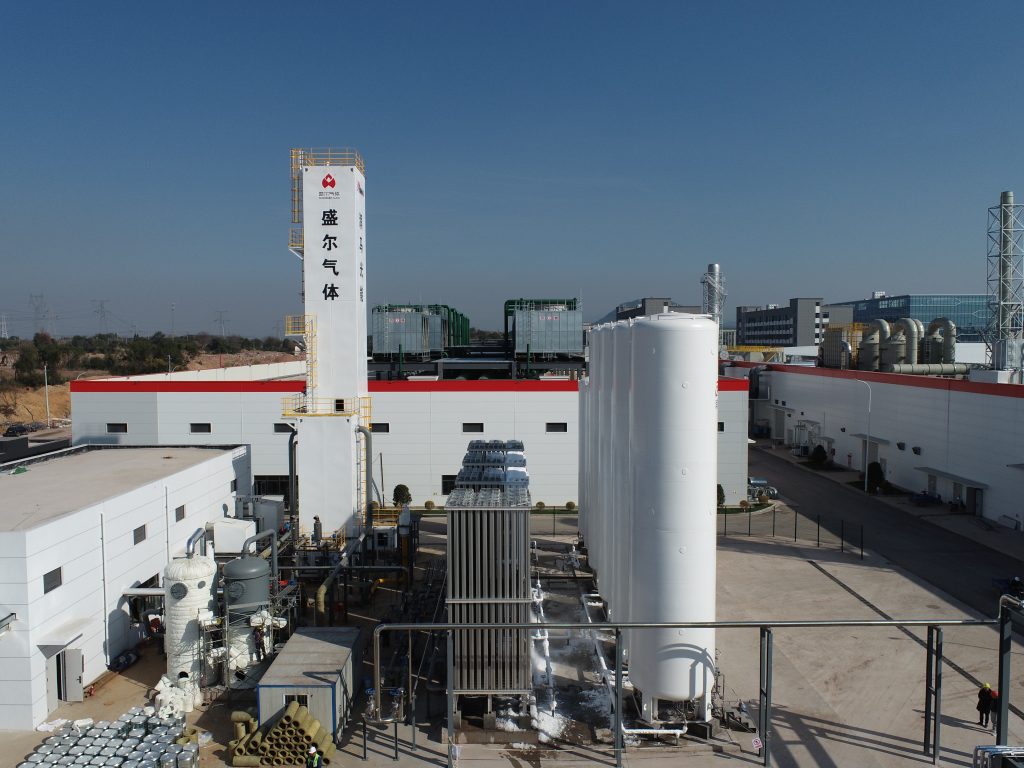
Purified air enters the main heat exchanger, most often a brazed aluminum plate-fin exchanger, where it is cooled by counter-current exchange with cold returning streams. Refrigeration is generated internally using expansion turbines. A portion of the high-pressure stream is expanded to produce low-temperature gas while recovering shaft work; this cold stream helps close the plant’s refrigeration balance. As temperature decreases, part of the feed condenses and becomes a two-phase mixture.
At this point, Cryogenic Air Separation for Oxygen Production becomes a controlled phase-equilibrium problem. Heat-exchanger approach temperature, pressure drop, and flow distribution determine how much liquid is available for rectification and how stable the column system will remain during load changes and ambient swings.
Distillation System: Double Column Heat Integration
Most industrial oxygen plants use a thermally coupled double-column scheme: a high-pressure (HP) column and a low-pressure (LP) column linked through a condenser–reboiler. Partially liquefied feed enters the HP column and separates into nitrogen-enriched vapor and oxygen-enriched liquid. The nitrogen overhead from the HP column condenses in the condenser–reboiler, releasing latent heat that provides boil-up for the LP column. This heat coupling is a defining feature of Cryogenic Air Separation for Oxygen Production because it converts a refrigeration problem into an internally balanced distillation system.
The LP column performs final rectification. Oxygen is withdrawn near the bottom as liquid oxygen (LOX) or as gaseous oxygen (GOX) after warming through the main heat exchanger. Nitrogen is withdrawn from the top as product or used as waste to maintain the cold balance. If argon recovery is required, side-draw configurations and dedicated argon columns can be added; these raise complexity and can add power, so argon schemes are typically justified by site economics rather than by oxygen purity targets alone.
Oxygen Delivery Modes: GOX, LOX, and Pressurized Supply
The oxygen supply specification shapes both equipment selection and the energy profile. Pipeline GOX supply is common for integrated industrial sites, while LOX production supports merchant distribution and provides buffering during short operational upsets. For elevated delivery pressures, oxygen can be compressed as warm gas, or LOX can be pumped to pressure and vaporized. LOX pumping often reduces energy demand for large pressure ratios, but it shifts design attention toward cryogenic pumping reliability, vaporizer thermal performance, and liquid handling safety.
Because delivery mode changes compressor duty, refrigeration balance, and operating constraints, it is best treated as part of the overall ASU process design rather than as a downstream add-on.
Efficiency in Cryogenic Air Separation for Oxygen Production
Electrical consumption is dominated by air compression. Refrigeration is generated through expansion and cold recovery, but the “cost” of cold still appears in pressure ratios and irreversibilities across valves, exchangers, and column internals. The most useful benchmarking metric is specific power consumption (kWh per Nm³ of oxygen), interpreted together with oxygen purity and product pressure.
In practice, efficiency improvements come from measurable engineering levers: compressor polytropic efficiency and staging, expander isentropic efficiency, main heat exchanger approach temperature, and cold-box pressure drops. Column pressures are a strategic choice: increasing HP column pressure strengthens the condenser–reboiler driving force but raises compressor work; lowering LP column pressure can improve separation but increases volumetric flow and pressure drop. Good designs balance these competing effects and retain headroom for seasonal conditions and site-specific transients.
A practical way to analyze Cryogenic Air Separation for Oxygen Production is to separate performance into three layers: (1) compression power, (2) cold-box losses (pressure drop plus exchanger approach), and (3) separation duty (reflux and column efficiency). Improvements in only one layer often deliver limited net benefit because constraints shift elsewhere.
Typical Operating Windows
The table below summarizes representative ranges commonly used in industrial design, commissioning targets, and performance screening. Actual values vary with capacity, ambient conditions, and whether nitrogen and argon are co-produced as valuable products.
Table 1. Representative operating ranges for industrial cryogenic oxygen ASUs
| Parameter | Typical range | Notes |
|---|---|---|
| Oxygen purity (vol%) | 99.5–99.8 | Higher purity feasible with design trade-offs |
| Oxygen capacity | 500–120,000 Nm³/h | Larger units typically show lower specific power |
| Specific power (kWh/Nm³ O₂) | 0.38–0.55 | Depends on product pressure and co-products |
| HP column pressure | 5.0–6.5 bar(a) | Chosen for heat coupling vs compressor work |
| LP column pressure | 1.1–1.4 bar(a) | Influenced by pressure drops and withdrawal points |
| Main heat exchanger ΔTmin | 1.5–4.0 K | Lower ΔT improves efficiency but increases exchanger size |
| Expander isentropic efficiency | 75–88% | Sensitive to operating point and maintenance |
| Typical annual uptime | 8,000–8,500 h | Base-load ASUs target high availability |
These figures are not theoretical best cases; they reflect what well-designed and well-maintained plants can sustain in continuous service. They also clarify why long-run monitoring matters: performance drift is often driven by gradual fouling, valve leakage, adsorbent aging, or instrumentation bias rather than by dramatic failures.
Operability, Safety, and Long-Run Stability
Cryogenic oxygen systems are sensitive to contamination. Trace hydrocarbons or lubricant aerosols can concentrate in oxygen-enriched zones, so air-quality management, filtration, and pre-purification performance monitoring are not optional. From an operational perspective, stability is achieved through conservative startup and cooldown procedures, tight level and pressure control in columns, and clear limits on abnormal temperature or impurity signals.
Turndown behavior is another practical constraint. At low load, columns approach flooding or weeping limits, and exchanger maldistribution becomes more likely. Well-tuned control systems prioritize separation margin over aggressive energy trimming, because forced reflux to maintain purity can silently increase power. These realities help explain why many sites operate Cryogenic Air Separation for Oxygen Production as a steady-state utility: the economics are strongest when utilization is high and the plant is allowed to remain close to its design point.
Applications and Why Cryogenic Still Dominates at Scale
Steelmaking remains the flagship application, but cryogenic oxygen is equally critical in gasification, synthetic fuels, non-ferrous metallurgy, and large oxidation chemistry. In these systems, oxygen quality consistency and supply stability reduce downstream variability—often improving plant economics more than a small change in nominal purity.
The technology also offers system-level advantages. Co-produced nitrogen can be used for inerting, blanketing, or purge services, and liquid storage can buffer short disruptions. For many integrated sites, these integration benefits reinforce the role of Cryogenic Air Separation for Oxygen Production even when alternative oxygen technologies look attractive on a narrow capital-cost comparison.
Conclusion
Cryogenic separation remains the reference method for high-flow, high-reliability oxygen supply. The process chain—compression, pre-purification, heat exchange, expansion refrigeration, and double-column distillation—creates multiple efficiency levers, but performance depends on how well those levers are integrated and controlled over long operating periods. When evaluated on specific power, operability, uptime, and integration value, Cryogenic Air Separation for Oxygen Production continues to define the practical benchmark for large industrial oxygen systems.