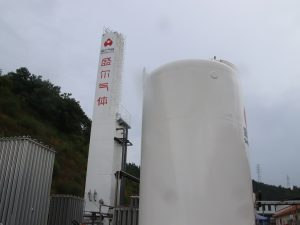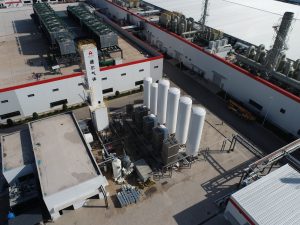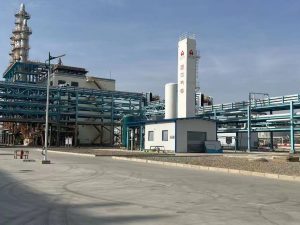
Industrial sites that require large, continuous streams of nitrogen and oxygen with repeatable purity control typically converge on a single mature solution: Cryogenic Air Separation for Nitrogen and Oxygen Production. The cryogenic route is not chosen because it is simple; it is chosen because it scales, supports multi-product slates, and remains stable over long campaigns when design and operations protect the system margins that matter.
This article is written for researchers and plant engineers. It follows the physical path from ambient air to gaseous products, explains the coupled refrigeration–distillation logic inside the cold box, and summarizes efficiency drivers, control boundaries, and integrity considerations.
Process overview
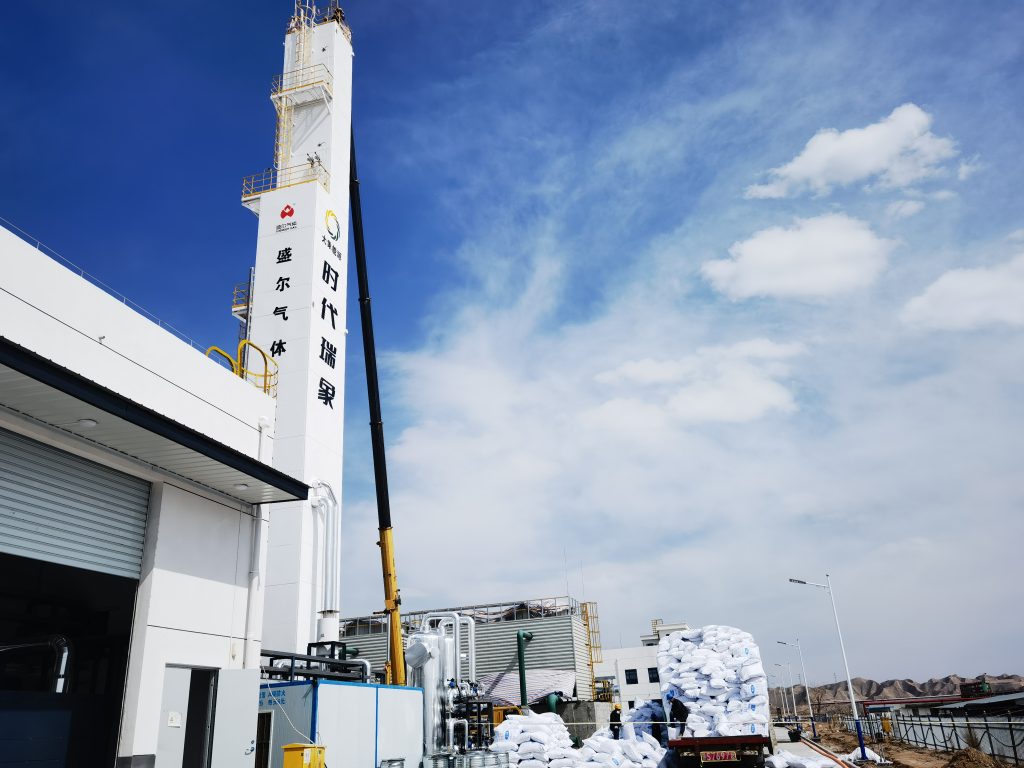
A modern ASU is best understood as five coupled blocks: (1) air compression, (2) pretreatment in a pre-purification unit (PPU), (3) cryogenic cooling in the main heat exchanger, (4) rectification in the distillation columns, and (5) product conditioning (warming, compression, storage, and delivery). In Cryogenic Air Separation for Nitrogen and Oxygen Production, these blocks act as one thermodynamic system, so a change in one block (for example, higher pressure drop or weaker pretreatment) often appears later as purity drift, higher specific power, or a narrower turndown window.
Air compression and intercooling
Ambient air is filtered and compressed, commonly using multi-stage intercooled centrifugal or integrally geared machines. Compression is typically the largest power draw, so practical efficiency work often starts here: reducing inlet restriction, keeping intercoolers clean, and minimizing downstream pressure losses through piping, filters, and the PPU. Discharge temperature influences adsorbent loading and switching stability.
Pre-purification unit (PPU)
Before air enters the cold box, moisture and CO₂ must be removed, usually with molecular sieve adsorption. Without reliable removal, H₂O and CO₂ freeze at the cold end of the exchanger and can block passages or damage distribution. Trace hydrocarbons are managed with filtration, operating envelopes, and validated procedures, because oxygen-enriched zones are intolerant to uncontrolled hydrocarbon accumulation.
For Cryogenic Air Separation for Nitrogen and Oxygen Production, pretreatment is not an accessory; it is a primary reliability lever. Good practice is to treat dew point and CO₂ slip as trending variables, not just alarm thresholds. When exchanger margin starts shrinking, the earliest evidence is often subtle: approach temperatures tighten at unexpected locations, column pressure control becomes “busy,” or purity margin erodes during turndown.
Main heat exchanger and refrigeration generation
Clean air is cooled against returning waste and product streams in a brazed aluminum plate-fin main heat exchanger. Refrigeration is generated by a combination of turboexpansion (work extraction), throttling, and internal heat integration. Many designs expand a portion of higher-pressure air through a turboexpander to create cold.
In Cryogenic Air Separation for Nitrogen and Oxygen Production, refrigeration is created and consumed throughout the cold box, not in one isolated “refrigeration unit.” Expander flow split, subcooling, and whether products are taken as gas or liquid all reshape the exchanger temperature profile and the column reflux balance. This is why seemingly minor exchanger or valve changes can alter both power and stability.
Distillation system and separation mechanism
Separation is achieved by fractional distillation of liquefied air, exploiting the volatility difference between nitrogen and oxygen. Most industrial plants use a double-column arrangement: a high-pressure (HP) column coupled to a low-pressure (LP) column through a condenser–reboiler. HP overhead nitrogen condenses in the condenser–reboiler, providing boil-up for the LP column, while oxygen-enriched liquid from the HP column feeds the LP section for final purification.
The condenser–reboiler is the “hinge” of Cryogenic Air Separation for Nitrogen and Oxygen Production because it couples separation duty to refrigeration and pressure levels. If condenser duty falls (for example, due to reduced liquid inventory, exchanger pinch, expander upset, or pressure imbalance), the plant will often show purity drift before it shows an obvious mechanical fault. Keeping stable column pressures and liquid levels is therefore as important as any theoretical-stage calculation.
Typical design and operating ranges
The ranges below are representative of industrial practice. Actual values depend on altitude, ambient conditions, required product pressures, liquid co-product requirements, and configuration choices (single vs. multiple expanders, liquid pumping strategies, and so on). They are useful screening benchmarks when evaluating Cryogenic Air Separation for Nitrogen and Oxygen Production performance.
| Parameter | Typical range | Engineering implication |
|---|---|---|
| Feed air to cold box | 5–7 bar(a) | Sets HP column pressure and expander options |
| HP column pressure | 5–6 bar(a) | Higher pressure eases condensation but raises compression work |
| LP column pressure | 1.2–1.6 bar(a) | Influences oxygen boiling temperature and column ΔP |
| Gaseous N₂ purity | 99.9–99.999% | Higher purity increases reflux and/or stage requirement |
| Gaseous O₂ purity | 90–99.6% | Many steel uses ~90–95%; higher for some chemical routes |
| Main exchanger approach | 1–3 K | Lower approach reduces power but reduces fouling tolerance |
| Specific power (GOX basis, large plants) | ~0.40–0.70 kWh/Nm³ O₂ | Depends on configuration and co-product balance |
| Typical turndown (standard design) | 60–100% | Below this, hydraulics and heat balance can constrain purity |
Efficiency drivers that matter in practice
The biggest lever is still compression: compressor efficiency, intercooler approach temperatures, and total pressure drop through filters, the PPU, and cold-box piping. The next lever is irreversibility in refrigeration generation and heat exchange. For Cryogenic Air Separation for Nitrogen and Oxygen Production, expander efficiency and expander flow split often change both power and the ability to hold purity at low load, because they reshape cold-end temperatures and reflux availability.
Column performance is frequently misunderstood in troubleshooting. Many “stage” problems are really distribution or balance problems: liquid maldistribution in structured packing, drifting pressure measurements, valve leakage that changes reflux, or an exchanger pinch that quietly reduces subcooling. A useful operational method is constraint-based tuning: identify the active constraint (nitrogen purity, oxygen purity, product pressure, or liquid withdrawal), then adjust the variable that directly relaxes it (reflux, feed split, expander flow, or product draw strategy). This keeps adjustments predictable and avoids fighting loops.
Product conditioning and delivery choices
After separation, product streams are warmed in the main exchanger to near-ambient temperature. Nitrogen may be delivered as low-pressure GAN or compressed to high-pressure GN₂. Oxygen is often delivered as GOX to a plant header, compressed for process injection, or buffered in receivers to smooth demand fluctuations. If liquid products are produced, additional subcooling, storage, and vaporization equipment is integrated, and operating strategy must account for how liquid withdrawal changes internal refrigeration and reflux.
A key point in Cryogenic Air Separation for Nitrogen and Oxygen Production is that delivery pressure decisions echo upstream. In Cryogenic Air Separation for Nitrogen and Oxygen Production, a realistic pressure strategy is one that preserves separation margin first, then optimizes power. Raising distillation pressure to avoid downstream compression can increase total compression power and reduce column efficiency; compressing products downstream can preserve an efficient distillation window but adds rotating equipment and maintenance. The optimum depends on capacity, electricity price, and required turndown behavior.
Operating window, turndown, and control philosophy
Real plants must handle ambient variation and changing demand. Stable control typically prioritizes (1) column pressure balance, (2) exchanger approach and pinch behavior, and (3) liquid inventory in sumps and the condenser–reboiler. Advanced strategies coordinate compressor inlet guide vanes, expander nozzle control, and reflux management to preserve separation while minimizing power.
In Cryogenic Air Separation for Nitrogen and Oxygen Production, deep turndown is commonly limited by column hydraulics (low vapor traffic reduces mass transfer) and cold-box heat balance (returning streams no longer “fit” the exchanger temperature glide). When a project needs deeper turndown, designers often add flexibility in refrigeration paths or use liquid buffering and controlled vaporization so the columns are not forced to chase every short demand spike.
Safety, integrity, and maintenance
Oxygen-enriched regions require strict cleanliness and hydrocarbon control. Procedures for cooldown, warmup, and upset recovery should be designed to prevent trapping condensables in oxygen-rich zones, and operating envelopes should be validated against known hazards. Mechanical integrity focuses on rotating equipment, cryogenic valves, and pressure-drop monitoring.
For Cryogenic Air Separation for Nitrogen and Oxygen Production, most “sudden” performance losses are the end of a slow drift: exchanger fouling, adsorbent aging, small leaks, or declining expander efficiency. A maintenance strategy that works combines condition monitoring (vibration and bearing temperatures), adsorbent health checks, and routine review of exchanger pinch and column pressure differentials. Trending these variables turns many major upsets into manageable corrections.
Where cryogenic separation fits best
Cryogenic plants are usually justified when flows are large, operation is continuous, purity margins are tight, or multi-product value matters. They are also attractive when on-site generation reduces logistics risk compared with delivered liquids. PSA and membranes remain excellent solutions at smaller scales or lower purity targets, but they do not match the multi-product flexibility and high-purity capability of Cryogenic Air Separation for Nitrogen and Oxygen Production at industrial scale.
FAQ
Why can cryogenic plants be more economical at high capacity?
Distillation and heat integration benefit from scale, and co-production allows energy to be shared across nitrogen, oxygen, and liquids.
Why do purity issues sometimes appear after months of stable operation?
Slow drifts—PPU performance, exchanger pinch changes, valve leakage, or expander efficiency loss—gradually reduce margin until the active constraint is reached.
Is ultra-high nitrogen purity always worth the energy cost?
Only if the application needs it. Each extra “nine” of purity generally costs in reflux, stages, and power, so the optimum depends on the user process.
Conclusion
Cryogenic Air Separation for Nitrogen and Oxygen Production remains the industrial standard for high-volume, high-stability gas supply because it integrates proven unit operations into a controllable separation system. The best results come from protecting pretreatment quality, minimizing pressure drops, maintaining exchanger margin, and operating the columns with clear constraint awareness. For researchers and engineers, systems thinking—tracking margins across the cold box rather than tuning single devices—is the most reliable path to better power and more stable purity.