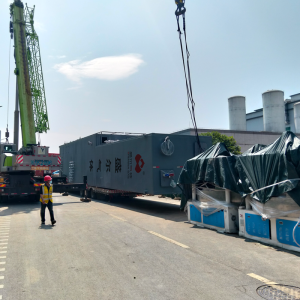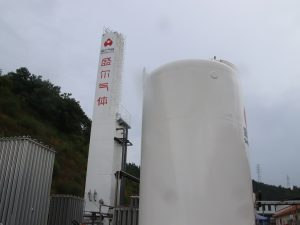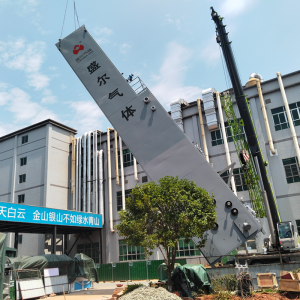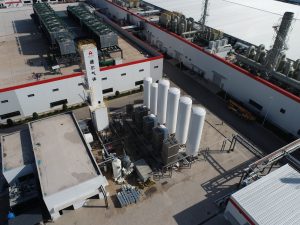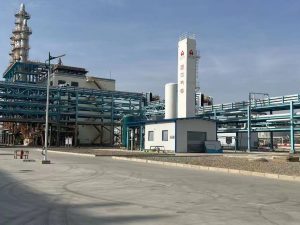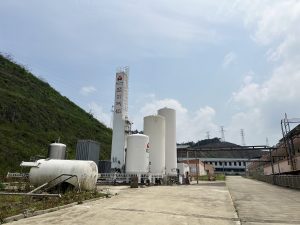
Cryogenic air separation oxygen production is the core technology used for industrial-scale generation of large volumes of pure oxygen and associated gases (such as nitrogen and argon). In a cryogenic air separation plant, atmospheric air is first filtered and compressed, then cooled in multi-stream heat exchangers until it liquefies. The partially liquefied air is fed into distillation columns that separate the components by their boiling points. This process yields high-purity oxygen (often 90–99.9% O₂) along with nitrogen (typically >99.9% purity) and, optionally, argon.
Large-scale ASUs typically produce hundreds to thousands of tons of oxygen per day. For example, plants with 1,000–5,000 tons per day capacity are in operation worldwide, serving steel mills, chemical complexes, and other industries. These air separation units usually run continuously (24/7) because the cryogenic distillation process demands steady operation. The principal process steps include the following:
- Air Compression: Ambient air is filtered (to remove dust and particulates) and compressed in multiple stages (typically with intercoolers) to the desired pressure (often 6–10 bar gauge). Inter-stage intercoolers remove heat and condense moisture. The compression step consumes the majority of the plant’s power input.
- Pre-purification: The high-pressure air then flows through molecular sieve adsorbers that remove water vapor, CO₂, and hydrocarbons. These impurities must be eliminated because they would freeze out during the cryogenic cooling step and clog equipment.
- Cryogenic Cooling: In cryogenic air separation oxygen production, the purified, compressed air is routed through the main cold-box heat exchanger, where it is progressively cooled by outgoing cryogenic streams. Expansion turbines (and/or Joule–Thomson valves) provide refrigeration to reach very low temperatures. As the air cools, part of it condenses into a liquid, yielding an oxygen-rich liquid stream and a nitrogen-rich vapor stream at the exchanger outlet.
- Distillation (Double Column): The cold feed enters the distillation block, comprising a high-pressure (HP) and a low-pressure (LP) column. In the HP column (∼5–7 bar abs.), nitrogen rises and leaves as nearly pure gaseous N₂ (top product, with only ppm oxygen). Oxygen and argon concentrate in the liquid, which is fed to the LP column (∼1.0–1.3 bar). In the LP column, remaining nitrogen is stripped overhead (high-purity N₂), and the bottom liquid is nearly pure oxygen (~99.5% O₂, with argon as the main impurity if not recovered).
- Argon Separation (Optional): If argon recovery is required, a vapor side-draw from the LP column (where argon content is highest) is fed to an argon column. This column yields crude argon (~98% purity) as the overhead product and returns liquid oxygen to the LP column. Recovering argon improves oxygen purity and provides a valuable by-product, but it increases energy use and requires a high reflux ratio.
- Product Recovery: The separated products are then warmed to near-ambient temperature in the main heat exchanger. Gaseous oxygen and nitrogen exit the cold box warm and dry. Liquid oxygen from the LP column is usually pumped to the required delivery pressure (via a cryogenic pump) and vaporized – pumping liquid is far more energy-efficient than compressing gas. Liquid nitrogen, if produced, is handled similarly. The remaining nitrogen-rich waste gas (with traces of O₂/Ar) is either vented or recycled (for example, to regenerate the molecular sieves).
These steps occur within a well-insulated “cold box” that houses the distillation columns and heat exchangers. A key feature is the integration of the HP and LP columns: the HP column’s top vapor condenses by boiling the LP column’s bottom liquid. This coupled condenser/reboiler provides reflux for both columns with very tight temperature approaches (often 1–2 K). The columns themselves are tall and packed or tray-equipped, with total stage counts often in the dozens. Overall, the plant design tightly integrates compressors, heat exchangers, columns, and expanders to achieve efficient cryogenic air separation.
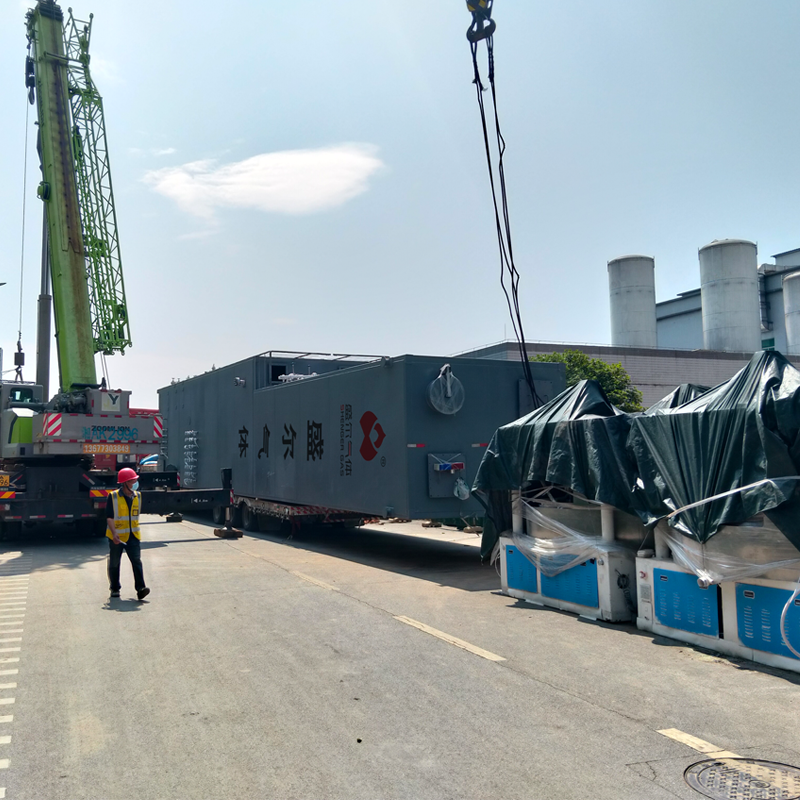
Design Considerations and Key Parameters
In cryogenic air separation oxygen production plants, several design parameters critically affect performance and cost:
- Operating Pressures: Large ASUs typically run the HP column at about 5–8 bar (abs) and the LP column near 1.0–1.3 bar. Higher HP pressure increases throughput but also raises compressor power. Designers balance these pressures to optimize capacity, purity, and efficiency.
- Oxygen Purity: Cryogenic units can produce oxygen from roughly 90% up to 99.9% purity. Higher purity requires additional column stages or higher reflux ratios (more liquid circulation), which increases energy use. Many industrial plants target ~93–99% O₂; ultrapure (99.9%) is used for specialty gas markets.
- Energy Consumption: Cryogenic air separation oxygen production is highly energy-intensive, so minimizing power usage is a key design goal. Modern large-scale ASUs often require around 170–250 kWh per ton of O₂ produced. Smaller or older plants may use 250–300+ kWh/t. The bulk of this energy goes into air compression and refrigeration. Minimizing pressure drops and tightening exchanger temperature differences helps reduce the power demand.
- Heat Exchangers: The main cold-box exchangers are usually multi-stream brazed aluminum or spiral-wound types designed for very low approach temperatures (1–3 K) between process streams. Multiple expanders (at different pressures) and intermediate cooling stages enable matching the refrigeration curve of the process. Efficient heat integration (like using turbine work to assist compression) is also important.
- Reflux Ratio and Stages: The number of theoretical stages (trays or structured packing) in each column and the reflux ratio determine separation performance. More stages or higher reflux improve oxygen recovery and purity but also increase energy per ton. State-of-the-art designs use high-efficiency structured packing to minimize column height and pressure drop while achieving the required separation.
- Argon Handling: If argon is recovered, the LP column has a side-draw feeding an argon column. This column produces crude argon (~98%) and returns liquid O₂ to the LP column. Including an argon column increases overall plant complexity and energy demand (due to high reflux), but it yields argon as a product and can slightly increase O₂ purity by removing argon from the oxygen stream.
- Product Pressurization: The delivery pressure of O₂ and N₂ depends on customer requirements. High-pressure oxygen (e.g. 5–10 bar) is typically supplied by pumping liquid oxygen to that pressure and then vaporizing it; this is far more efficient than compressing gas. If only low-pressure products are needed, the gas can be taken directly from the column. Designers size liquid pumps and any additional compressors based on these needs.
- Control Systems: Continuous operation requires precise process control. Modern ASUs use distributed control systems (DCS) with analyzers and automated valves. Controllers adjust compressor speed, expansion valve positions, and reflux flows to maintain setpoints. Reliable instrumentation (for flow, pressure, temperature, and O₂ purity) is essential for stable operation.
For reference, Table 1 compares typical values for key parameters in medium-scale and large-scale cryogenic air separation oxygen production plants:
| Parameter | Medium ASU (≈500 t/d O₂) | Large ASU (≈3,000 t/d O₂) |
|---|---|---|
| HP Column Pressure | 6–7 bar (abs) | 7–8 bar (abs) |
| LP Column Pressure | 1.0–1.2 bar | 1.0–1.3 bar |
| Oxygen Purity | ~99.5% (liquid O₂) | ~99.9% (liquid O₂) |
| Nitrogen Purity | >99.9% (gas N₂) | >99.99% (gas N₂) |
| Argon Recovery | ~98% | ~99% |
| Energy Consumption | ~300 kWh/ton O₂ | ~200 kWh/ton O₂ |
| O₂ Production Rate | ~500 ton/day | ~3,000 ton/day |
Key equipment includes multi-stage compressors, heat exchangers, cryogenic pumps, and the distillation columns themselves. The cold box is highly insulated (using vacuum jackets and perlite or multilayer insulation) to minimize heat ingress. All of these design choices are tailored to meet the required purity, flow rates, and energy targets of the plant.
Plant Operation and Control
Effective operation of a cryogenic air separation oxygen production plant requires maintaining stable conditions and well-designed controls. Key operational aspects include:
- Steady-State Operation: Cryogenic air separation oxygen production plants are run continuously at near-design conditions. They have limited turndown; reducing production below ~50–60% of design can cause the columns to flood or shut down. Start-up and shutdown are complex sequences involving gradual cooling, pressure balancing, and careful inventory management.
- Instrumentation and Safety: The plant is equipped with analyzers and sensors (for O₂ concentration, pressure, temperature, etc.) to monitor performance. Safety systems include pressure relief devices and materials compatibility measures, since high-purity oxygen environments have fire hazards. The cold-box and pipework are purged or leak-tested to prevent air ingress.
- Control Systems: In cryogenic air separation oxygen production plants, ASUs use advanced DCS control to regulate flows and columns. Controllers adjust compressor speed, expander valves, and reflux ratios to achieve target product purity. For example, if oxygen purity drifts, the control system will adjust column reflux. The DCS also manages molecular sieve regeneration cycles and interlocks.
- Maintenance: Routine maintenance includes servicing compressors, expanders, and heat exchangers. The molecular sieve beds undergo regular regeneration (often using waste nitrogen). During planned outages, the cold-box may be warmed and opened for cleaning of exchangers or removal of ice/oil. Well-planned maintenance is essential for reliable 24/7 operation.
Applications and Advantages
Cryogenic air separation oxygen production plants are used wherever very large oxygen flows or extremely high purity are required. Typical applications include steelmaking (basic oxygen furnaces), glass and electronics manufacturing, chemical synthesis (like ethylene oxide or hydrogen peroxide), gasification, and large-scale medical oxygen supply. The advantages of cryogenic ASUs include:
- High Purity & Recovery: Cryogenic air separation oxygen production plants achieve oxygen purities up to ~99.9% with very high recovery. This far exceeds what pressure-swing adsorption (PSA) or membrane generators can deliver at large scale.
- Large Capacity: Cryogenic units scale efficiently to very large outputs (hundreds to thousands of tons of O₂ per day). Economies of scale in compressors and exchangers reduce the specific energy consumption as plant size grows.
- Multiple Products: A single cryogenic plant can co-produce liquid oxygen, liquid nitrogen, and argon. Having multiple saleable products improves overall plant economics.
- Continuous Base-Load: Cryogenic air separation oxygen production plants are designed for uninterrupted operation, providing a stable 24/7 oxygen supply. Their steady demand can serve as a controllable base-load on the power grid.
- Efficient High-Pressure Supply: High-pressure oxygen is supplied by pumping and vaporizing liquid O₂. Pumping liquid oxygen to pressure (instead of compressing gas) greatly reduces energy use when delivering O₂ at pipeline pressures.
Conclusion
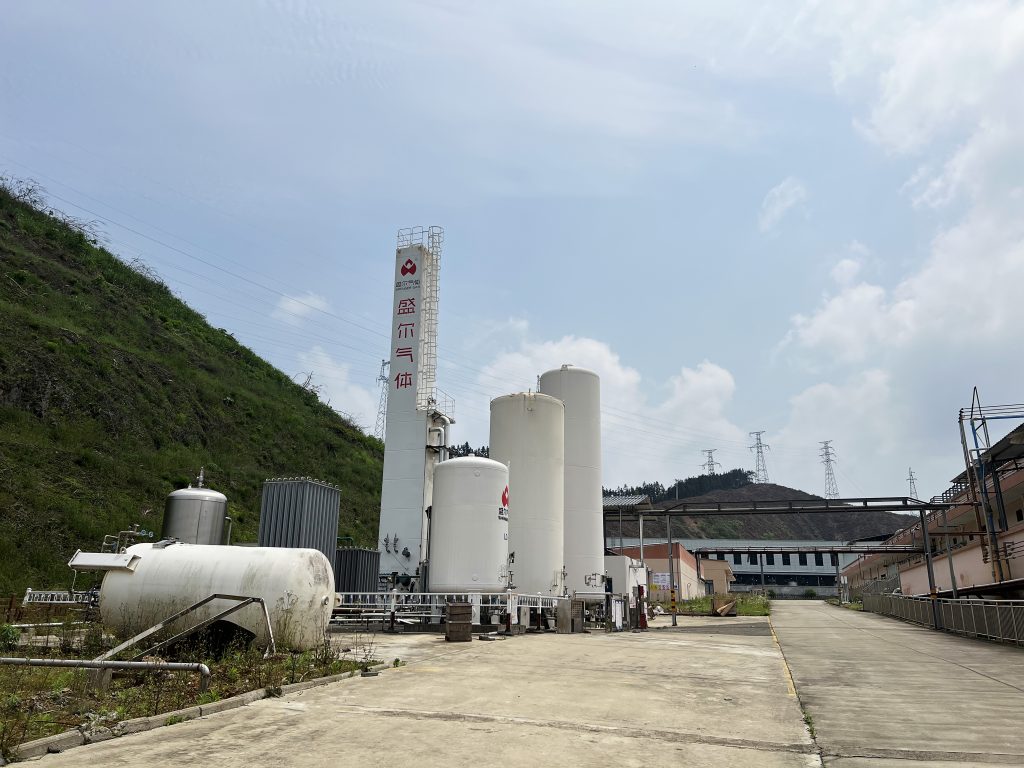
In summary, cryogenic air separation oxygen production is a mature and highly engineered process for meeting large-scale oxygen demands. By integrating multistage air compression, low-temperature refrigeration, and coupled distillation columns, ASUs continuously deliver ultra-pure oxygen (along with nitrogen and argon) to industry. Modern designs emphasize energy efficiency through advanced heat exchanger technology, efficient expanders, and optimized controls. Cryogenic ASUs remain the backbone of industrial oxygen supply for high-volume and high-purity applications, and ongoing innovations continue to enhance their performance and economic attractiveness. Cryogenic air separation oxygen production thus exemplifies a distillation-based process continually refined for efficiency and output. Cryogenic air separation oxygen production thus remains an essential industrial process for high-volume oxygen supply.