Introduction
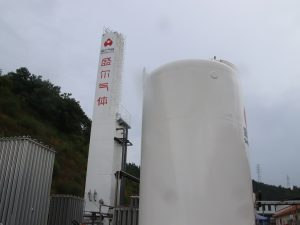
Cryogenic air separation oxygen production is widely used in industries that require large volumes of high-purity oxygen. This process leverages cryogenic distillation of air: atmospheric air is filtered, compressed, and progressively cooled until it liquefies so that oxygen can be separated from nitrogen and argon. Ambient air is first compressed through multi-stage centrifugal compressors with intercoolers, then purified to remove water and CO₂ to prevent freezing. The cleaned air is finally cooled to –170…–190 °C in highly efficient multi-stream heat exchangers (cold boxes), where fractional distillation in a cascade of columns separates oxygen, nitrogen, and argon. Oxygen is recovered as a liquid or vapor stream of typically 95–99.6% purity (up to 99.9% for specialty grades). In practice, cryogenic air separation oxygen production plants run continuously and reliably; at large scale they often operate above 90–99% uptime. For large-volume demands (hundreds of tons per day or more), cryogenic air separation oxygen production is the preferred method due to its efficiency and scalability. Indeed, this mature technology underpins the steady supply of industrial oxygen in steelmaking, chemicals, and other sectors worldwide. For decades, cryogenic air separation oxygen production has been refined to meet growing industrial needs for oxygen, nitrogen, and argon.
Process Overview
The cryogenic oxygen production process consists of several coordinated steps that enable continuous separation of air into oxygen, nitrogen, and argon:
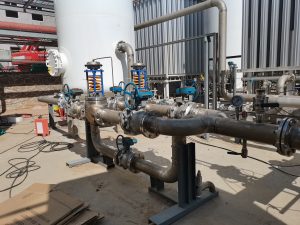
- Air Intake and Compression: Ambient air is filtered and drawn into a multi-stage, oil-free compressor. The compressor raises the air to the design distillation pressure (typically 4–10 bar). After each compression stage, intercoolers (water-cooled heat exchangers) remove most of the compression heat and condense out bulk moisture. This staging and intercooling greatly reduce the refrigeration load on the downstream cold equipment.
- Purification: The high-pressure air then passes through purification modules – usually molecular sieve beds or a refrigeration exchanger – to remove residual H₂O, CO₂, and hydrocarbons. These trace contaminants would otherwise freeze at cryogenic temperatures. Adsorbers (zeolite-based beds) alternate between adsorption and regeneration to give Clean Dry Air (CDA). By the end of this stage, the feed air is oil-free, bone-dry, and CO₂-free at full pressure, ready for cryogenic cooling.
- Cryogenic Cooling: The purified, high-pressure air enters the cold box, a well-insulated enclosure housing multi-stream brazed-aluminum heat exchangers. Here the feed is precooled by countercurrent flow with the cold outgoing product streams (liquid and vapor oxygen, nitrogen, and argon). Part of the feed may also be expanded through a turbo-expander (isentropic expansion) to generate extra refrigeration. As heat is removed stagewise, the feed air gradually approaches its liquefaction temperature. By the end of the exchanger, the air is typically around –170 to –190 °C and is partially liquefied. Efficient heat integration – warming the cold products against the incoming air – recovers most of the refrigeration.
- Fractional Distillation: The cold, partly-liquefied air flows into a series of distillation columns (typically a high-pressure column feeding a low-pressure column). In the high-pressure column (operating around 4–6 bar), rising nitrogen-rich vapor is removed at the top while oxygen/argon-enriched liquid gathers at the bottom. That oxygen-rich liquid is fed to the lower-pressure column (around 1 atm), where rising vapors strip out most remaining nitrogen. The bottom of the low-pressure column yields nearly pure liquid oxygen (LOX), and the top produces low-purity nitrogen vapor. A small portion of liquid oxygen may be pumped to higher pressure (for LOX delivery) or vaporized to supply high-purity gaseous O₂.
- Argon Recovery (Optional): If argon product is required, a side-draw liquid is taken from the low-pressure column at a point where the vapor is 7–15% argon (balance O₂). This argon-rich liquid is sent to an auxiliary distillation column. That column produces high-purity liquid argon and recovers the remaining oxygen back into the main oxygen product. (When argon recovery is not needed, this stream is typically wasted or blended with oxygen.)
- Product Collection and Regeneration: High-purity oxygen (LOX or gas) is withdrawn from the bottom of the low-pressure column. A cryogenic liquid pump raises the LOX to the required delivery pressure (for pipeline or storage); gas-phase oxygen is compressed as needed. The nitrogen product (often >99% purity) is drawn from the column top. Reflux drums and condensers at the top of each column provide liquid reflux to stabilize the separation. Finally, all cold product streams (O₂, N₂, Ar) pass back through the heat exchanger to warm to ambient, thereby balancing the refrigeration. Any waste tail gases are warmed and vented or used to regenerate the purification beds.
Throughout these steps, careful heat integration and pressure control maximize oxygen recovery while minimizing power use. Each aspect of cryogenic air separation oxygen production must be finely tuned for optimal performance. The entire cycle operates continuously, so that liquefaction of a portion of the air supplies the needed refrigeration. Maintaining precise column temperatures and reflux ratios is crucial for achieving both high purity and high yield of oxygen.
Key Equipment in Cryogenic ASUs
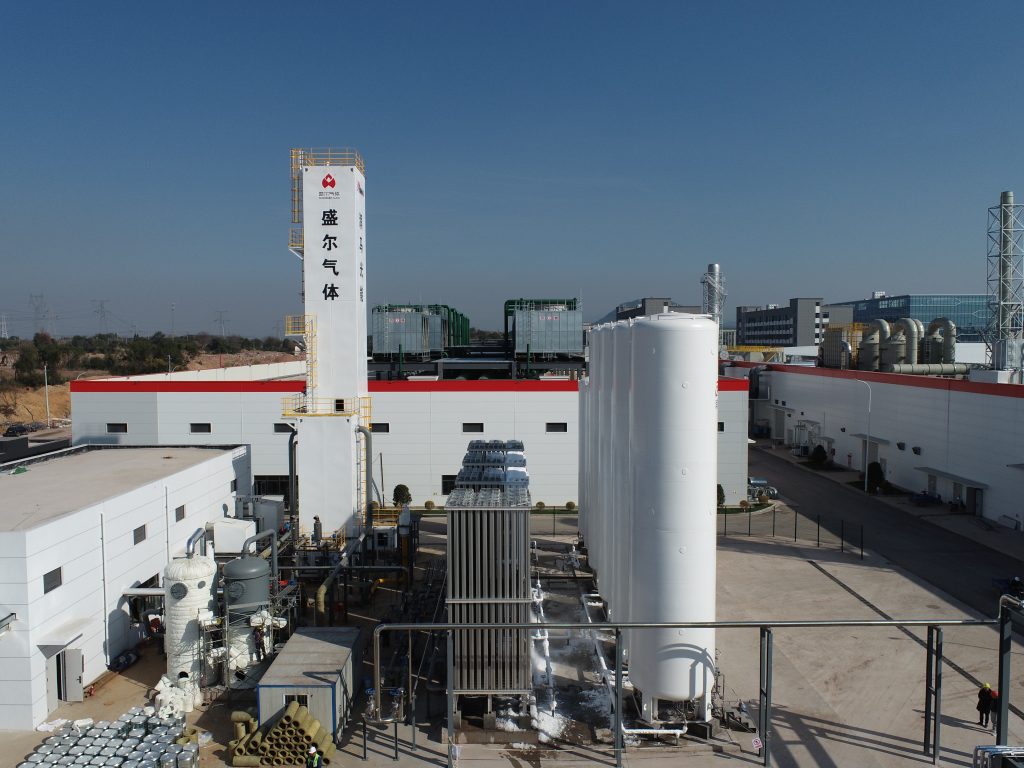
In a cryogenic air separation oxygen production plant, each piece of equipment plays a vital role. Table 1 summarizes the major components and their functions:
| Equipment | Function |
|---|---|
| Air Compressor | Multi-stage centrifugal compressor that pressurizes ambient air to the distillation pressure (typically 4–10 bar). |
| Intercoolers/Aftercoolers | Shell-and-tube or plate heat exchangers between compressor stages; remove heat and condense moisture from compressed air. |
| Molecular Sieve Purifiers | Adsorption beds (zeolite/alumina) that remove residual H₂O and CO₂ from the high-pressure air, preventing icing in the cold box. |
| Main Heat Exchanger (Cold Box) | Multi-stream brazed-aluminum exchanger (plate-fin type) where feed air is cooled by counterflow to outgoing product streams (oxygen, nitrogen, argon). |
| Expansion Turbine (Turboexpander) | Refrigeration device in the cold box that expands a portion of high-pressure air (or N₂) to provide extra cooling (isentropic expansion). |
| High-Pressure Distillation Column | Fractional distillation column (~4–6 bar); feeds are separated, yielding nitrogen-rich vapor overhead and oxygen/argon-rich liquid at bottom. |
| Low-Pressure Distillation Column | Fractional distillation column (~1 bar); further separates the feed, producing high-purity liquid O₂ at bottom and low-purity N₂ overhead. |
| Reflux Drums/Accumulators | Cryogenic vessels that condense and collect reflux liquid (e.g. liquid N₂) and supply it back to the columns to maintain stable operation. |
| Liquid Oxygen Pump | Cryogenic pump that raises the pressure of liquid oxygen (LOX) to delivery or storage pressure (e.g. for pipeline injection). |
| Argon Distillation Column | (If recovering Ar) A separate column that takes the argon-rich side draw and produces high-purity liquid argon (and recovers oxygen). |
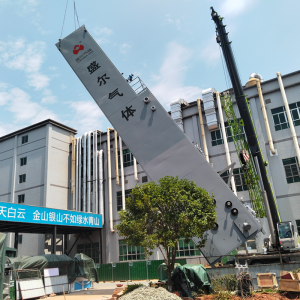
For any cryogenic air separation oxygen production plant, the proper sizing and integration of these components is crucial. The cold box houses the main heat exchanger, expansion turbine, and column packings in a compact, vacuum-jacketed enclosure. Thermal design minimizes temperature differences (“pinch”) in exchangers. Efficient compressors with intercoolers minimize work input. Together, the arrangement of compressors, precoolers, expanders, and columns defines the thermodynamic cycle. Each equipment item (compressor, heat exchanger, column, pump, etc.) must be selected and engineered for the specific capacity and purity targets of the ASU.
Energy and Efficiency Considerations
Cryogenic air separation oxygen production is inherently energy-intensive, because vast refrigeration is required to liquefy air. The main power consumers are the air compressors (for compression and intercooling) and any turbo-expanders. A typical large ASU will consume roughly 0.4–0.7 kWh per normal m³ of O₂ (about 300–600 kWh per tonne of O₂), depending on product pressure and purity. For example, pumping oxygen to very high pressure (for cylinder filling or pipelines) may increase the power to ~500 kWh/t, whereas moderate delivery pressure (~2–10 bar) might be ~400 kWh/t.
In practice, compressor power often dominates electricity use. Modern ASUs therefore optimize the compressor train with multiple stages and efficient intercooling. Turbo-expanders are used in preference to simple throttling valves where possible: the isentropic expansion of a feed stream through a turbine generates useful refrigeration (and sometimes recovers shaft work), raising the overall thermodynamic efficiency.
Despite these measures, the real energy consumption far exceeds the theoretical minimum. Exergy losses occur in multi-stage expansion and finite-temperature-approach heat exchange. Key opportunities to improve efficiency include: maximizing heat exchanger effectiveness (smaller ΔT in plate-fin exchangers), using multi-stage expansion and work recovery in multiple streams, and integrating any available cold or waste heat. For instance, some facilities use low-grade waste heat or even LNG regasification cold to supplement their refrigeration. However, any added complexity must be balanced against cost.
Because electrical power often represents 70–80% of the ASU’s operating cost, small percentage savings in specific power can yield significant economic benefit. Design trade-offs involve capital vs. energy: larger exchanger area or additional expanders (higher CAPEX) can reduce kWh per tonne (lower OPEX). Every cryogenic air separation oxygen production project must consider factors such as electricity rate, plant operating hours, and required oxygen recovery. In summary, optimal efficiency is achieved by carefully matching compressor pressure, column pressures, and refrigeration strategy to the production goals.
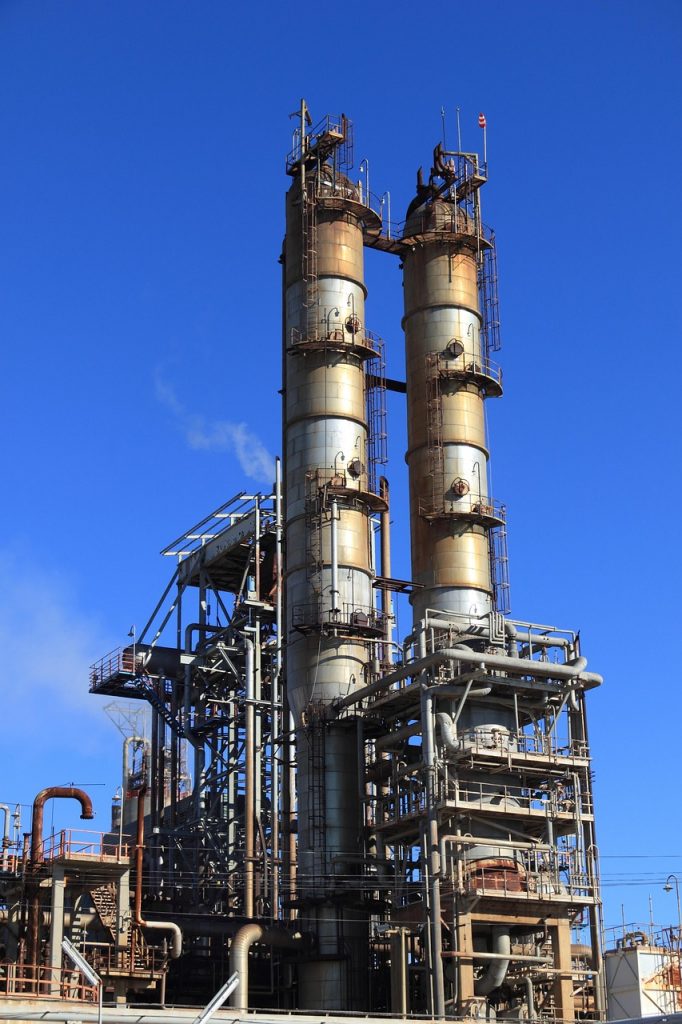
Applications in Industry
Cryogenic air separation oxygen production serves a wide range of industrial sectors that require high-purity O₂ (as well as N₂ and Ar byproducts). Examples include:
- Steel and Metalmaking: Oxygen is used in blast furnaces and basic oxygen furnaces to intensify combustion and oxidize impurities. Large steel plants often draw oxygen directly from on-site cryogenic ASUs (via pipelines) at rates of thousands of Nm³/h.
- Petrochemicals and Refining: Processes such as steam reforming, partial oxidation, catalytic reforming, and flue gas cleanup use oxygen or nitrogen. Cryogenic ASUs supply oxygen for making syngas and clean fuels, and produce nitrogen for inerting reactors and power generation processes.
- Chemical Manufacturing: Many chemicals rely on pure O₂ (ethylene oxide, nitric acid, methanol synthesis, etc.). Cryogenic plants also provide ultra-pure nitrogen and argon for blanketing and separation of sensitive reactions.
- Glass and Ceramics: Oxygen-enriched combustion in glass-melting furnaces raises flame temperatures, improving melting efficiency and glass quality. Cryogenic ASUs supply the needed oxygen and inert gases for these high-temperature operations.
- Environmental and Power: Wastewater treatment, waste incineration, and oxy-combustion in power boilers use oxygen to enhance oxidation. Emerging processes like coal or biomass gasification and carbon capture by oxy-fuel processes depend on large flows of high-purity O₂ from cryogenic units.
- Medical and Semiconductor: While smaller in scale, liquid oxygen plants supply hospitals and biotech facilities (medical O₂ grade ~99.5%). High-purity nitrogen (99.999%) and argon from cryogenic ASUs are critical for electronics manufacturing.
In each of these industries, the production facility is tailored to the site’s demand profile. Large installations feed gaseous oxygen into pipeline networks or storage tanks. Smaller plants may directly fill cryogenic dewars or cylinders. In every case, careful engineering of the cryogenic ASU and its integration with the host plant ensures reliable performance. The scale of oxygen demand and required purity drive the choice of cycle and equipment configuration.
Conclusion
Cryogenic air separation oxygen production remains the cornerstone technology for supplying large quantities of high-purity oxygen (along with nitrogen and argon). As industries grow, this well-established process continues to adapt: advanced heat exchanger designs, improved expanders, and better process integration yield incremental gains in efficiency and capacity. Design engineers must balance energy consumption, capital cost, and product requirements to meet specific goals. For example, increased oxygen output or higher delivery pressure can significantly raise power demand, so cryogenic air separation oxygen production systems are often optimized to the particular application. Specific design choices — such as refrigeration cycle type, compressor stages, and exchanger sizing — directly influence both CAPEX and OPEX. Ultimately, the ability to fine-tune these parameters allows cryogenic ASU operators to meet growing industrial gas needs efficiently and reliably. As global demand for oxygen (and co-produced gases) continues to rise, cryogenic air separation oxygen production will play a key role in providing a steady, high-purity supply for world industries.