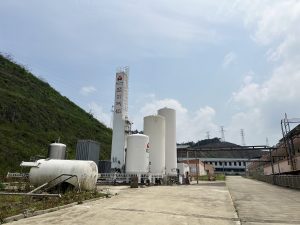
Introduction: Cryogenic Air Separation is a fundamental industrial process used to separate atmospheric air into pure oxygen, nitrogen, and argon by cooling and liquefying air and then distilling its components. It is the preferred method for producing large volumes of high-purity gases needed in various industries. Pioneered by Carl von Linde over a century ago, this process remains vital today – from providing tonnage oxygen for steelmaking to ultra-high-purity oxygen for semiconductor fabrication. Below we explain how cryogenic air separation works step by step (from compression to distillation), compare single-column and double-column air separation unit (ASU) designs, describe Argon Recovery in Cryogenic Air Separation Units, and discuss why industries like steel and microelectronics rely on this technology.Cryogenic Air Separation remains the most reliable method for large-scale, high-purity industrial gas production.

Cryogenic Air Separation Process Overview
The cryogenic air separation process relies on cooling air to extremely low temperatures so it can be distilled into its constituent gases. The process involves several key stages, each using proper engineering techniques to ensure efficiency and purity. Here is an overview of the main steps involved in Cryogenic Air Separation:
- Air Compression: In Cryogenic Air Separation,Intake air is first filtered to remove dust, then compressed to around 5–6 bar using a multi-stage main air compressor with interstage cooling. Compressing the air raises its pressure and temperature; intercoolers condense and remove moisture between stages. By the final compression stage, the air is at a high pressure (typically 70–90 psi) and much of the initial water vapor has been knocked out as liquid.
- Pre-Purification: The compressed air then passes through a purifier (often called a pre-purification unit, PPU). This usually consists of a chiller and molecular sieve adsorbers that remove impurities like residual moisture, carbon dioxide, and hydrocarbons. The air is cooled to near 5 °C (40–55 °F) to condense out water, then flows through beds of desiccant and zeolite adsorbents that trap CO₂ and any trace contaminants. Removing these is critical — otherwise they would freeze solid in the cold box and clog the equipment. Modern ASUs use twin adsorption beds that alternate so one regenerates (using heated waste gas) while the other bed is online, ensuring a continuous flow of clean, dry air.
- Cooling and Liquefaction: During Cryogenic Air Separation, the purified high-pressure air enters the cold box, which contains brazed aluminum plate-fin heat exchangers. Here the air is cooled from ambient temperature down to cryogenic temperatures (~–175 °C to –185 °C) by heat exchange against returning cold product and waste streams. As the air cools to below the boiling points of its components, a portion of the flow condenses into liquid. By the time the air reaches the bottom of the main heat exchanger, it is a mix of liquid and vapor (often an oxygen-enriched liquid and a nitrogen-rich vapor). This refrigeration is generated internally by expanding a part of the air flow through a turbo-expander (an expansion turbine) which produces the low temperatures needed. The cold equipment is all insulated inside the cold box to minimize heat leak.
- High-Pressure Distillation: The partially liquefied air is fed into the high-pressure (HP) distillation column, which operates at around 5–6 bar (absolute). In this tall column, the separation of nitrogen and oxygen begins. The high-pressure column behaves like a traditional distillation column: as the mixture travels upward, nitrogen (with the lower boiling point) tends to vaporize and rise, while oxygen (higher boiling point) tends to stay in the liquid phase and drip downward. At the top of the HP column, nearly pure nitrogen vapor is produced. This nitrogen is condensed to liquid by cooling against boiling oxygen in the low-pressure column (via an interlinked condenser/reboiler, explained in the next step). The condensed liquid nitrogen is partly withdrawn as a product or reflux and partly sent as reflux to both columns. Meanwhile, at the bottom of the HP column, an oxygen-enriched liquid (often containing roughly 40–60% O₂, with the remainder mostly N₂ and some Ar) collects. This liquid is sent onward to the second column for further refinement.
- Low-Pressure Distillation: The oxygen-enriched liquid from the HP column feeds the top of a low-pressure (LP) distillation column, which operates at about 1.2–1.3 bar (just above atmospheric pressure). Operating at lower pressure widens the relative volatility gap between oxygen and nitrogen, allowing higher purity separation. In the LP column, the remaining nitrogen is distilled out of the liquid and rises to the top, while oxygen concentrates in the liquid at the bottom. The overhead nitrogen vapor from the LP column is very pure (typically 99.999% N₂) and is withdrawn as gaseous nitrogen product (or liquefied if needed). The bottom of the LP column produces liquid oxygen with high purity (generally 95–99.5% O₂ depending on design). A portion of this liquid oxygen is withdrawn as product (and often pumped and vaporized to supply gaseous oxygen at required pressure), while some may be boiled to provide reflux for the column. The two columns are thermally linked: the condenser at the top of the high-pressure column doubles as the reboiler for the low-pressure column. In other words, the cold high-pressure nitrogen gas is condensed to liquid by boiling the low-pressure oxygen-rich liquid. This clever heat integration allows the two-column system to provide its own refrigeration and reflux, greatly increasing energy efficiency compared to a single column. The result is a near-complete separation of oxygen and nitrogen.
- Argon Recovery in Cryogenic Air Separation Units: Because argon’s boiling point (≈–186 °C) lies between those of oxygen (–183 °C) and nitrogen (–196 °C), argon will accumulate in the middle of the low-pressure column (where the concentration of argon might reach about 8–15%). If high-purity argon is desired, an argon side column (operating near 1.2 bar as well) is added to the system. A vapor side-draw from the low-pressure column at the height of maximum argon concentration is fed into this argon distillation column. In a typical design, the argon side column produces crude argon containing ~97% argon with a small amount of oxygen (~2–3%). The crude argon can then be processed further: for example, it may be warmed and passed over a catalytic deoxidizer (with hydrogen) to remove the O₂ by reacting it to water, then dried and re-distilled cryogenically to produce pure argon (>99.99%). Some modern plants forego the hydrogen step and instead use very tall cryogenic argon columns with structured packing to directly produce argon with only a few ppm of oxygen. This full-cryogenic method avoids hydrogen but requires a high reflux ratio and longer stabilization time. In any case, adding argon recovery increases the complexity and power consumption of the ASU, but it allows valuable argon (approximately 1% of air) to be captured rather than lost. In designs without an argon column, the argon simply remains mixed with the oxygen or in waste streams and is not separately captured (the oxygen product in such cases will have a slight argon impurity, typically up to 0.5%).
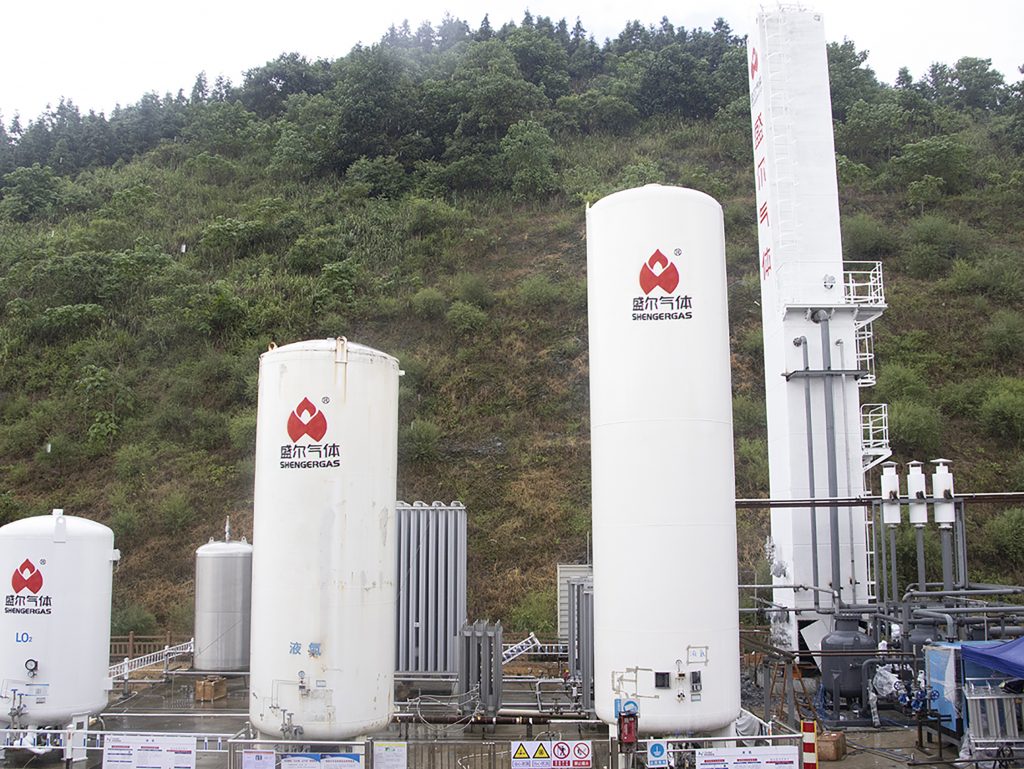
- Product Warming and Delivery: All product gases leaving the cold box are reheated back to near ambient temperature via the heat exchangers, cooling the incoming air in the process (this heat integration maximizes energy recovery). By the time the oxygen and nitrogen (and argon, if recovered) exit the cold box, they are dry, high-purity gases at roughly ambient temperature. The products can then be delivered to end users. Oxygen from cryogenic air separation is often sent by pipeline at low pressure for immediate use, or stored as liquid oxygen in insulated tanks for later vaporization. In many large ASUs, liquid oxygen is pumped to high pressure and then vaporized through the main heat exchanger, so that gaseous O₂ can be delivered at pipeline pressures without requiring massive gas compressors. Nitrogen is supplied either as gas (for inerting and purging) or stored as liquid for transport. Argon is typically exported as a liquid product in dewars or tankers. All gases produced by cryogenic air separation are of very high purity, making this process ideal for industries that demand extremely clean gases.
Single-Column vs. Double-Column Cryogenic Air Separation Designs
Cryogenic air separation units can be configured in different ways, with the double-column design being the industry standard for most medium to large plants. However, it is useful to understand the differences between older single-column systems and modern double-column systems:
Single-Column ASU Design
Early air separation plants (and some small-capacity or special-purpose units) use a single distillation column to separate air. In a single-column ASU, the air is typically compressed to a higher pressure, then cooled and partially liquefied. That single column (operating at an elevated pressure, often 5–10 bar) handles the entire distillation of oxygen and nitrogen. It is supplied with reflux by externally cooling a portion of the vapor or by using Joule-Thomson expansion to liquefy part of the air. A single-column setup can produce reasonably pure oxygen (up to ~99% O₂, and in some cases 99.5% purity). However, it has limitations. Without a second low-pressure column, the separation is less efficient and significant argon cannot be extracted (argon will remain as an impurity in the oxygen product). The single column also requires an external refrigeration cycle or a higher boil-up rate, making it less energy-efficient. In practice, single-column systems are seldom used for large-scale oxygen production because their power consumption per unit of product is higher and oxygen recovery is lower. They are mostly seen in early historical plants or small portable liquid nitrogen generators where simplicity is more important than efficiency.
Double-Column ASU Design
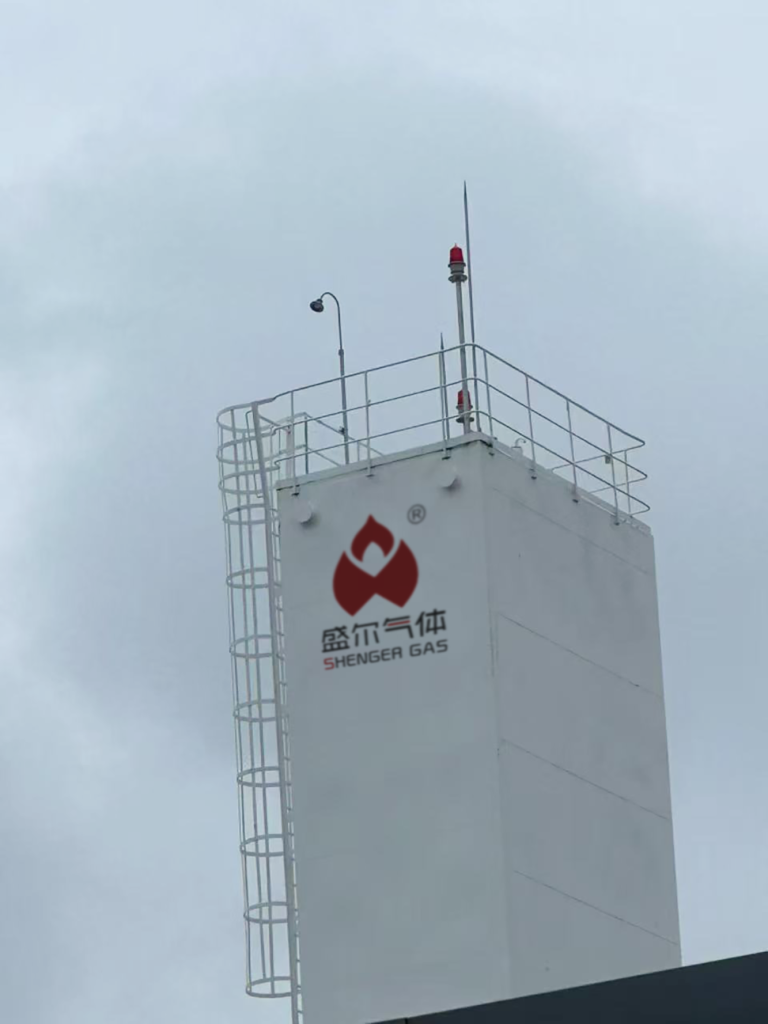
Modern cryogenic ASUs almost exclusively employ a double-column design (sometimes called a two-column rectifier system). This design, invented by Linde in the early 20th century, uses two primary distillation columns operating at different pressures in a stacked configuration. The high-pressure column partially liquefies the air and does the first cut of separation, producing oxygen-enriched liquid and high-purity nitrogen vapor. The low-pressure column then refines the oxygen-enriched liquid into high-purity oxygen at the bottom and nitrogen at the top. The two columns are thermally coupled: the condenser at the top of the high-pressure column serves as the reboiler for the low-pressure column. This internal heat exchange means the latent heat released by condensing nitrogen in the HP column is used to boil oxygen in the LP column. Such integration greatly reduces the external refrigeration needed. Double-column ASUs are far more efficient than single-column ones, as they capitalize on the lower-pressure distillation to achieve better purity and higher yield while using the higher-pressure column to provide the necessary reflux condensate. Additionally, double-column systems make argon recovery possible (with the addition of an argon side column). Almost all large oxygen plants (for steel mills, chemical plants, etc.) use the double-column process. The design is characterized by a tall cold box containing the two columns (and sometimes a third argon column), numerous heat exchanger cores, and an expansion turbine. Despite the higher complexity, the double-column ASU is preferred for its efficient use of energy and ability to produce multiple high-purity products simultaneously.
Argon Recovery: With vs. Without Argon Column
In any air separation unit, argon is a minor but valuable component (about 0.9% of air). Whether an ASU includes an argon recovery system depends on the desired products and economic considerations:
- Without Argon Recovery: Many smaller or older ASUs do not recover argon at all. In a basic two-column system producing just oxygen and nitrogen, the argon mostly ends up associated with the oxygen product or is lost in waste streams. The low-pressure column in such plants is operated in a way that argon does not concentrate to dangerous levels (since it isn’t extracted, operators must ensure it doesn’t accumulate and upset the purity targets). The result is that the oxygen product will contain a small percentage of argon as an impurity. For example, a typical spec might be 99.5% O₂ with the remaining 0.5% being argon (and a trace of N₂). This level is acceptable for most steelmaking and industrial uses. The unrecovered argon simply leaves the plant in the waste nitrogen gas that is vented after cooling the heat exchanger (or it stays dissolved in the liquid oxygen product). A no-argon-recovery design is simpler and slightly less costly to build and operate, but it foregoes the opportunity to produce argon as a saleable product.
- With Argon Recovery: For plants where argon is needed or profitable to capture (common in larger ASUs), an argon extraction unit is included. As described earlier, a side stream is drawn from the low-pressure column at the point where the argon concentration is highest (typically around 10% Ar, 90% O₂). This stream is fed to a dedicated argon column. In a two-column with argon setup, the argon column (sometimes called the crude argon column) will yield a crude argon gas that is mostly argon but contains a few percent oxygen. Further purification is then required to achieve commercial purity argon. The incorporation of an argon column allows the main oxygen product to become ultrapure (often >99.9% O₂, since argon is no longer a contaminant in it). For many large plants, argon recovery is standard practice because argon is in demand for uses like welding, lighting, and electronics. However, running an argon column has trade-offs: it increases power consumption and requires careful control (argon columns often have very high reflux ratios and can be over 60 meters tall with many trays or packing to separate argon from oxygen). Overall, including argon recovery is worthwhile when the argon product can be sold or when extremely high oxygen purity is needed (e.g., semiconductor-grade oxygen, which must have minimal argon).
Typical Operating Conditions and Purities in a Cryogenic ASU
The table below summarizes typical process conditions and product purities for a modern cryogenic air separation unit (double-column design with argon recovery):
| Parameter | High-Pressure Column | Low-Pressure Column | Argon Column |
|---|---|---|---|
| Operating Pressure | ~5–6 bar (abs) | ~1.2–1.3 bar (abs) | ~1.2–1.3 bar (abs) |
| Operating Temperature Range | ~-170°C at top (N₂ condenses) up to ~-140°C at bottom | ~-196°C at top (N₂ boils) ~-183°C at bottom (O₂ boils) | ~-186°C typical (argon boils) |
| Key Function in ASU | Partial separation of air; provides reflux (liquid N₂) | Final separation of O₂ and N₂; produces pure O₂ and N₂ | Purifies argon from O₂; produces crude/pure Ar |
| Major Output Purity | N₂ gas ~99.9% (overhead) | O₂ liquid 95–99.5% (bottom) N₂ gas 99.999% (top) | Ar ~97% (crude overhead) up to 99.999% after refining |
| Typical Product State | N₂ withdrawn as gas or liquefied | O₂ withdrawn as liquid (pumped to gas) N₂ as gas (or liquid byproduct) | Ar withdrawn as crude gas (then liquefied) |
Notes: The high-pressure column produces an oxygen-rich liquid at its bottom (around 40–60% O₂) which feeds the low-pressure column. The low-pressure column produces high-purity oxygen (usually 99.+% for industrial O₂) and high-purity nitrogen (often <1 ppm O₂). The argon column shown is a side-arm off the low-pressure column; if included, it allows argon product of 99.99%+ purity. All temperatures above are approximate boiling/condensing temperatures at the given pressures (for reference, nitrogen boils at 77 K and oxygen at 90 K at 1 atm). In operation, modern ASUs carefully control these conditions to optimize purity and recovery while minimizing energy usage.
Oxygen Use Cases in Steelmaking
One of the largest consumers of oxygen from Cryogenic Air Separation is the steel industry. Steelmaking (specifically the basic oxygen furnace process and electric arc furnace steelmaking) relies on a huge throughput of gaseous oxygen. In a basic oxygen furnace (BOF), a lance blows high-purity oxygen onto molten iron to oxidize excess carbon and impurities, thereby converting iron into steel. This requires oxygen of roughly 99.5% purity delivered at high flow rates and pressure. Cryogenic air separation plants located at integrated steel mills produce oxygen on site, often in the range of several hundred to thousands of tons per day, to supply the BOF and other processes. The high purity from cryogenic distillation is crucial—using nearly pure oxygen ensures the efficiency of reactions and avoids introducing too much nitrogen (which would form unwanted nitrides or dilute the process). Additionally, oxygen is used in reheating furnaces and for cutting/burning scrap in electric arc furnaces, and these applications similarly benefit from high-purity oxygen for hotter flames and cleaner combustion. The cryogenic air separation process is well-suited to steelmaking’s needs because it can deliver oxygen in large volumes economically. Some steel plants may accept slightly lower purity (e.g. 95% O₂ from cheaper PSA units) for certain operations, but for the primary oxygen blow in BOF steelmaking, cryogenic ASUs remain the standard since they reliably provide the required 99+% purity oxygen and the enormous quantities needed continuously. In summary, without cryogenic oxygen on tap, modern high-volume steel production would not be possible at its current scale and efficiency.
Oxygen Use Cases in Semiconductor Manufacturing
On the opposite end of the spectrum, the semiconductor industry demands relatively smaller quantities of oxygen, but at extremely high purities. Semiconductor fabrication plants (fabs) use ultra-high-purity oxygen in processes such as silicon wafer oxidation, thin film deposition (CVD, ALD), etching, and furnace annealing. Any contaminants in the oxygen (even parts-per-billion levels of hydrocarbons or moisture) can ruin semiconductor devices by introducing defects. Cryogenic Air Separation is crucial here because it produces a very clean oxygen baseline (often 99.9% or 99.99% O₂ with minimal argon and nitrogen). For electronics use, this oxygen is often further purified using special gas purifiers to reach 99.999% or 99.9995% purity (so-called 5N or 5.5N grade O₂). In practice, semiconductor facilities might get their oxygen supply from a dedicated small cryogenic ASU or more commonly from delivered liquid oxygen that is produced at an air separation plant and then vaporized on-site. The cryogenic air separation process also provides high-purity nitrogen and argon, which are heavily used in semiconductor manufacturing (nitrogen for purging and inert atmospheres, argon for sputtering and as a carrier gas). For example, nitrogen is required in massive volumes in fabs (often tens of thousands of cubic meters per hour of 99.999% N₂), typically supplied by large onsite ASUs. Oxygen needs are smaller but critical in quality. Thus, the semiconductor sector benefits from cryogenic separation technology’s ability to supply ultra-pure gases. The reliability and purity of cryogenically separated oxygen ensure that chip manufacturers can maintain the ultra-clean environments needed for etching microscopic circuits without chemical contamination. Simply put, only cryogenic separation (combined with additional purification) can meet the stringent purity specifications demanded in semiconductor processes.
Conclusion
Cryogenic Air Separation is a mature yet continually improving technology that enables the economical production of high-purity industrial gases. By compressing air, removing impurities, and employing cleverly integrated double-column distillation at cryogenic temperatures, ASUs supply the lifeblood gases of modern industry: oxygen, nitrogen, and argon. We explored how both single-column and double-column designs work, noting that virtually all large plants use double columns (and often argon side columns) for efficiency and completeness of separation. We also reviewed how some ASUs include argon recovery while others do not, depending on product requirements. Finally, we saw the diverse applications of oxygen from cryogenic plants – from the tonnage oxygen used in basic oxygen steelmaking to the ultra-pure oxygen used in semiconductor fabrication. In each case, cryogenic separation delivers the necessary volume and quality of gas. This process, from initial air compression to final low-temperature distillation, remains a cornerstone of industrial gas production. As demand for high-purity oxygen and other gases grows in both heavy industry and high-tech fields, Cryogenic Air Separation continues to be the cornerstone technology for producing oxygen, nitrogen, and argon at industrial scale.