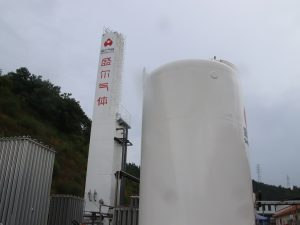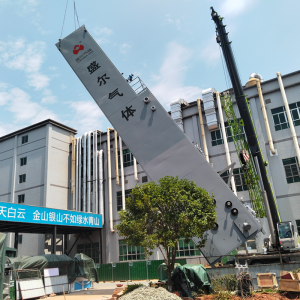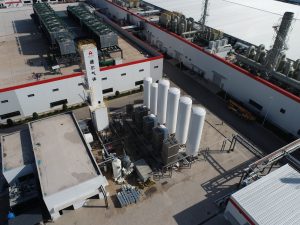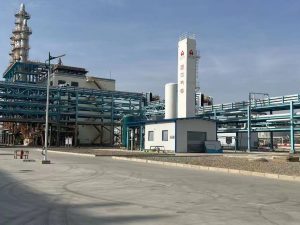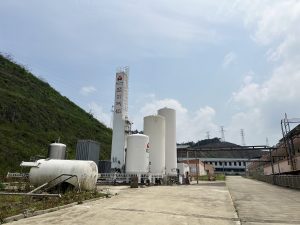
Cryogenic air separation technology remains the dominant method for producing tonnage oxygen, nitrogen, and argon when purity and volume matter most. In late 2025, virtually every new plant above 1000 tpd is cryogenic—nothing else comes close on energy efficiency at scale. The process itself is mature: compress air, purify it, cool it to –190°C, and distill. Yet the real action now happens in the details—compressors that hit 92% polytropic efficiency, packings that cut column height by 15%, and control systems that shave another 5–8% off the power bill without anyone noticing.
Distillation Column and Packing Advances in Cryogenic Air Separation Technology
Structured packing has moved from generation 5 to generation 7 in just a few years. The latest high-capacity packings from Sulzer and Koch-Glitsch now deliver specific surface areas above 800 m²/m³ while keeping flooding factors below 2.2 kPa/m. What this means in practice: a 4000 tpd plant commissioned in China this year runs its upper column with only 42 theoretical stages yet achieves 99.8% oxygen recovery and 97.5% argon recovery without a separate argon column.Liquid distributors have finally solved the maldistribution nightmare. New designs with multiple drip points and self-cleaning features maintain uniform wetting down to 30% turndown—essential for plants that must follow renewable power curves.
Energy Efficiency Breakthroughs in Cryogenic Air Separation Technology: The LEC-ASU Era Begins
In modern cryogenic air separation technology, the Low-Energy, Low-Cost ASU (LEC-ASU) concept, first published in detail in October 2025, is now moving from simulation to metal. By combining a vapor-compression heat pump with cold storage tanks, these units shift over 65% of compression work to valley hours and recover cold that would otherwise be wasted to atmosphere.Pilot results reported this quarter show specific power consumption of 188–208 kWh/t O₂ for gaseous oxygen at 99.6% purity—numbers that beat even the best conventional plants by more than 25%.Here is where the industry actually stands in November 2025:
| Plant Configuration | Specific Power (kWh/t O₂ GOX 99.6%) | Argon Recovery (%) | Turndown Ratio (%) | Commissioning Year Examples |
|---|---|---|---|---|
| Classic double-column (pre-2020) | 335–365 | 88–92 | 70–100 | Legacy fleet |
| Advanced packed + VFD (2021–2024) | 255–285 | 93–96 | 45–105 | Most new Asian plants |
| Heat-pump assisted (2024–2025) | 215–245 | 95–97 | 35–110 | Europe & Middle East |
| LEC-ASU with full cold storage (2025 pilots) | 188–208 | >97 | 30–115 | China & Germany pilots |
These are not theoretical minimums—these are operating plants reporting to owners this year.
Renewable Integration in Cryogenic Air Separation Technology
More than twenty large plants using cryogenic air separation technology now operate in true flexible mode worldwide. They ramp between 30% and 115% load on 15-minute notice, absorbing surplus wind or solar power and storing liquids as both product and energy vector.Cold storage tanks—typically 5000–15000 m³ of LOX or LIN—act as thermal batteries. When grid power is cheap, the plant liquefies extra air. When power is expensive, stored liquids are pumped back through the cold box to maintain gaseous delivery without running the main compressors.Round-trip efficiencies in hybrid ASU-LAES systems now exceed 64% in commercial operation, making cryogenic air separation technology one of the only long-duration storage technologies that pays for itself through gas sales.
Hydrogen Economy: The Integration Everyone Actually Wants
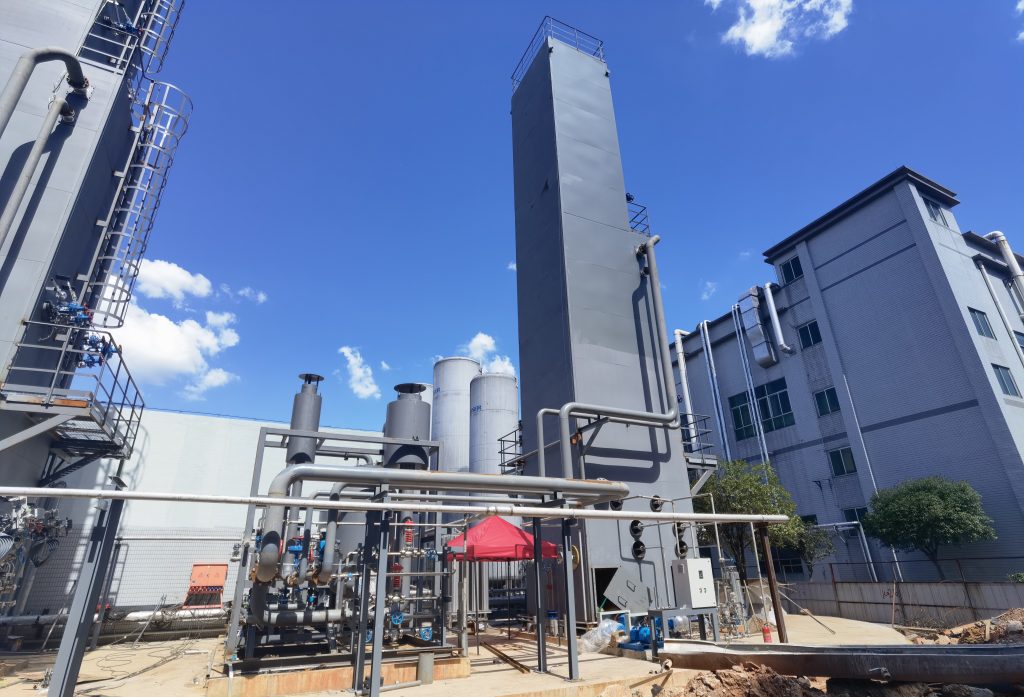
Every green hydrogen project above 250 MW awarded in 2025 includes a dedicated cryogenic ASU. The reason is brutally economic: oxygen from an ASU at 40 barg costs less than half as much as compressing electrolyzer by-product from 1.5 barg—and you get valuable cold recovery for hydrogen liquefaction as a bonus.Blue hydrogen and DRI steel plants go further. New designs use cryogenic distillation to separate CO₂ directly from shifted syngas, achieving 97–98% capture with specific energy below 85 kWh/t CO₂ captured—numbers that beat amine systems once you account for steam and cooling loads.
Materials and Equipment: Incremental but Critical Gains
Active magnetic bearings are now standard on all new expanders above 3 MW. MTBF exceeds 150,000 hours, and oil systems are simply gone—no more hydrocarbon contamination risk in oxygen service.High-strength aluminum alloys have displaced 30–40% of stainless steel in cold-box piping for plants up to 2000 tpd, cutting structural weight and erection time by months.Perlite-vacuum superinsulation with multi-layer radiation shields routinely achieves heat inleak below 0.28 W/m² in large cold boxes commissioned this year.
Digitalization That Delivers Real Money
Hybrid physics-ML control systems are now standard on new Linde and Air Liquide plants. These controllers learn plant-specific behavior over the first six months and then continuously adjust column pressures, reflux ratios, and compressor guide vanes.One operator in Germany reported a 6.2% energy reduction in the first year of ML-assisted operation—worth approximately €4.8 million annually on a 3500 tpd plant.Digital twins have moved from marketing to daily use. Operators now run “what-if” scenarios every shift for demand changes, ambient conditions, or maintenance planning.
Market Reality in Late 2025
Global cryogenic air separation capacity additions this year are running at approximately 180,000 tpd of oxygen equivalent—roughly 50 large plants or equivalent modular units.Asia continues to dominate with metallurgy-driven demand, but the surprise growth region is the Middle East, where hydrogen and DRI projects are driving multiple 5000+ tpd oxygen awards.Modular, shop-fabricated plants in the 500–1000 tpd range now cost under USD 70 million delivered—down 40% in real terms from 2018.
Outlook Through 2030
Plants being designed today will operate at under 185 kWh/t O₂ while being carbon-negative through full renewable powering and CO₂ liquefaction for permanent sequestration.Cryogenic air separation technology is not facing disruption—it is becoming the central enabling technology for the net-zero industrial economy. The physics is settled. The remaining work is execution: better compressors, smarter packings, tighter integration with electrolyzers and carbon capture.Engineers working on these details today are the ones who will deliver the next 25–35% efficiency gain before 2030. The plants they build will still be running profitably in 2070, supplying the oxygen and nitrogen that a decarbonized world simply cannot function without.