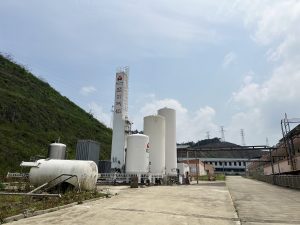
Introduction to Industrial Nitrogen Generators
Energy-efficient industrial nitrogen generators are on-site systems designed to produce nitrogen gas from compressed air, providing a reliable supply of nitrogen for various industrial applications. Unlike traditional bulk delivery methods (liquid nitrogen tanks or high-pressure cylinders), on-site nitrogen generators offer independence from deliveries and the ability to generate nitrogen on demand. The key advantage of energy-efficient industrial nitrogen generators lies in their ability to significantly reduce operational costs and carbon footprints. Energy efficiency is especially critical because generating nitrogen involves continuous operation of air compressors and separation units. For industries such as food packaging, electronics manufacturing, or chemical processing, improving energy efficiency can directly impact both profitability and sustainability. In this article, we will explore how energy-efficient industrial nitrogen generators work and why energy efficiency has become a focal point in their design and operation.
Nitrogen makes up ~78% of air, and industrial generators separate nitrogen from oxygen and other gases to supply high-purity N₂ for industrial use. The most common on-site generation methods for energy-efficient industrial nitrogen generators are Pressure Swing Adsorption (PSA) and Membrane Separation. Each method uses a different mechanism to extract nitrogen, but both have been engineered for improved efficiency in recent years. In contrast, large-scale cryogenic separation (refrigerating air until it liquefies and distilling nitrogen) is used for very high volumes and purities. Cryogenic plants can achieve ultra-high purity (up to 99.999% N₂) and massive flow rates, but they have high energy demands and complexity, making them less practical for typical on-site needs. For most industrial sites that require anywhere from a few cubic meters to a few thousand cubic meters of nitrogen per hour, PSA and membrane generators strike a better balance between purity, capacity, and energy efficiency.
In the following sections, we will compare PSA and membrane technologies, examine the factors that influence their energy efficiency, analyze lifecycle costs, explore industry applications, and discuss future trends. By understanding these aspects, engineers and facility managers can make informed decisions when selecting energy-efficient industrial nitrogen generators for their needs.
Overview of PSA and Membrane Separation Technologies
PSA and membrane technologies are the most energy-efficient choices for small to medium-scale nitrogen generation, balancing purity, energy consumption, and cost.Modern on-site nitrogen generators primarily use Pressure Swing Adsorption (PSA) or Membrane Separation techniques to extract nitrogen from air. Both technologies can deliver nitrogen continuously, but they differ in principle, achievable purity, and ideal usage scenarios. Below is an overview of each:
Pressure Swing Adsorption (PSA)
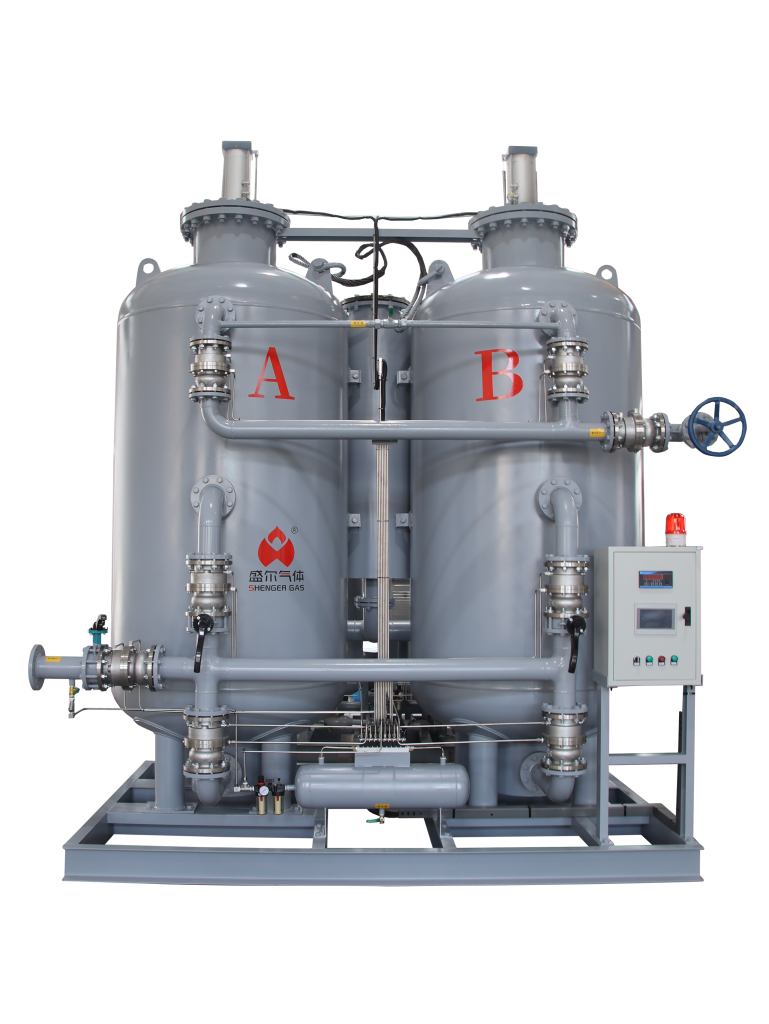
Pressure Swing Adsorption is a technology that separates gases using specialized adsorbent materials. In a PSA nitrogen generator, compressed air is passed through vessels filled with a carbon molecular sieve (CMS) adsorbent. The CMS has tiny pores that preferentially trap oxygen, moisture, and other trace gases under pressure, allowing nitrogen to pass through as the product gas. PSA systems typically consist of dual (or multiple) adsorption towers that alternate between adsorption and regeneration cycles:
- Adsorption Phase: Compressed, filtered air (usually at 0.6–0.8 MPa pressure) enters the first tower. Oxygen and other molecules are adsorbed onto the CMS, and nitrogen molecules (which are not adsorbed as strongly) flow out of the vessel as high-purity nitrogen gas. This process continues until the CMS in that tower approaches saturation with oxygen.
- Desorption/Regeneration Phase: Before the first tower becomes fully saturated, the airflow is redirected to the second tower. The first tower is then depressurized, which releases the trapped oxygen and impurities (venting them out as waste gas). Some product nitrogen may be used to purge the bed as well. The CMS thus regenerates and is ready for the next cycle. The towers alternate so one is always producing nitrogen while the other is being regenerated.
Energy-efficient industrial nitrogen generators using PSA technology offer adjustable nitrogen purity by tuning the cycle time and pressure.By default, PSA generators produce high purity nitrogen; typical ranges are 95% up to 99.999%. One major advantage of PSA is its ability to achieve very high purities (99.99%+) suitable for electronics, pharmaceuticals, and other sensitive industries. However, producing ultra-high purity comes at the cost of higher energy per unit of N₂ (because more air is required and the cycle may run longer). PSA units have a relatively quick startup (often 15–30 minutes to reach specified purity from a cold start) and can ramp production up or down to match demand.
In terms of equipment, a PSA nitrogen generator package includes an air compressor, pre-treatment filters and dryers (to provide clean, dry air), the twin adsorption towers with CMS, automatic valves for switching cycles, and a control system (PLC). Maintenance involves periodic replacement of filters and valves and eventual replacement of the CMS adsorbent (typically every 5–10 years). PSA generators do have moving parts (valves cycling with each adsorption/desorption switch), so maintenance is moderate but not onerous. Overall, PSA systems are valued for their reliability, ability to reach high purity, and efficient use of compressed air at moderate purities.
Membrane Separation
Membrane nitrogen generators, often found in energy-efficient industrial nitrogen generators, use permeable fiber membranes to separate nitrogen from compressed air by exploiting differences in gas diffusion rates. In a membrane system, compressed air (usually at 0.7–1.0 MPa) is fed into a bundle of hollow fibers made of a selective polymer. As air travels through these fibers, “fast” gases like oxygen, carbon dioxide, and water vapor permeate through the membrane walls quicker than nitrogen. The nitrogen, which permeates more slowly, remains at a higher concentration in the core of the fibers and emerges as the product gas. Essentially, oxygen-rich air is vented out (permeate side), while the product nitrogen (depleted of oxygen) flows out the other end of the membrane module. This efficient process is a key feature of modern energy-efficient nitrogen generation systems, making it ideal for applications where energy savings are a priority.
Energy-efficient industrial nitrogen generators using membrane separation have no moving parts in the separation process, making them low maintenance and highly reliable, which makes them inherently simple and very robust. These energy-efficient nitrogen generation systems typically include an air compressor, filtration (to remove oil, particulate, and moisture so the membranes aren’t fouled), and one or multiple membrane modules arranged in parallel or series to achieve the desired flow and purity. Key characteristics of membrane-based energy-efficient nitrogen generators include:
- Rapid Startup: Membrane systems have an almost instantaneous response. They can start producing nitrogen at target purity within a few minutes (often under 5 minutes) of startup. This makes them ideal for applications that need nitrogen on an intermittent or emergency basis, or where systems are frequently turned on and off.
- Purity Limitations: A trade-off with membrane generators is that achieving very high purity is difficult or inefficient. Membrane units are typically most economical in the 95–99% purity range. Pushing beyond ~99% nitrogen purity usually requires multiple membrane stages or significantly more membrane surface area, which sharply increases cost and reduces the system’s overall efficiency. Many membrane systems are used for moderate purity needs (for example, 95–98% N₂ for tank blanketing or fire prevention) where they excel in simplicity and low maintenance.
- Scalability: Membrane modules can be manifolded to increase capacity. Individual membranes might produce a small flow (tens of Nm³/h), but modules can be added in parallel to meet higher demand. However, very large flows at high purity are typically better served by PSA or cryogenic systems. Membrane generators are commonly found in small to medium flow applications (from a few Nm³/h up to a few hundred Nm³/h per skid is typical, though modular systems can reach higher).
- Low Maintenance: Because there are no switching valves or moving components in the separation process, maintenance primarily consists of keeping the air supply clean and replacing filters. The membrane fibers themselves have a finite life (gradual permeability loss over time) and often need replacement after 3–5 years of continuous use. Still, the maintenance requirements are minimal – no extensive overhauls, just swap out filters and membrane cartridges as needed – and do not usually require specially trained personnel.
PSA vs. Membrane – Summary: In general, PSA nitrogen generators are chosen for higher purity requirements or larger volumes, whereas membrane generators are chosen for ease of use, quick startup, and lower purity needs. PSA units may consume a bit less energy per unit of nitrogen at high purities because of more efficient use of compressed air (lower air-to-nitrogen ratio when optimized), while membrane units shine in applications where ~95–98% purity is acceptable and the absolute lowest energy input is needed at those levels. Both types have benefited from engineering improvements making them more energy-efficient and reliable. Many modern energy-efficient industrial nitrogen generators incorporate smart controls and advanced materials (better adsorbents in PSA, better polymers in membranes) to improve performance.
(Note: A third category, cryogenic nitrogen generators, is used for large-scale, high-purity production. Cryogenic systems can produce nitrogen at 99.999% purity or higher and handle tens of thousands of Nm³/h, but due to high energy consumption (roughly 0.6–0.8 kWh per Nm³ at 99.999% purity) and complex operation, they are typically reserved for very large industrial facilities. For the scope of this article, we focus on PSA and membrane systems which are more common for on-site nitrogen generation in most industries.)
Key Factors Influencing Energy Efficiency in Nitrogen Generation
Designing an energy-efficient nitrogen generation system requires understanding what factors most affect power consumption. For energy-efficient industrial nitrogen generators, the energy cost of producing nitrogen is largely driven by the electricity needed to compress air and the inherent efficiency of the separation process. The following are key factors influencing energy efficiency in industrial nitrogen generators:
- Required Nitrogen Purity: This is perhaps the most significant factor in energy-efficient industrial nitrogen generators. Higher nitrogen purity (>99.5% N₂) means more of the oxygen must be removed, which often exponentially increases energy usage. In a PSA energy-efficient nitrogen generator system, achieving higher purity involves longer adsorption cycles or additional adsorption towers, leading to more compressed air use per cubic meter of N₂. In membrane-based energy-efficient nitrogen generators, higher purity means a larger fraction of the air is vented as waste (permeate), so you need to supply much more air for a given nitrogen output. For example, producing nitrogen at 99.9% purity will consume significantly more compressor power per Nm³ than producing 98% purity. Optimizing purity to the real needs of the application (and not overshooting purity) is crucial for energy efficiency in energy-efficient nitrogen generation systems. If a process works with 95% nitrogen, there is no benefit to using 99.999% nitrogen – it would only waste energy.
- Air Compression Efficiency: The air compressor is the powerhouse of any nitrogen generator system. Efficiency of the compressor (design, motor efficiency, pressure delivered, etc.) has a direct impact on the energy per Nm³ of nitrogen. Modern systems use high-efficiency rotary screw compressors or other designs with energy-saving features like variable speed drives (VSD/VFD). A variable-speed compressor can modulate its output to match the nitrogen generator’s demand, avoiding the wasteful practice of running at full speed when demand is low. Proper compressor sizing (not oversized or undersized) and maintaining an optimal delivery pressure (producing just enough pressure needed for the separation process, rather than excessive pressure) will improve overall energy efficiency of nitrogen generation.
- Air-to-Nitrogen Ratio: This is the ratio of how many units of air are required to produce one unit of nitrogen. A lower air-to-N₂ ratio indicates a more efficient separation. PSA systems typically have lower air-to-gas ratios at high purities compared to single-stage membrane systems. For instance, a well-optimized PSA generator might use around 2.2–2.5 volumes of air for 1 volume of N₂ at 99% purity, whereas a membrane system might require more air for the same purity. Selecting a technology (or combination) that offers the best air utilization for the desired purity will reduce energy consumption (since compressing less air saves power).
- System Design and Sizing: Proper system design goes a long way toward efficiency. A common mistake is installing an overcapacity nitrogen generator “just in case” of future needs – but running a generator significantly below its capacity can be inefficient, especially for PSA where the system will cycle regardless of demand. The most energy-efficient industrial nitrogen generators are those that are right-sized to the user’s average consumption with some allowance for peaks (often buffered by a nitrogen storage tank). Additionally, features like automated shut-off or standby modes can save energy when demand is zero (for example, stopping the air compressor and closing valves when the downstream nitrogen receiver is full and no consumption is happening).
- Maintenance and Air Quality: Maintenance plays an indirect but important role in energy efficiency. A well-maintained system operates closer to its optimal design efficiency. For example, if filters are clogged, the compressor works harder to push air through, raising energy use. If a PSA’s valves leak or timing is off, or the adsorbent is contaminated, efficiency drops. Regular maintenance of compressors (ensuring proper lubrication and cooling), replacement of filter elements, and keeping the adsorbents and membranes in good condition preserves the generator’s energy efficiency over time. Air quality is also critical – excessive oil or moisture carryover into a PSA or membrane will damage the separation media and reduce efficiency, so filtration and dryer upkeep saves energy in the long run by keeping the system efficient.
- Operating Pressure and Conditions: Both PSA and membrane generators have optimal operating pressure ranges. Running a system at higher pressure than needed wastes energy (since compressing to higher pressure consumes more kWh). Also, ambient and inlet air temperatures can affect performance – for instance, very high inlet air temperature can reduce a PSA’s adsorption capacity, meaning more air (and thus more energy) is required to produce the same nitrogen output. Designing the system to operate under favorable conditions (proper cooling for compressors, perhaps using heat exchangers to cool inlet air) can improve efficiency. Some systems even incorporate heat recovery from the compressor (using waste heat for other processes or facility heating) – while this doesn’t reduce the energy consumed by nitrogen generation, it improves overall plant energy utilization.
- Smart Controls and Monitoring: Modern nitrogen generators often include intelligent control systems that optimize the operation. They can adjust cycle times, number of online modules, or compressor speed based on real-time demand. By avoiding over-production of nitrogen and cycling equipment off when not needed, these smart systems eliminate unnecessary energy usage. Additionally, sensors can monitor purity and flow continuously to ensure the system is not working harder than necessary. For instance, if demand drops, a smart PSA might extend its adsorption cycle slightly (allowing a bit lower throughput) to save energy until demand picks up again, or a membrane system might automatically close off some membrane modules to avoid excess air consumption at low demand.
By carefully considering these factors during design and operation, facilities can drastically improve the energy performance of their nitrogen generators. An energy-efficient industrial nitrogen generator isn’t just about having the right technology; it’s also about how you operate and maintain it. The next section will look at how energy efficiency translates into cost savings over the system’s lifecycle.
Lifecycle Cost Analysis and Operational Efficiency
When evaluating industrial nitrogen generators, it’s important to look beyond just the purchase price. The lifecycle cost of a nitrogen generation system includes initial capital cost, energy costs, maintenance, and the operational efficiencies gained (or lost) over time. Energy-efficient designs often have a higher upfront cost but provide significant savings throughout their lifespan.
Initial Investment vs. Operating Cost: PSA and membrane generators typically involve a substantial initial investment in equipment (air compressor, generator unit, storage tanks, etc.). However, once installed, the operating cost per Nm³ of nitrogen is relatively low compared to delivered liquid or bottled nitrogen. The primary operating expense is electricity to run the air compressor. For example, a mid-sized PSA or membrane system might consume on the order of 0.3–0.5 kWh of electricity to produce 1 Nm³ of nitrogen (at moderate purity). If electricity costs around $0.10 per kWh, that translates to roughly $0.03–$0.05 per Nm³. In contrast, liquid nitrogen delivery not only carries a commodity cost but also includes losses (evaporation) and transportation energy. Studies have shown that generating nitrogen on-site can cut the per-unit cost by 30–50% compared to purchasing liquid nitrogen, especially when usage is consistent and high.
Energy Efficiency and Cost Savings: An energy-efficient industrial nitrogen generator will have a lower cost of ownership due to reduced power consumption. Even small improvements in kWh/Nm³ add up significantly over time. For instance, consider a generator producing 100 Nm³/h running continuously. If you improve its efficiency from 0.5 kWh/Nm³ to 0.4 kWh/Nm³, at 100 Nm³/h that saves 10 kWh every hour. Over a year (8000 hours of operation), that’s 80,000 kWh saved. At $0.10/kWh, that’s $8,000 less in annual electricity cost. Over a typical 10-year equipment life, energy savings alone could be tens of thousands of dollars, often paying back any premium spent on higher-efficiency equipment.
Maintenance and Downtime: Another aspect of lifecycle cost is maintenance and reliability. PSA generators have more mechanical components that may require service (e.g. valve replacements, adsorbent renewal), whereas membrane systems have fewer moving parts but the membranes gradually degrade. Both types generally have low maintenance costs relative to their output. Filter changes and routine checks are minor expenses. However, if a system is poorly maintained and operates below optimal efficiency (e.g., due to leaks or fouled adsorbent), the energy cost per Nm³ rises, effectively increasing operating expenses. Thus, investing in good maintenance practices keeps the operational efficiency high and lifecycle costs low. Downtime can be very costly if nitrogen supply is interrupted, so reliable, well-maintained generators also save money by preventing production stoppages. In terms of lifecycle analysis, many companies find that on-site generation has a payback period of only 1–3 years compared to buying delivered nitrogen, after which the ongoing savings accrue directly.
Operational Efficiency and Workflow Benefits: Beyond dollar costs, having an on-site energy-efficient industrial nitrogen generator can streamline operations. There’s no need to coordinate deliveries or handle heavy cryogenic tanks, which reduces labor and improves safety. The ability to generate nitrogen as needed means you can avoid over-purging or excessive usage just to “use up” delivered supply – instead, the Energy-efficient nitrogen generator produces what you need, when you need it, which is inherently efficient. Additionally, advanced Energy-efficient nitrogen generation systems today often come with remote monitoring and optimization algorithms, ensuring they run at peak efficiency with minimal operator intervention. Such features enhance overall operational efficiency and can extend the life of the equipment.
In summary, lifecycle cost analysis strongly favors energy-efficient nitrogen generators, especially for users with continuous or high nitrogen demand. The combination of lower energy consumption, reduced dependency on deliveries, and manageable maintenance makes on-site generation an economically attractive option. The next section will discuss how these generators are applied across different industries, each with their specific requirements.
Applications in Different Industries
Nitrogen is a versatile inert gas used in a wide range of industries. Energy-efficient nitrogen generators have enabled more industries to generate their own nitrogen on-site, tailored to their purity and volume needs. Below are some major industry applications and the role of on-site nitrogen generation in each:
- Food and Beverage Packaging: Many food products (snack foods, coffee, fresh produce, packaged meats, etc.) are packaged in a nitrogen atmosphere to displace oxygen and extend shelf life. On-site nitrogen generators (often PSA systems or membranes for lower purities) provide a continuous supply of food-grade nitrogen for modified atmosphere packaging (MAP). Purity requirements here are typically in the 98–99.5% range – enough to suppress oxidation. Generators in this sector must be reliable and often need stainless steel piping and food-safe components. The energy efficiency of modern generators helps food processors reduce costs, important in an industry with tight margins. Additionally, having an in-house generator ensures the packaging line is never halted due to gas delivery delays.
- Electronics and Semiconductor Manufacturing: The electronics industry requires extremely high-purity nitrogen (99.99% to 99.999% or higher) for processes such as wave soldering, reflow ovens, PCB manufacturing, and semiconductor fabrication. PSA nitrogen generators are common in this field because of their ability to achieve ultra-high purities. These industries value energy efficiency because the generators often run 24/7 to maintain a continuous purge in equipment. Even small improvements in energy use per cubic meter can significantly lower the facility’s utility bills. On-site generation also allows electronics manufacturers to control quality and avoid impurities that could come from delivered liquid nitrogen. For semiconductor fabs with very large consumption, a combination of on-site generation methods might be used (some even have small cryogenic plants), but PSA systems have become standard for many due to lower operating costs and quick response in ramping up or down with production needs.
- Chemical and Petrochemical Plants: Nitrogen is widely used for blanketing flammable chemicals, purging reactors, and pressure transferring liquids in chemical manufacturing. Refineries and petrochemical plants often have huge nitrogen demands, and reliability is paramount. These facilities might use large PSA units or even cryogenic generators for high volume. Purity needs can vary: for inerting and purging, 95–98% may be sufficient to prevent combustion (a small O₂ content can be acceptable), which means membrane generators can sometimes be used (for example, in remote oilfield operations, portable membrane nitrogen generators provide 95–97% N₂ for well purging and pipeline commissioning). Energy-efficient generators reduce the operating cost of providing nitrogen across large plants, which is significant as nitrogen is often used in massive quantities. Also, by producing nitrogen on-site, these industries minimize truck deliveries of liquid nitrogen, improving safety (less handling of cryogenic liquids) and reducing greenhouse gas emissions from transportation.
- Pharmaceutical and Biomedical: Pharmaceutical manufacturing uses nitrogen for blanketing reactive ingredients, purging storage tanks, and packaging medicines under inert atmosphere. Labs and biotech processes also use nitrogen to control environments or run instruments. Purity requirements here are usually high (99–99.999%) since products must not be contaminated. PSA generators are frequently installed in pharmaceutical plants for their purity capability. A key concern in pharma is also the quality of the nitrogen (it may need to be sterile or have low moisture content), so generators might be equipped with additional purification steps like bacterial filters or catalytic oxygen removal for ultra-purity. Energy efficiency in this context helps pharma companies meet sustainability goals and reduce heat output (important in temperature-controlled manufacturing areas). For smaller labs or medical facilities, compact PSA or membrane units can supply nitrogen for uses like operating laboratory analytical instruments (e.g., LC-MS, GC) or preserving biological samples.
- Metal Fabrication and Laser Cutting: In metal fabrication, nitrogen is often used as a laser cutting assist gas, especially for stainless steel and aluminum, to blow away molten metal and prevent oxidation of cut edges. Laser cutting operations can require high flows of nitrogen at purities around 95–99.99%, depending on the material and desired cut quality. Traditionally many shops used liquid nitrogen, but on-site generators (either PSA for higher purity or membrane for moderate purity) are increasingly popular to avoid the recurring costs of delivered liquid. These generators need to deliver high flow rates on demand (when the laser is operating) and may idle in between jobs – a scenario where a quick-start membrane system can be useful. Welding applications also use nitrogen in some specialized shield gas mixtures, and nitrogen generators can supply those needs too. Energy-efficient generators in this field allow fabricators to cut operating costs and have more predictable expense planning (no price volatility of bulk gases). They also free the operation from dependence on suppliers and the logistics of storing cryogenic tanks.
- Oil & Gas and Fire Prevention: In oil and gas exploration, nitrogen is used for inerting wells, pressure testing pipelines, and enhanced oil recovery techniques. Portability and fast response are key, so skid-mounted membrane nitrogen generators are often deployed at well sites to provide 95–98% nitrogen on demand. These membrane units are valued for their ruggedness and rapid startup. Energy efficiency translates to being able to run off portable power sources more effectively and reduce fuel consumption in remote locations. In fire prevention, nitrogen generators are used to produce nitrogen-enriched air for reducing oxygen in protected spaces (like data center fire prevention systems that keep the atmosphere at ~15% O₂). These systems often run constantly to maintain low oxygen, so energy-efficient operation is crucial for long-term feasibility. On-site generation is the only practical method here, as you cannot practically supply such systems with delivered nitrogen.
Across all these industries, the common theme is that on-site nitrogen generators provide control, continuity, and often cost savings. The specific generator setup may vary (PSA vs membrane, large vs small, single vs multiple units) based on the purity and volume needs. Energy efficiency remains a selling point and operational advantage in each case: companies can achieve the nitrogen purity they need without wasteful energy overhead. Many industrial users also cite environmental benefits – by using efficient on-site systems, they eliminate the emissions associated with trucking in liquid nitrogen and reduce overall electricity usage through optimized production.
Future Trends and Innovations
The field of industrial gas generation is continuously evolving, and several emerging trends aim to make nitrogen generation even more efficient, smart, and adaptable. Here are some future directions and innovations for energy-efficient industrial nitrogen generators:
- Advanced Materials and Adsorbents: Research is ongoing into new adsorbent materials for PSA systems (and even new membrane materials). Improved carbon molecular sieves or alternative adsorbents can increase adsorption capacity or selectivity, allowing more nitrogen to be produced per cycle with less energy. For instance, next-generation adsorbents might enable effective nitrogen capture at lower pressures or offer faster cycling, directly cutting energy consumption. Similarly, membrane technology is benefiting from advances in polymer science – new membrane fibers with higher selectivity (better at blocking oxygen) and durability can achieve higher nitrogen purities without multi-stage setups, thus improving efficiency.
- Hybrid Systems: One innovation is combining technologies to leverage the strengths of each. Hybrid nitrogen generators might use a membrane as a first stage to get nitrogen from 80% up to ~98%, then polish it to 99.999% with a small PSA unit. This can be more efficient than running a large PSA alone to do the whole separation, because the membrane reduces the load (especially the bulk of oxygen) in an energy-efficient way, and the PSA only has to remove the last couple percent of O₂. Another hybrid approach is using cryogenic and PSA in tandem at large plants: e.g., a cryogenic plant provides base load high-purity nitrogen, but during peak demands a PSA kicks in to supply additional gas – this avoids oversizing the cryogenic plant for rare peaks. These approaches illustrate how innovation isn’t limited to one technology, but in how systems are integrated for efficiency.
- Energy Recovery and Heat Integration: Future generators may incorporate more clever ways to reclaim energy. For example, the expansion of waste gas (like the oxygen-rich off-gas from a PSA or membrane) could potentially be used to perform work (though this is challenging at the scales in question). More practically, waste heat from compressors and PSA adsorption beds (which release heat during adsorption) can be captured. Some modern compressor systems already recover waste heat for facility heating or pre-heating boiler feedwater. We may see nitrogen generators integrated into plant energy systems, where the byproducts (heat, or even the waste oxygen in some contexts) are utilized, improving overall energy efficiency beyond the generator itself.
- Smart Controls and Industry 4.0 Integration: The next wave of improvement is digital. Nitrogen generators are getting smarter, with PLCs and sensors being supplemented by IoT connectivity and advanced analytics. Predictive maintenance algorithms can monitor performance (purity trends, pressure drops, valve cycle counts, etc.) and predict when maintenance is needed, keeping the system running at optimal efficiency and avoiding the energy drag of a malfunctioning component. Integration with plant SCADA systems means the nitrogen generator can dynamically adjust to plant conditions — for instance, ramping up production when a certain process starts and idling when it’s not needed, all automatically. This ensures no energy is wasted producing excess nitrogen that isn’t used. Additionally, user-friendly dashboards and remote monitoring allow engineers to fine-tune settings for efficiency and get alerts if the system starts to deviate from optimal performance (like an increase in air consumption per Nm³ of N₂ indicating a possible leak or issue).
- Lower Pressure and Vacuum Swing Adsorption: Traditional PSA operates by swinging pressure from high (adsorption at ~5–8 bar) to near atmospheric. Some newer systems use vacuum swing adsorption (VSA or VPSA for nitrogen) where the adsorption happens closer to atmospheric pressure and desorption is aided by pulling a vacuum. VPSA is already common in oxygen generation; for nitrogen, it’s a bit more complex but some larger systems use it. The advantage is eliminating the need for very high compression, thereby saving energy, especially for moderate purity needs. We may see more VPSA nitrogen generators for certain scales, which can significantly cut kWh consumption by using vacuum pumps in place of part of the compression energy.
- Modular and Decentralized Generation: As efficiency and control improve, the concept of decentralizing nitrogen generation within a facility is emerging. Instead of one large generator feeding the whole plant (with long piping that can cause pressure losses and leaks), future facilities might use several smaller, point-of-use generators located near consumption points. These modular generators can be turned on only when that section of the plant is active, saving energy during downtime. They also allow tailored purity for different processes (one area might need 99.9%, another only 95%), so each generator can be optimized for lower energy use rather than one unit producing a uniform high purity for all. Modular systems, combined with smart controls, can self-balance and share load efficiently. This trend is akin to microgrids in electricity – a more localized, demand-driven approach.
- Sustainability and Renewable Integration: With global emphasis on reducing carbon emissions, there’s interest in powering nitrogen generators with renewable energy or integrating them into facilities aiming for net-zero operations. An energy-efficient nitrogen generator pairs well with solar or wind power sources: for example, running more during times of excess renewable energy and throttling down when power is scarce. Some industrial sites use energy management systems that coordinate all equipment – in such scenarios, the nitrogen generator might adjust its production schedule (if possible) to coincide with lower electricity tariff periods or renewable availability. Moreover, replacing delivered nitrogen (which has a hidden carbon cost in liquefaction and transport) with on-site generation helps companies reduce their Scope 3 emissions. Future nitrogen generators might come with energy ratings or certifications indicating their efficiency and environmental impact, much like appliances do today.
In conclusion, the future of industrial nitrogen generation is geared toward smarter, cleaner, and more energy-efficient industrial nitrogen generators. Engineers and researchers are continuously refining these systems to deliver required performance at lower energy costs. Whether through better materials, integrated systems, or digital intelligence, the goal is to make on-site nitrogen supply as economical and seamless as possible. For industrial end-users, these innovations promise easier operation, reduced costs, and alignment with sustainability objectives. By staying informed about these trends, companies can plan upgrades or new installations that will serve them efficiently for the next decade and beyond.
Comparison of Nitrogen Generator Technologies
To summarize the technical differences, the table below provides a neutral comparison of the main types of industrial nitrogen generation technologies (PSA, membrane, and cryogenic), highlighting their typical capabilities and costs:
| Technology Type | Nitrogen Purity Range | Energy Consumption (kWh per Nm³) | Typical Flow Rate Range (Nm³/h) | Maintenance Requirements | Operational Cost per Nm³* |
|---|---|---|---|---|---|
| PSA (Pressure Swing Adsorption) | ~95% to 99.999% | ~0.3–0.6 kWh/Nm³ | ~5 to 3,000 Nm³/h (scalable to larger systems) | Moderate – periodic filter changes, valve maintenance, adsorbent replacement (~5–10 year life) | Approx. $0.04–$0.06 per Nm³ |
| Membrane Separation | ~95% to 99% (single stage) (up to ~99.5% with multiple stages) | ~0.2–0.5 kWh/Nm³ (for 95–98% purity; higher for >99%) | ~1 to 500 Nm³/h per module (modular systems can reach >1000 Nm³/h) | Low – minimal moving parts; mainly regular filter replacement and occasional membrane cartridge replacement (3–5 year life) | Approx. $0.05–$0.08 per Nm³ |
| Cryogenic Distillation | 99.9% to 99.999%+ | ~0.6–0.8 kWh/Nm³ (for 99.999% purity; higher at smaller scales) | >1000 Nm³/h up to tens of thousands Nm³/h (best for large volumes) | High – complex machinery (compressors, expanders, distillation column); requires specialized maintenance | Approx. $0.08–$0.12 per Nm³ |
*Estimated operational costs assume typical electricity pricing and include only energy and basic maintenance, not labor or depreciation. Actual costs vary by region and scale.
As shown in the table, PSA and membrane generators are generally more energy-efficient and cost-effective for small to medium scale needs, while cryogenic systems, though capable of ultra-high purity and massive flow rates, incur higher energy usage and complexity, making them suitable mainly for large-scale production. Users aiming for an energy-efficient industrial nitrogen generator should match the technology to their purity and flow requirements: use PSA or membrane for on-site generation up to the mid range, and reserve cryogenic for when ultra-high purity at huge volume is indispensable.
By understanding the differences in technologies, the factors affecting efficiency, and the total costs involved, industries can optimize their nitrogen supply strategy. Energy efficiency is a central theme in modern nitrogen generation – improving not only the bottom line for businesses but also contributing to broader environmental and sustainability goals.