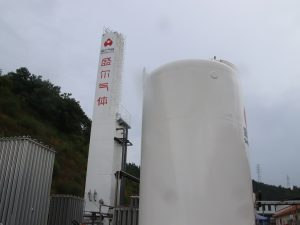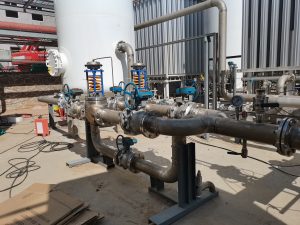
Cryogenic nitrogen production is the primary method for obtaining high-purity nitrogen by cooling air to cryogenic temperatures so it can be liquefied. This process harnesses fundamental thermodynamic principles to condense atmospheric air and separate its components based on boiling point differences. In this article, we provide a clear step-by-step explanation of how cryogenic nitrogen production works at both industrial and laboratory scales, covering each major stage in detail.

Industrial-Scale Cryogenic Nitrogen Production
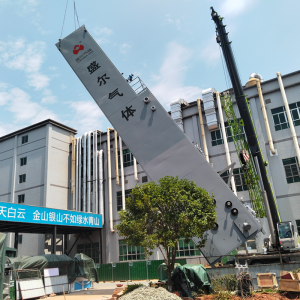
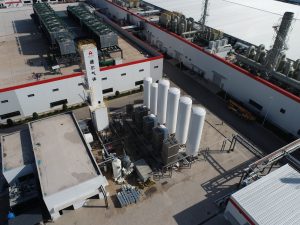
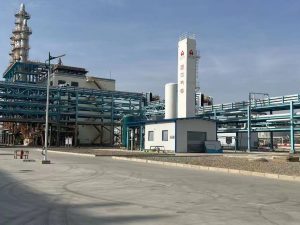
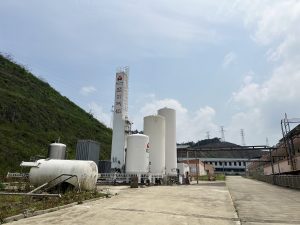
Industrial-scale cryogenic nitrogen production typically takes place in large facilities known as air separation units (ASUs). These plants are engineered to produce nitrogen (as well as oxygen and argon as byproducts) in bulk volumes with purities often reaching 99.9% or higher. The process leverages cryogenic distillation—a technique where liquefied air is separated into components at extremely low temperatures. Below is a step-by-step breakdown of the industrial process:
- Air Intake and Compression: Ambient air is drawn into the system through intake filters to remove dust and particulates. The air is then compressed to a high pressure (about 5–6 bar) using multi-stage compressors with intercoolers. Compressing the air raises its temperature, so intercoolers cool it between stages. High pressure is critical because it makes the subsequent cooling and liquefaction steps more efficient.
- Removal of Impurities (Purification): After compression, the air must be purified to eliminate moisture, carbon dioxide (CO₂), and hydrocarbons. If not removed, these impurities would freeze at cryogenic temperatures and clog the equipment. Purification is typically done by cooling the compressed air to near ambient temperature and passing it through molecular sieve adsorbers. The result is clean, dry air (approximately 78% N₂ and 21% O₂, with trace gases) ready for cooling.
- Cryogenic Cooling and Liquefaction: The purified high-pressure air is next cooled to cryogenic temperatures using heat exchangers and expansion refrigeration cycles. The air flows through a counter-current heat exchanger, where it is pre-cooled by outgoing cold product and waste gases. To reach liquefaction, a portion of the air is expanded through a turbine (turboexpander), producing a Joule–Thomson cooling effect. By the end of this stage, the air is cooled to roughly –180 °C (around 93 K), causing most of it to liquefy. The outcome is a high-pressure mixture of liquid air (rich in liquid oxygen and nitrogen) in equilibrium with some cold gas.
- Fractional Distillation (Separation): The cold liquefied air is fed into a cryogenic distillation column system to separate nitrogen from oxygen (and other gases). Industrial ASUs usually employ a double-column design at different pressures. In the high-pressure column (about 5–6 bar), the liquid air partially boils: oxygen (boiling point –183 °C) tends to remain as liquid at the bottom, while nitrogen (boiling point –196 °C) tends to vaporize and rise. The nitrogen-rich vapor from the top of the high-pressure column is nearly pure nitrogen. It is condensed against boiling oxygen in a condenser-reboiler heat exchanger and then fed as liquid reflux into the second, low-pressure column (≈1 bar). In the low-pressure column, further refinement occurs: nitrogen, having the lower boiling point, concentrates as vapor at the top, and oxygen collects as liquid at the bottom. By carefully controlling temperatures and reflux in the columns, the process yields high-purity nitrogen gas at the top (often 99.9% to 99.999% N₂). (Any argon present is typically extracted via a side draw in the lower column, since argon’s boiling point lies between oxygen and nitrogen.)
- Nitrogen Collection and Storage: The separated nitrogen gas from the top of the low-pressure column is collected as the final product. If gaseous nitrogen is desired, it is warmed back to ambient temperature through heat exchangers (recuperating cold energy to assist in cooling incoming air) and then stored or delivered via pipelines at the required pressure. If liquid nitrogen is the intended product, the nitrogen can be withdrawn as a cryogenic liquid (at approximately –196 °C) and stored in insulated cryogenic tanks or Dewars. Throughout this stage, insulation and pressure control are maintained to minimize boil-off losses. The oxygen byproduct is drawn from the bottom of the distillation system (often as a liquid) and handled separately. At this point, the nitrogen is isolated, high-purity, and ready for use in various applications.
For reference, the table below summarizes the typical temperature, pressure, and nitrogen purity values at each major stage of the industrial process.
| Stage | Temperature (°C) | Pressure (bar) | Nitrogen Purity (% N₂) |
|---|---|---|---|
| Ambient air intake | ~ 20 °C (ambient) | ~ 1 bar | ~ 78% (atmospheric air) |
| After compression & purification | ~ 5 °C (post-cooling) | ~ 6 bar | ~ 78% (no separation yet) |
| After cryogenic cooling (liquefied air) | ~ –180 °C (cryogenic) | ~ 6 bar | ~ 78% (air in liquid form) |
| Nitrogen product output | ~ –196 °C (if liquid) or warmed to ~20 °C (if gas) | ~ 1 bar (storage or delivery) | ≥ 99.9% (high-purity N₂) |
Notice that the nitrogen concentration remains around 78% until the distillation step, where it jumps to over 99.9% as the gases are separated. By maintaining these low temperatures and appropriate pressures, industrial cryogenic nitrogen production efficiently achieves the desired nitrogen purity and output phase (liquid or gas).
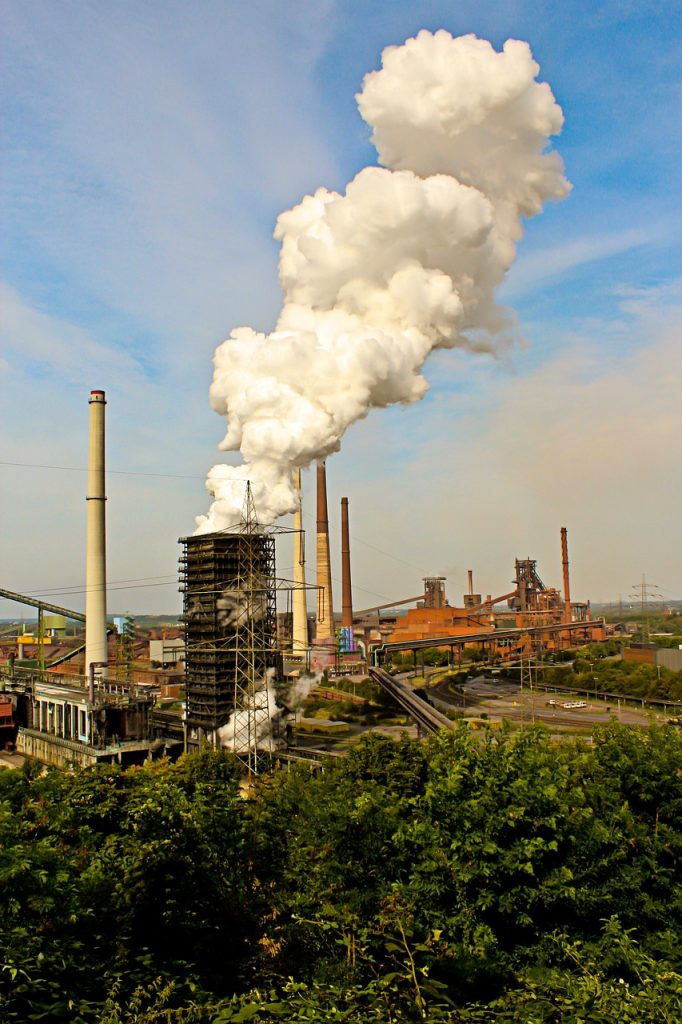
Laboratory-Scale Cryogenic Nitrogen Production
Cryogenic nitrogen production is not limited to large industrial plants; there are also laboratory-scale systems capable of producing liquid nitrogen. These lab-scale systems are used in research laboratories and medical facilities that require moderate amounts of liquid nitrogen without relying on bulk deliveries. While the fundamental principles remain the same, the implementation and scale differ from industrial-scale cryogenic nitrogen production.
In these systems, ambient air is first compressed and purified much like in the industrial process. However, instead of using tall cryogenic distillation columns, lab generators typically employ a pressure swing adsorption (PSA) unit or membrane module to separate nitrogen at room temperature. The PSA unit contains molecular sieve materials (carbon zeolites) that trap O₂, CO₂, and other molecules under pressure, yielding a stream of nitrogen gas (often ~98–99% N₂). This nitrogen gas is then directed into a compact cryogenic cooling device.
For liquefaction, laboratory generators use small cryocoolers (often based on the reversed Stirling cycle) or Joule–Thomson refrigeration to cool the nitrogen gas down to its liquefaction point. The gas circulates around the cryocooler’s cold head inside an insulated vessel, condensing into liquid nitrogen at around –196 °C. The liquid collects in an internal storage dewar. Because the feed gas is already mostly pure nitrogen, the resulting liquid is essentially liquid nitrogen with high purity (usually 99% N₂ or higher). Any residual oxygen content is minimal, and higher-purity outputs (up to 99.999% N₂) can be achieved by using more refined adsorption steps if needed.
Once liquefied, the liquid nitrogen is stored in the generator’s built-in vessel or transferred to portable containers for use. Laboratory LN₂ generators often produce on the order of a few liters per day and automatically cycle on or off to maintain the required supply. This on-demand production provides a convenient and safe source of cryogenic nitrogen for lab users, eliminating the need for frequent liquid nitrogen deliveries.
Conclusion
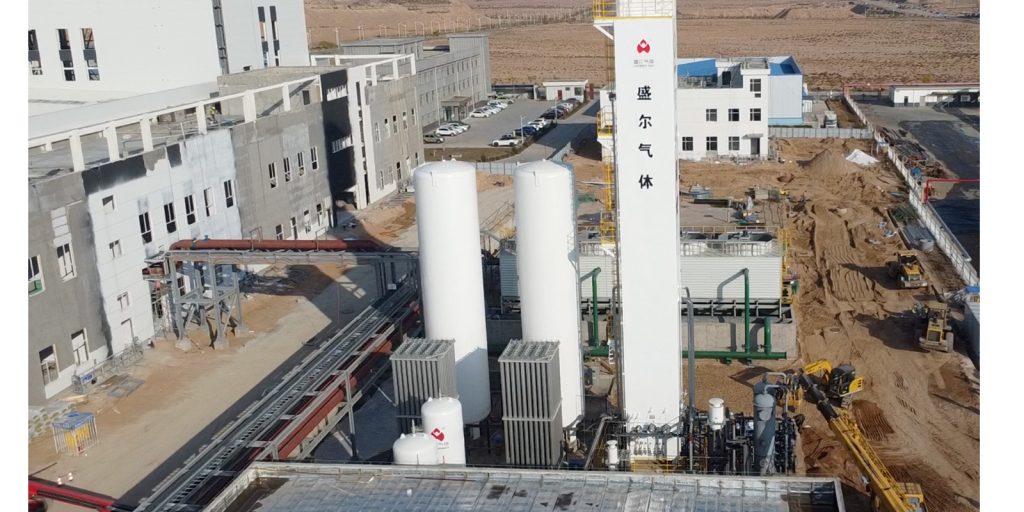
Industrial and laboratory-scale cryogenic nitrogen production rely on cooling air to cryogenic temperatures and separating nitrogen based on its boiling point. In industrial settings, fractional distillation in large ASUs provides massive quantities of high-purity nitrogen for sectors like manufacturing, chemicals, and food preservation. At the laboratory scale, self-contained nitrogen liquefiers enable researchers and medical facilities to generate their own liquid nitrogen for experiments and storage. By understanding the step-by-step process—from air compression and purification to cryogenic liquefaction and final separation—one gains insight into how cryogenic nitrogen production works and why it remains a cornerstone technique for obtaining pure nitrogen in both industry and science.