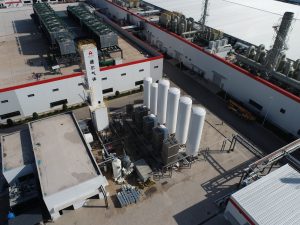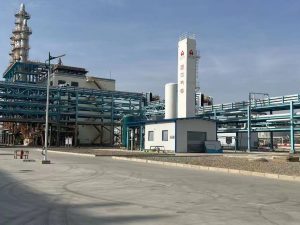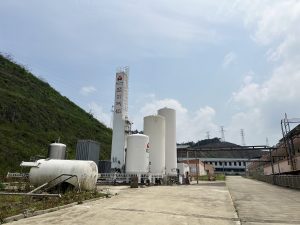
Cryogenic oxygen production is an industrial process that separates oxygen from air by liquefying the air at extremely low temperatures and then distilling it. Air contains about 21% oxygen (with most of the rest being nitrogen and argon), which is too diluted for many industrial uses. Large-scale operations such as steelmaking, petrochemical production, energy generation, and healthcare require high-purity oxygen in substantial quantities. To meet this demand, industries turn to cryogenic oxygen production in Air Separation Units (ASUs) to achieve ~99% oxygen purity and maintain a continuous, reliable supply.

Principles of Cryogenic Oxygen Production
The principle behind cryogenic oxygen production is to use fractional distillation based on the different boiling points of air’s components. Nitrogen, oxygen, and argon each liquefy at different temperatures (approximately –196 °C for N₂, –183 °C for O₂, and –186 °C for Ar). By cooling air to these cryogenic temperatures, it can be separated into its constituents: nitrogen (the lowest boiling point) vaporizes and rises to the top of the distillation column, while oxygen (with a higher boiling point) remains as a liquid at the bottom. Argon, with an intermediate boiling point, accumulates at a mid-point in the column and can be siphoned off to an argon purification unit if high-purity argon is needed.
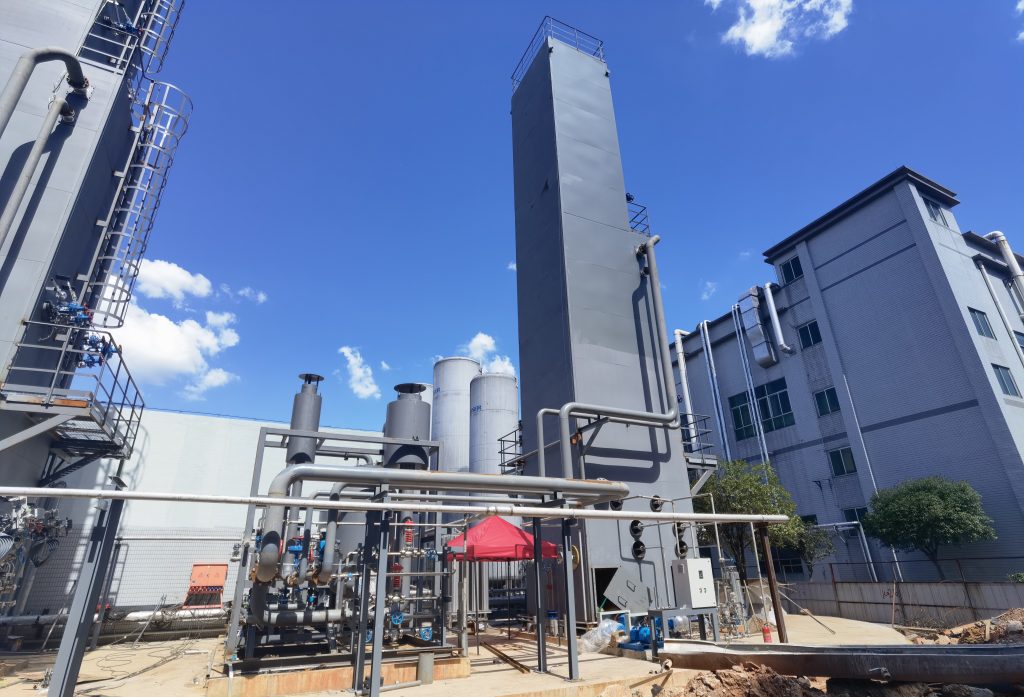
Achieving these ultra-low temperatures requires significant refrigeration. Modern ASUs use efficient plate-fin heat exchangers and expansion turbines (turboexpanders) to generate the necessary cold via the Joule–Thomson effect while also recovering some energy. All the cold equipment is housed within an insulated “cold box” to minimize heat gain from the environment. Using this approach, cryogenic air separation can produce oxygen at 99%+ purity and also yield high-purity nitrogen and argon as co-products.
Process Steps in Cryogenic Oxygen Production
Industrial cryogenic air separation involves several key steps from air intake to oxygen output. A simplified overview of the process is as follows:
- Air Compression and Purification: Ambient air is compressed to around 6 bar. Intercoolers remove the heat of compression and condense out most water vapor. The pressurized air then passes through molecular sieve beds that adsorb remaining moisture, carbon dioxide, and hydrocarbons, preventing these impurities from freezing in later stages.
- Cryogenic Cooling and Liquefaction: The dry, purified air is cooled to about –180 °C in brazed aluminum heat exchangers by exchanging heat with returning cold gas streams. To achieve full liquefaction, a portion of the air is expanded through a turboexpander, generating a refrigeration effect that liquefies most of the air.
- Fractional Distillation: The liquefied air flows into a two-column distillation system (high-pressure and low-pressure columns). In these columns, the components separate by boiling point: nitrogen (the most volatile) concentrates as a vapor at the top, while oxygen (less volatile) remains as a liquid at the bottom. The low-pressure column yields liquid oxygen around 99% purity at its base and nearly pure nitrogen gas at the top. Argon concentrates at an intermediate level; if needed, an argon-rich side stream is drawn off to a smaller argon distillation unit for purification.
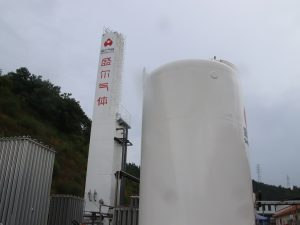
- Product Extraction and Storage: Oxygen is withdrawn from the bottom of the low-pressure column, typically as liquid oxygen (LOX), and pumped to the required delivery pressure. It is then vaporized in heat exchangers to supply gaseous oxygen to pipelines or processes. Alternatively, LOX can be stored in insulated cryogenic tanks for later use or transport. Nitrogen from the top of the column is delivered as a gas or liquefied for storage, and argon (if produced) is likewise stored or delivered for industrial use.
Efficiency and Scale Considerations
Cryogenic oxygen production is highly effective for generating large volumes of high-purity oxygen, but it is also energy-intensive. In practice, modern cryogenic ASUs consume roughly 300–600 kWh of electricity per ton of O₂ produced — several times the theoretical minimum — with higher purity or pressure requirements pushing consumption toward the upper end of that range.
Larger plants are generally more energy-efficient due to economies of scale, so cryogenic ASUs are usually chosen when oxygen demand exceeds a few hundred tons per day. Smaller-volume users often rely on non-cryogenic methods, as a large cryogenic plant may not be justified for low demand.
Typical performance parameters for a mid-size industrial cryogenic oxygen plant are summarized below:
| Parameter | Typical Value |
|---|---|
| Oxygen output capacity | ~1000 Nm³/h (≈35 tons O₂ per day) per train |
| Oxygen purity | 95–99.5% (99.5% typical industrial grade) |
| Delivery pressure | 5–20 bar (for gaseous O₂ product) |
| Specific energy usage | ~0.4–0.6 kWh per Nm³ O₂ (≈350–550 kWh/ton) |
| Argon co-production | ~5% of oxygen output (if argon is recovered) |
For example, a plant producing on the order of 40 tons of O₂ per day at ~99% purity might consume around 450 kWh per ton. Much larger plants (hundreds of tons per day) achieve the lower end of the specific energy range, while smaller units are at the higher end. Despite the high power requirements, ASUs run continuously with excellent reliability, ensuring a steady oxygen supply.
Industrial Applications and Advantages
Cryogenic oxygen production is the backbone of oxygen supply for many industries due to its ability to generate very high-purity gas in bulk. Key applications include:
- Metallurgy and Steelmaking: Blast furnaces and basic oxygen furnaces consume large volumes of oxygen to boost combustion and refine molten iron. Cryogenic oxygen provides a steady, high-purity supply for these processes, improving furnace efficiency and throughput.
- Chemical and Petrochemical Processing: Refineries and chemical plants use oxygen for processes like partial oxidation and gasification. Cryogenic plants deliver the required high-purity O₂ and flow rates needed for these large-scale reactions.
- Energy and Environmental Technologies: Oxygen is employed in oxy-fuel combustion for power generation and waste incineration, and it serves as the oxidizer in rocket launch systems. Only cryogenic oxygen production can economically supply the massive oxygen volumes required in these cases.
- Healthcare and Medical Gas Supply: Hospitals rely on bulk oxygen (often delivered as liquid oxygen from a cryogenic plant) for medical use. Cryogenic production meets strict medical-grade purity standards (≈99.5% O₂) and ensures an uninterrupted supply for patient care.
In addition to oxygen, cryogenic ASUs simultaneously produce high-purity nitrogen and argon, which have their own important uses (nitrogen for inert atmospheres, argon for shielding in welding and specialty metallurgy). This co-production makes large ASUs very cost-effective for facilities that utilize all the gases. Modern plants are also highly automated and incorporate safety measures to handle oxygen’s reactivity, ensuring dependable and safe operation.
Conclusion
In industrial air separation, cryogenic oxygen production remains the method of choice for obtaining extremely pure oxygen at large scale. By liquefying air and distilling its components, ASUs can generate oxygen (along with nitrogen and argon) on a massive scale to support diverse industries. Although the process is energy-intensive, ongoing advances in heat exchangers and energy recovery are improving efficiency. The core technology has proven reliable over decades, ensuring that when high oxygen volumes and purities are required, cryogenic air separation continues to be essential.