Role of a Refrigerated Air Dryer in a Compressed Air System
In a compressed-air system, water problems usually show up long before anyone thinks about standards or flow diagrams: water in drip legs, rusty fittings, sticking valves, and blisters in paint or coating. The root cause is simple physics – air leaving the compressor is hot and close to 100 % relative humidity, and as it cools in piping it crosses its saturation point and drops liquid water. A refrigerated air dryer is put in the line to move that condensation point out of the network and into one controlled location. By cooling the air and removing the liquid, it fixes a pressure dew point typically somewhere between about 2 °C and 10 °C (≈ 35–50 °F).维基百科+1 At normal plant pressures around 6–10 bar(g), that dew point is enough to keep lines dry in indoor environments and to meet ISO 8573-1 water content classes 4–5 for “plant air” in many factories.CAGI+2PneumaTech+2 For most general uses – tools, cylinders, packaging machines, non-critical instruments – a refrigerated air dryer gives a clean, repeatable baseline without the cost and complexity of desiccant equipment designed for much lower dew points.
How a Refrigerated Air Dryer Works in Practice
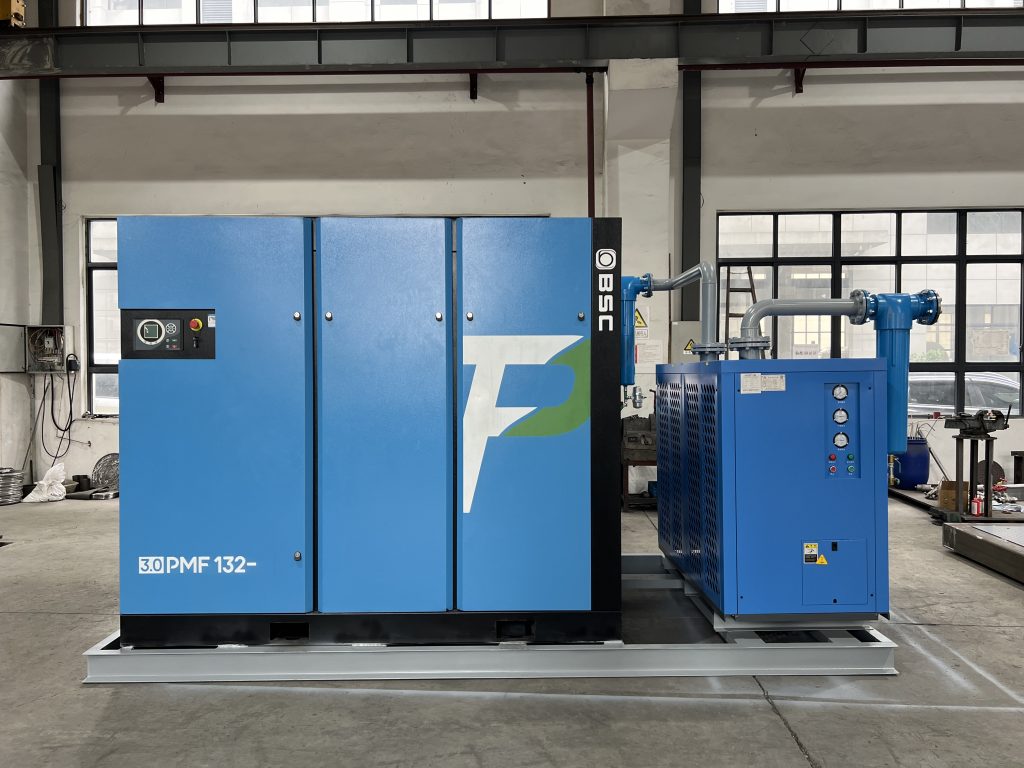
A refrigerated air dryer uses a small refrigeration circuit and a couple of heat exchangers to pull heat out of the compressed air until water condenses and can be drained off. Warm, saturated air from the compressor first passes through an air-to-air exchanger where it is pre-cooled by the outgoing dry air; at the same time, that outgoing air is reheated so the plant doesn’t end up with sweating pipework. The pre-cooled stream then enters the evaporator, an air-to-refrigerant heat exchanger where liquid refrigerant evaporates at just above 0 °C. As the air temperature is pulled down close to the evaporating refrigerant, its relative humidity hits 100 %, droplets form, and most of the water leaves the vapour phase. Immediately after the evaporator, a mechanical separator – cyclone or demister – strips out the liquid water, and an automatic drain valve discharges the condensate. The air then loops back through the air-to-air exchanger to pick up a few degrees of temperature from the incoming stream and leaves the refrigerated air dryer close to room temperature but with a much lower moisture content and a stable pressure dew point.维基百科+2SMC世界+2 In day-to-day operation, the refrigeration compressor, condenser fan and expansion valve work in the background to keep the evaporator at the right temperature; on more efficient units the cooling capacity is modulated or cycled so the evaporator does not freeze at light load.
Main Components and Typical Performance Data
Inside a refrigerated air dryer there are really two systems sharing a frame. On the compressed-air side you typically find an inlet section (often with a bulk separator or pre-filter), an air-to-air exchanger, the evaporator, a moisture separator and one or more condensate drains. Pressure drop across this path matters because every extra 0.1–0.2 bar the dryer consumes has to be made up by the compressor. On the refrigeration side there is a hermetic or semi-hermetic compressor, an air-cooled or water-cooled condenser, an expansion valve and connecting pipework. Smaller units tend to use common refrigerants such as R134a or R410A; larger industrial frames may use other blends, but in all cases the idea is the same – reject heat in the condenser, throttle the refrigerant, boil it in the evaporator and repeat. Some refrigerated air dryer designs add a thermal mass tank or variable-speed drive so the refrigeration compressor can slow down or stop at light load without letting the dew point drift too far. Table 1 summarises typical data for a medium-size industrial refrigerated air dryer rated under standard test conditions (about 7 bar(g), 35 °C inlet, 25 °C ambient); specific numbers vary by manufacturer, but the ranges are consistent with current product literature.约翰·亨利·福斯特+2Induchem Group+2
Table 1 – Typical technical data for a medium industrial refrigerated air dryer (indicative ranges)
| Parameter | Typical range / value | Comment |
|---|---|---|
| Nominal flow capacity | 100–2 000 Nm³/h (≈ 60–1 200 scfm) | Larger frames built as multiple parallel circuits |
| Operating pressure range | 4–14 bar(g) | Check maximum allowable working pressure on datasheet |
| Rated inlet air temperature | 35 °C | Higher inlet temperature reduces effective capacity |
| Usual ambient temperature range | 5–40 °C | Above ≈ 35–38 °C, condenser derating is significant |
| Typical pressure dew point | +2 to +7 °C | Corresponds roughly to ISO 8573-1 water class 4–5 |
| Residual water at 7 bar(g) | ≈ 0.005–0.008 kg/m³ | > 90–98 % of inlet moisture removed |
| Pressure drop through dryer | 0.15–0.30 bar | Aim to keep system treatment losses below ~0.5 bar total |
| Dryer power (order of magnitude) | 0.08–0.15 kWh per Nm³/min of rated flow | Strongly load- and design-dependent |
| Typical electrical supply | 230 V 1-ph or 380–460 V 3-ph, 50/60 Hz | Follows local grid standards |
These figures are enough for a first-pass check of how much a refrigerated air dryer will affect compressor power and network pressure. Once a specific model is chosen, its correction curves for pressure, inlet temperature and ambient temperature should be applied to see how much capacity is left under real site conditions.

Selection Notes and Where a Refrigerated Air Dryer Fits Best
When you size a refrigerated air dryer for a project, it helps to start with three simple questions: what is the real maximum air flow, how hot is the air when it actually reaches the dryer, and how warm does the compressor room get in summer. Catalogue capacities are usually based on clean conditions – moderate inlet temperature, moderate ambient, nominal pressure – but many compressor rooms run hotter, and many aftercoolers are partially fouled. If the air arrives at 45–50 °C instead of 35 °C, and the room sits at 35–40 °C, the same frame can deliver noticeably less drying capacity than the nameplate suggests. A practical approach is to apply the manufacturer’s correction factors for pressure, inlet temperature and ambient temperature, then add a margin of 20–30 % to cover seasonal peaks and gradual fouling. In most plants the refrigerated air dryer is installed straight after the compressor and aftercooler, ahead of the main distribution header. That way it fixes a system-wide dew point and limits corrosion and water issues across the network, while point-of-use filters tidy up particles and oil to whatever quality class is needed locally.CAGI+2Digital Wealth+2
In terms of application window, a refrigerated air dryer fits well wherever piping is indoors and ambient temperatures stay above its pressure dew point. It is the normal choice for workshop air, general assembly, non-contact food and beverage packaging, many paint and coating lines, and utility air for valves in mild climates. It is the wrong tool where piping will see sub-zero ambient temperatures or where the process demands very low dew points (for example, −40 °C instrument air in cold climates or certain pharmaceutical and electronics processes). In those cases the usual arrangement is a refrigerated air dryer as a “bulk” dryer followed by a desiccant stage that pulls the dew point down further.维基百科+2电厂与计算+2 Used in the right range and sized from realistic data, a refrigerated air dryer quietly removes most of the moisture load from a compressed-air system and turns water from a chronic nuisance into a controlled parameter.