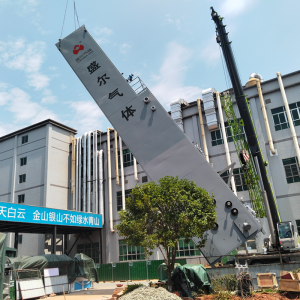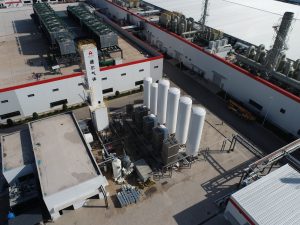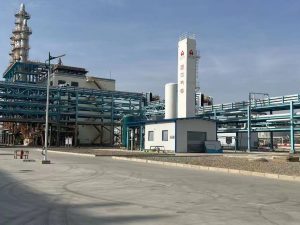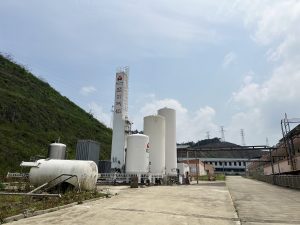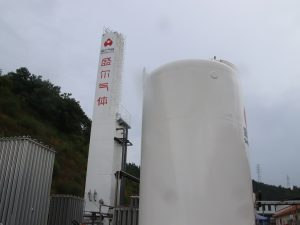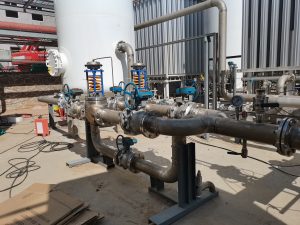
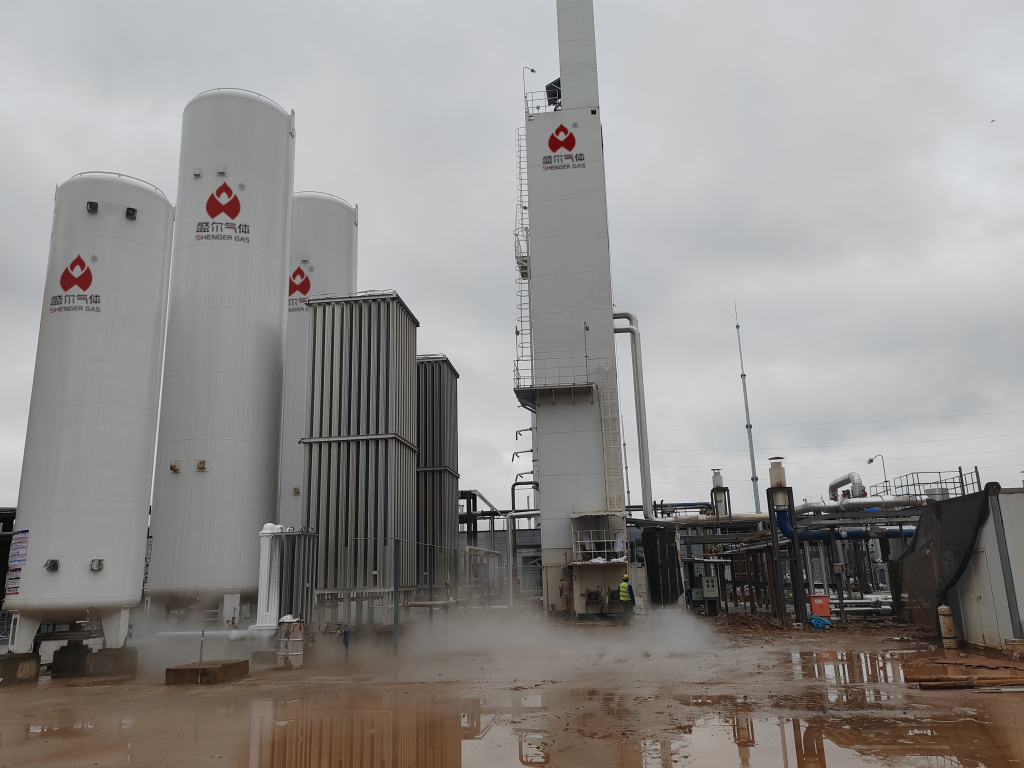
Across American industry, large cryogenic air separation units (ASUs) are attracting new investment as companies race to secure high-purity oxygen and nitrogen. These massive plants cool and distill air to produce O₂ (typically ≥99.5% pure) and N₂ (≥99.9% pure), often with argon co-productionshengerhk.commathesongas.com. In the U.S., demand from traditional sectors and emerging clean-energy projects is fueling a surge in ASU capacity. Leading gas suppliers and manufacturers are breaking ground on new cryogenic ASUs (for example, Messer’s $70M plant in Arkansas and new Air Products facilities in Georgia and North Carolina) to meet soaring industrial gas needs. Key drivers for this trend include:
- Steelmaking Decarbonization: Modern steel mills burn and refine iron using pure oxygen. Blast furnaces and basic oxygen furnaces consume thousands of cubic meters of 99%+ O₂ per hour, and they also use N₂/Ar for inert atmospheres and casting processes. New decarbonization strategies (hydrogen-based reduction, oxy-fuel combustion with carbon capture) still hinge on reliable O₂ supply.
- Chemical Industry Growth: Ammonia, methanol, olefins and other chemicals rely on large volumes of air gases. Anhydrous ammonia plants require pure nitrogen from ASUs (H₂ is combined with N₂), and many oxidation reactions (ethylene oxide, hydrogen peroxide, etc.) depend on high-purity O₂. The fertilizer and petrochemical sectors expanding capacity (including green ammonia and methanol projects) are driving robust N₂/O₂ demand.
- Clean Energy & Hydrogen Economy: Scaling up hydrogen for fuel and chemicals creates new ASU needs. “Green” hydrogen (via electrolysis) may vent O₂ but producing green ammonia or fuels still needs N₂ from ASUs. O₂-rich combustion (oxy-fuel boilers and gasifiers) is also used in carbon capture and bioenergy, creating additional oxygen consumption. In short, the growing hydrogen hubs and carbon-capture projects all benefit from on-site ASUs to supply ultra-pure gases.
These trends come against a backdrop of government support for industrial decarbonization (multi-billion-dollar DOE investments and tax credits) and aggressive corporate plans. For example, the U.S. Department of Energy’s programs have earmarked billions for cleaner manufacturing and hydrogen hubs, implicitly boosting demand for the oxygen/nitrogen infrastructure ASUs provideinvesting.commesser-us.com. Major industrial gas players are responding: Air Products, Messer, and Matheson (Nippon Sanso) have announced new cryogenic ASUs, while mergers like Baker Hughes’ purchase of Chart Industries signal strategic focus on cryogenic technologyopenpr.commesser-us.com.
Steel Sector: Oxygen Demand and Decarbonization
The steel industry remains the largest individual user of cryogenic ASUs. Integrated steel mills blow 99%+ pure oxygen into blast furnaces and basic oxygen furnaces, and they circulate N₂ and Ar for inert atmospheres in casting and heat treatment. For instance, enriching a blast furnace’s hot air with extra O₂ (to ~30–40%) dramatically reduces coke use and boosts productivityshengerhk.com. Similarly, modern oxygen converters inject thousands of cubic meters of O₂ in each melt to oxidize impurities, a process that would be impossible without ASUs supplying high-rate, high-purity oxygenshengerhk.com. In continuous casting, argon from ASUs is bubbled through steel to remove inclusions, and N₂ is used for protective gas blankets. All these processes have relied on centrally supplied ASU gases for decades.
In the push to decarbonize, steelmakers are exploring hydrogen and oxy-fuel technologies — but even those strategies require ASUs. Hydrogen-based reduction still often coexists with oxygen enrichment in furnaces, and “oxy-fuel” combustion (burning hydrocarbons with pure O₂) can capture almost all CO₂ in the exhaust. Oxygen-fired process heaters and waste-gas burners (enabled by ASUs) can thus lower emissions intensity. Even scrap-based electric arc furnaces use ASU oxygen for burner heating, and ASU nitrogen helps clean secondary metallurgical processes. In short, any U.S. steel plant aiming for low-carbon production needs on-site or nearby cryogenic ASUs to supply pure oxygen and inert gases. New steel projects and retrofits (such as U.S. Steel’s Big River expansion and others) are partnering with gas suppliers to secure dedicated ASU capacity. This long-term demand is why steel companies and DOE-backed projects alike emphasize building out cryogenic ASUs.
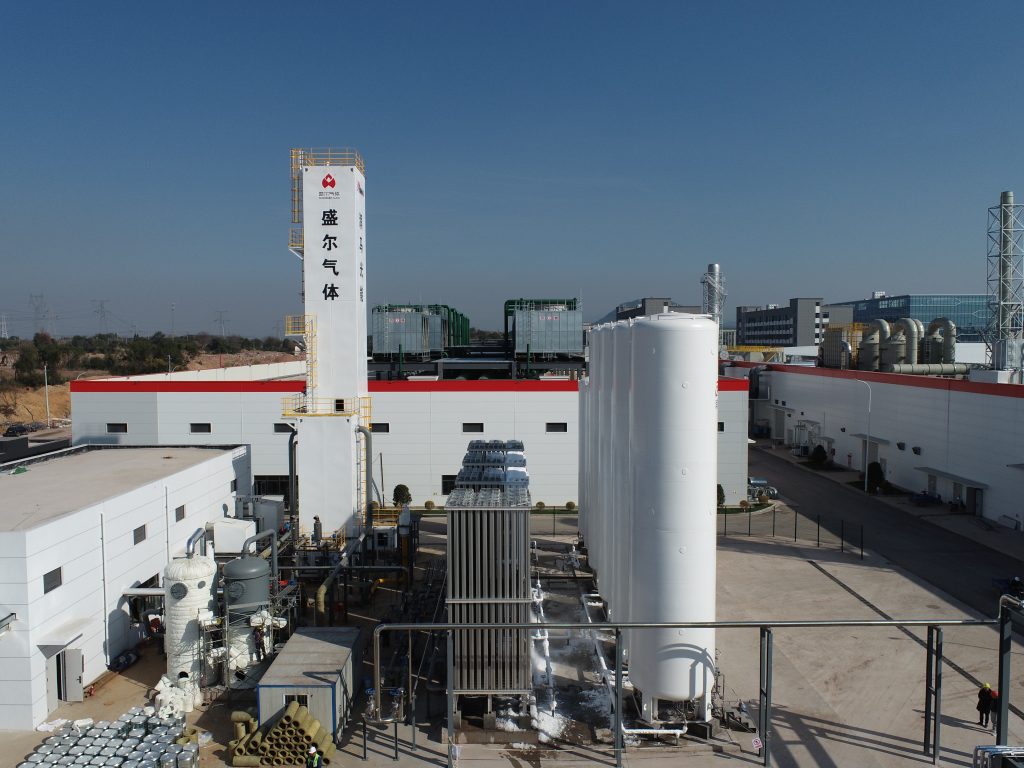
Chemical Sector: Nitrogen and Purity Requirements
The chemical industry is another cornerstone of ASU demand. Bulk chemical processes — from ammonia and fertilizers to petrochemicals and glassmaking — require high-purity gases at high volumes. Ammonia synthesis (for fertilizers and green hydrogen carriers) needs pure nitrogen blended with hydrogen; these N₂ volumes (often hundreds of Nm³/hour) come from cryogenic air separation. Likewise, hydrogen production itself can use ASU oxygen in reforming or autothermal processes. Large chlor-alkali and hydrocarbon oxidation plants consume oxygen in reactors to make ethylene oxide, propylene oxide, styrene, and other intermediates. When chemical producers expand capacity or switch to cleaner production (e.g. electrified processes), they often need additional ASU supply.
Recent industry investments underscore this trend. For example, chemical firms in the U.S. have announced new blue and green ammonia projects; all of them integrate new ASUs to provide nitrogen. The Dave Donaldsonville project (CF Industries and ThyssenKrupp) will run electrolysis + Haber-Bosch, tapping an ASU for N₂ to produce 20,000 tons/year of green ammoniadecarbonfuse.com. Similarly, methanol and synthetic fuels plants often co-locate ASUs to capture air components, and chemical parks may commission multi-gas cryogenic plants to serve many units. The Messer ASU in Arkansas, explicitly built “to meet the growing demand for industrial gases” in metals and chemicalsmesser-us.com, is one recent example: its oxygen and nitrogen output will feed local fertilizer and petrochemical operations. In general, any expansion of the chemical complex or shift to cleaner chemicals (renewable methanol, green polymers, etc.) drives fresh ASU investment.
Clean Energy & Hydrogen Economy
The clean-energy transition is creating new demand patterns for ASUs. As green hydrogen, green ammonia, and other energy vectors scale up, the need for high-purity air gases grows. Electrolyzers produce pure hydrogen (for fuel cells or ammonia) and simultaneously produce high-purity oxygen as a byproduct — but unless that O₂ finds a use, it is often vented. In practice, electrolyzer projects sometimes plan to reuse or sell this oxygen (for example in wastewater treatment or as industrial O₂), increasing ASU-equivalent requirements. More directly, the move to hydrogen economy means larger ammonia and fuel plants, which demand ASU nitrogen. The expansion of hydrogen hubs (recently spurred by federal funding) implicitly boosts ASU capacity needs; an ASU is a standard partner in any large hydrogen/ammonia project for the required N₂ or O₂.
Oxygen from ASUs is also central to several carbon-capture and low-carbon fuel processes. Oxy-combustion power plants and gasifiers rely on pure O₂ to burn fuels with minimal nitrogen. For example, biomass and waste-to-energy projects may use ASU oxygen to generate syngas under controlled, low-N₂ conditions. This oxy-combustion yields a nearly pure CO₂ stream that is easier to capture. Similarly, direct air capture plants sometimes use nitrogen (from ASUs) to purge captured CO₂ or to regenerate sorbents. In other words, clean energy and decarbonization technologies — whether hydrogen synthesis or carbon capture — generally integrate cryogenic ASUs to supply the necessary pure gases.
Recent years have seen many announcements tying ASUs to the hydrogen economy. Besides the ammonia projects noted above, air gas companies are aligning with hydrogen: for instance, Linde and Air Products are key suppliers for multiple U.S. hydrogen hub clusters. In one case, Air Products is building a giant ASU as part of its Mississippi Gulf Coast hydrogen complex, aimed at producing clean hydrogen and helium. And Matheson (Nippon Sanso) recently contracted Nikkiso to build a new ASU in Las Vegas (online by 2027) specifically to produce oxygen, nitrogen, and argon for the growing West Coast hydrogen, electronics, and energy marketsgasworld.com. These moves reflect a broader clean-energy strategy: build cryogenic ASUs to underpin the hydrogen-fueled industries of the future.
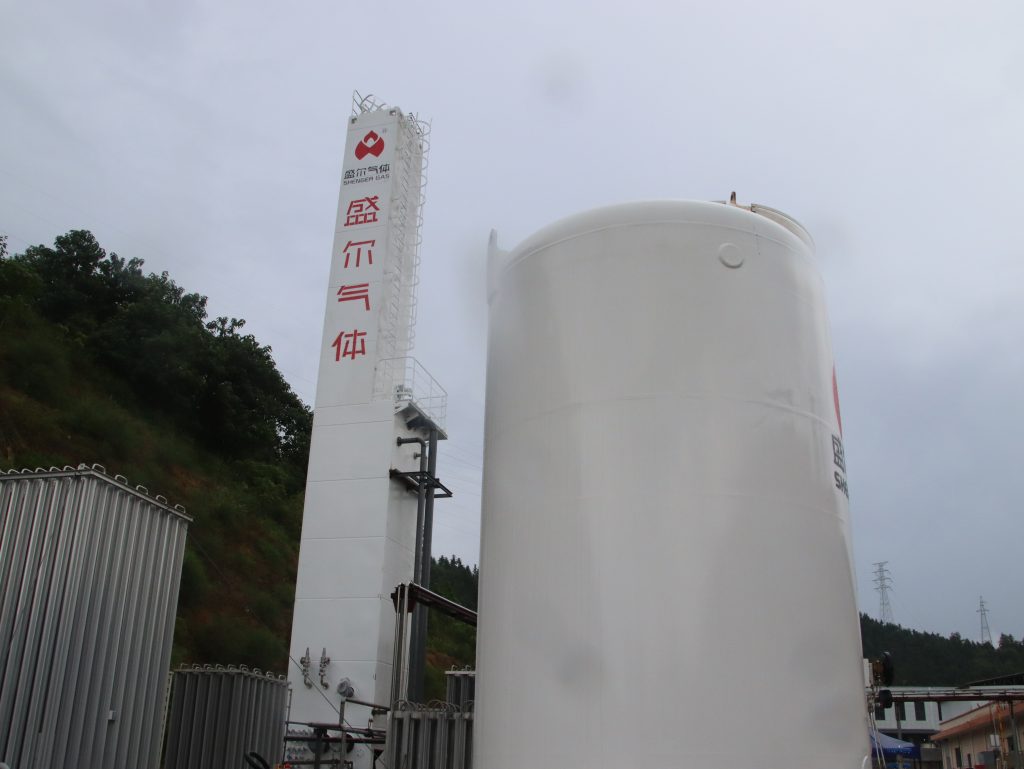
Comparing Separation Technologies
The choice of air-separation technology depends on required scale and purity. Cryogenic ASUs dominate for very high output and ultra-high purity, while PSA (pressure-swing adsorption) and membrane systems serve smaller or medium applications. The table below compares typical performance:
| Technology | Typical Scale | O₂ Purity | N₂ Purity | Energy Use (per unit O₂) |
|---|---|---|---|---|
| Cryogenic ASU | Very large: 100–5,000+ tons/day (thousands of Nm³/h) | ≥99.5% O₂ (liquid O₂), ≥99.9% N₂, with co-produced Ar | ≥99.9% | High energy (~400–600 kWh/ton O₂) but improves at scale |
| PSA (adsorption) | Small–medium: ~10–1,000 Nm³/h | ~90–95% O₂ (max) | ~95–99.5% N₂ | Moderate (equivalent ~200–300 kWh/ton O₂) |
| Membrane Separation | Small: tens–hundreds Nm³/h | Low, typically <50% O₂ | ~90–99% N₂ | Lower (but limited purity and output) |
Cryogenic ASUs use cryogenic distillation columns and typically serve centralized, continuous operations. They require higher capital and electricity, but they yield bulk production with flexibility to adjust purity and co-produce argon. PSA systems (often used on-site for hospitals or small labs) switch adsorbent beds to generate moderate-purity O₂ or N₂; they start up quickly but cannot reach the ultra-high purities or volumes of cryogenic units. Membrane units (more common for nitrogen generation) pass compressed air through selective polymer membranes, offering small footprints and low maintenance but limited output.
In practice, any major steel mill or chemical plant that needs thousands of tons of oxygen/N₂ per day will opt for cryogenic ASUs. Large cryogenic plants achieve economies of scale – the electricity consumed per unit of gas drops as capacity grows – making them cost-effective for big industrial usersminnuogas.commathesongas.com. By contrast, smaller manufacturing or medical facilities may rely on PSA or liquid deliveries for flexibility. Modern cryogenic designs also incorporate digital controls and energy-recovery (for example, improved heat exchange or waste-heat power generation) to boost efficiency. Some ASUs now even combine cryogenic and membrane/PSA elements to match variable demand or to reduce power use in partial loads.
Outlook: Decarbonization and Industry Implications
Cryogenic ASUs are proving critical to U.S. industrial decarbonization efforts. By enabling oxygen-intensive processes (oxy-fuel combustion, hydrogen-based metallurgy, clean chemical synthesis) and supplying the pure gases needed for new fuels, they support emissions cuts across sectors. National policy is reinforcing this trend. For example, in 2024 the DOE announced roughly $6 billion for advanced manufacturing and hydrogen projects, explicitly targeting greenhouse gas reduction in steel, cement, and chemical plantscarbonherald.com. Such funding, along with tax incentives for clean hydrogen (45V credit), encourages companies to invest in supporting infrastructure — including ASUs.
In parallel, leading industrial gas firms are aggressively expanding capacity. The record acquisition of Chart Industries by Baker Hughes in 2025 (for ~$13.6B) emphasized expanding cryogenic capability and hydrogen infrastructureopenpr.com. Air Products is committing multi-billion-dollar capex to new ASUs and hydrogen trains. Even energy companies like Exxon and Chevron are exploring “blue” hydrogen hubs which rely on ASU-supplied O₂ for steam methane reformers and N₂ for carbon capture.
For technical professionals, the message is clear: the U.S. is moving toward an era where gigawatt-scale industrial processes need equally massive, pure gas supplies. Engineers designing next-generation steel mills or refineries must plan for on-site cryogenic ASUs. Plant operators can expect tighter integration of ASUs with renewable electricity (to mitigate the grid intensity of ASUs) and with carbon capture systems (using ASU oxygen to produce a pure CO₂ stream). The increasing deployment of cryogenic ASUs also highlights opportunities in energy optimization — innovations like variable-speed compressors, advanced turbines, or hybrid systems (cryogenic+adsorption) can yield further efficiency gains.
In summary, U.S. industries are investing in cryogenic ASUs because these units are the only viable source of the massive, ultra-pure oxygen and nitrogen volumes required by modern steelmaking, chemical production, and emerging clean-energy applications. This investment trend reflects combined pressures: aging ASU fleets needing replacement, surging demand from decarbonization projects, and a favorable policy climate. As a result, cryogenic air separation is set to remain a backbone technology of heavy industry and the energy transition for the foreseeable future.