How Cryogenic Air Separation Works: From Compression to Distillation

This overview follows the process from compression to double-column distillation with an engineering lens. The goal is to connect thermodynamics and mass transfer to the real constraints that researchers and plant engineers care about: dryness and cleanliness, main heat exchanger pinch, expander work recovery, column coupling, and the operational margins that keep an ASU stable through ambient swings and turndown.

cryogenic air separation

The warm end begins with filtration and, for large plants, a multi-stage centrifugal main air compressor with intercooling. Compression is not only about delivering flow; it defines the pressure “architecture” of the entire flowsheet. Higher pressure can make some refrigeration and liquefaction steps easier, but it increases compressor work and amplifies the energy penalty of downstream pressure drops.

Aftercoolers remove the heat of compression and condense a substantial portion of inlet moisture. Effective knock-out and drainage here reduce the loading on adsorption beds and lower the risk of ice formation later. For variable-load operation, surge control, inlet guide vane strategy, and compressor map selection can matter as much as the headline polytropic efficiency.

Before deep cooling, air must be stripped of species that would solidify at cryogenic temperatures. Water and carbon dioxide are the primary targets; depending on site air quality and hydrocarbon risk management, trace organics and nitrous oxide may also be monitored. Modern plants typically use a temperature-swing adsorption (TSA) pre-purification unit (PPU) with molecular sieves arranged as two (or more) beds cycling between adsorption and regeneration.

During adsorption, cooled compressed air passes through a guard layer (often activated alumina) and a zeolite layer that captures H₂O and CO₂ to very low residual levels. During regeneration, hot dry gas—commonly waste nitrogen—desorbs impurities and restores capacity. In cryogenic air separation, especially for plants that operate year-round, the PPU is a reliability gate: breakthrough can lead to freezing in narrow passages, rising pressure drop, degraded heat transfer, and ultimately a forced warm-up.

Two design constraints dominate in practice. First is the minimum temperature approach (pinch): reducing pinch lowers power but increases exchanger size and sensitivity to maldistribution. Second is pressure drop: additional cold-box pressure drop is not local—it feeds back into the required compressor head and shifts effective column pressures. This is why detailed passage layout, fin selection, and distribution quality are treated as first-order design decisions, not packaging details.

To reach the cold end, the plant must create refrigeration. A turboexpander is usually the primary device because it produces cold while extracting work from the gas. That work can be recovered in a brake compressor or generator, improving overall efficiency. Expander inlet temperature, pressure ratio, and isentropic efficiency largely determine how much of the feed can be liquefied and how robust the cold balance remains during load changes.

Joule–Thomson throttling (JT) is also used, typically for cold-balance trimming and for generating additional liquid under favorable conditions. Unlike an expander, a JT valve produces no shaft work, so it is generally less efficient as a refrigeration source; its advantage is simplicity and controllability.

A common large-plant strategy is to split the purified air. One portion is boosted/cooled to support the high-pressure column, while another portion is expanded toward low-pressure conditions to generate refrigeration and partial liquefaction. The split is a core degree of freedom linking efficiency to operability in cryogenic air separation.

Separation is achieved by rectification once the air is partially liquefied. Cryogenic air separation exploits the volatility difference between nitrogen and oxygen (and argon, if recovered). Because relative volatility is modest, industrial plants usually rely on a double-column system: a high-pressure (HP) column coupled to a low-pressure (LP) column through a condenser–reboiler.

In the HP column, cooled air enters near its dew point. Nitrogen-rich vapor rises while oxygen-enriched liquid flows downward over trays or structured packing, establishing internal reflux and sharpening composition profiles. The nitrogen overhead from the HP column is condensed in the condenser–reboiler. The latent heat released there boils oxygen-rich liquid on the LP side, providing the vapor traffic that drives high-purity separation without an external reboiler.

The LP column operates closer to atmospheric pressure. Nitrogen is typically withdrawn near the top as gas (and/or liquid), while oxygen is withdrawn from the bottom region as liquid. If pressurized gaseous oxygen is required, pumping liquid oxygen and vaporizing it in the MHE is often energetically favorable compared with compressing gaseous oxygen to the same delivery pressure.

Argon recovery, when included, tightens the operating window further by adding additional separation stages and increasing sensitivity to column hydraulics and reflux stability. In those designs, leak-tightness and steady cold balance become as important as equilibrium stage count.

Products leave the cold end and are warmed in the MHE, returning cold to the incoming air. The objective is to meet delivery conditions (temperature, pressure, purity) while minimizing net cold loss. Nitrogen may be delivered as gas, as liquid nitrogen, or as both. Oxygen may be delivered as gas, as liquid oxygen, or as pumped liquid that is vaporized to a higher pressure.

Waste nitrogen is not merely a vent. It often supplies PPU regeneration, instrument purges, and sealing gas, and it is a practical manipulated variable for stabilizing column pressures and condenser duty across ambient swings and turndown. In both experiments and full-scale operation, many “small” losses (heat leaks, valve leakage, analyzer drift) manifest as shifts in waste flow and noticeable changes in the apparent efficiency of cryogenic air separation.

The ranges below are representative of large modern double-column plants. Actual values depend on product slate (gaseous vs. liquid products), integration (booster, expander, liquid backup), and site conditions.

Section / Parameter典型范围工程意义
主空气压缩机排气口5–7 bar(a)Sets HP column level; higher pressure increases compressor work
HP column top pressure4.5–6.5 bar(a)Determines condenser–reboiler temperature driving force
LP column top pressure1.1–1.4 bar(a)Influences separation sharpness and oxygen boiling temperature
Cold-end temperature, N₂-rich~77–82 KVaries with pressure and nitrogen purity target
Cold-end temperature, O₂-rich~88–92 KNear oxygen boiling region under operating pressure
Typical oxygen purity (gas)95–99.5 mol%Higher purity usually raises reflux and power
Typical nitrogen purity (gas)99.9–99.999 mol%Ultra-high purity amplifies leak-tightness and control demands
Indicative specific power0.35–0.65 kWh/Nm³ GOXDepends strongly on scale, co-products, and delivery pressure
PPU outlet dryness target≤ -70 °C dew pointMargin against icing and CO₂ freeze-out in the MHE

If you track losses by the second law, avoidable irreversibilities in cryogenic air separation are dominated by pressure drops and finite-temperature heat transfer. A few millibars of extra pressure drop through the MHE or columns can translate into a higher compressor discharge pressure, which the plant pays continuously. This is why cold-box pressure-drop budgets are often treated like contract items rather than “nice to have” specifications.

Pinch strategy in the MHE is the other major lever. Smaller approach temperatures reduce power but increase surface area and sensitivity to flow maldistribution; more conservative approaches improve robustness but raise refrigeration duty. The best pinch is therefore a techno-economic decision tied to electricity price, uptime requirements, and expected operating discipline.

Integration choices often move the needle more than incremental hardware tweaks. Delivering oxygen as pumped liquid, recovering expander work effectively, selecting column pressures that align with compressor best-efficiency regions, and minimizing unnecessary throttling can all reduce specific power while improving operability.

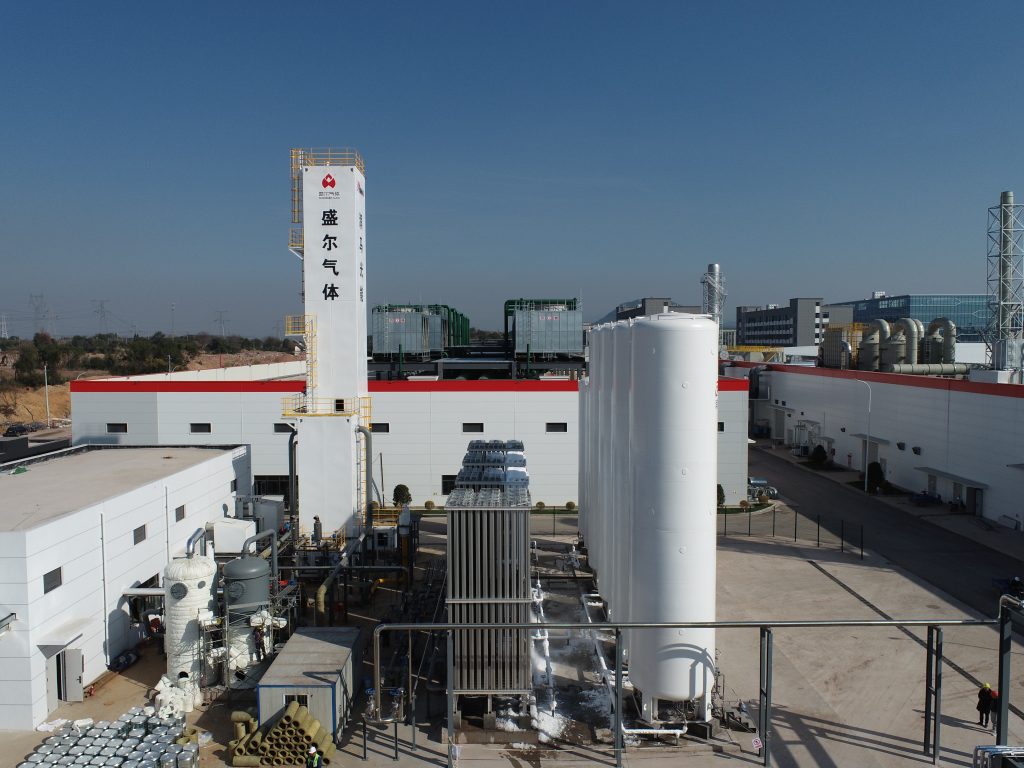
DCIM100MEDIADJI_0023.JPG

Once cold and dry, an ASU can run for long campaigns, but unplanned warm-ups tend to trace back to a small set of causes: moisture ingress during maintenance, adsorption breakthrough, hydrocarbon management incidents, or instrumentation failures that disturb reflux or condenser duty. These issues begin at the warm end and become severe at the cold end because ice and solids accumulate in narrow passages and cannot be “flushed out” without warming.

Start-up and cool-down procedures deserve the same rigor as steady-state optimization, because cryogenic air separation has very little tolerance for transient moisture or unstable cold balance. Thermal gradients can stress plate-fin exchangers, column internals, and cryogenic piping, while premature admission of insufficiently dry air can seed icing where it is hardest to remove. For researchers and plant engineers alike, the practical lesson is that cryogenic air separation is an integrated system: compression, purification, heat exchange, expansion, and distillation must be tuned as a whole.

A double-column ASU is, in essence, a refrigeration machine wrapped around a distillation problem. When you map the system from compression to distillation, the recurring themes become clear: pressure drop is a permanent energy tax, dryness is a non-negotiable constraint, and reflux stability is what keeps specifications from drifting. These are not “details”; they are the mechanisms that decide whether cryogenic air separation delivers predictable purity and recovery at acceptable power.For most large plants, cryogenic air separation remains the most scalable route to high-purity oxygen and nitrogen.

相關文章