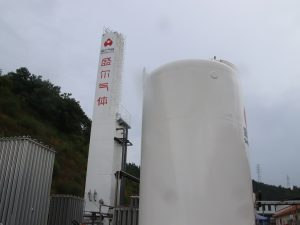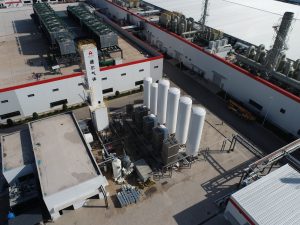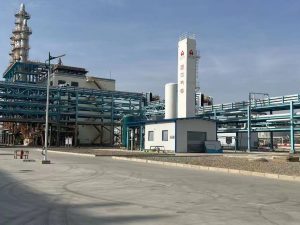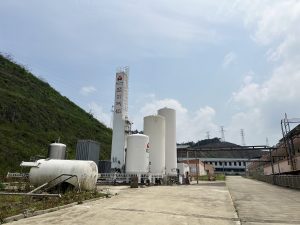
In cryogenic air separation, the Double Column System in Cryogenic Air Separation is the predominant configuration for large-scale oxygen and nitrogen production. This system uses two thermally coupled distillation columns operating at different pressures (typically ~5–6 bar in the high-pressure column and ~1.2–1.3 bar in the low-pressure column) to efficiently separate compressed air into O₂ and N₂. By integrating heat exchange between the columns, this design achieves high separation efficiency and allows very high product purities and recoveries.
Design of the Double Column System in Cryogenic Air Separation
The double-column ASU uses a high-pressure (HP) column and a low-pressure (LP) column that share a common heat exchanger (acting as the HP condenser and LP reboiler). Ambient air (≈78% N₂, 21% O₂) is first filtered and compressed to roughly 6–8 bar, then dried to remove moisture, CO₂, and hydrocarbons. The clean, high-pressure air is precooled in multi-stream brazed-plate heat exchangers (to ~–170 °C). In many designs, a portion of this high-pressure air is expanded through a turbo-expander or Joule–Thomson valve to generate extra refrigeration, yielding a cold feed mixture of liquid and vapor for the distillation columns.
The cooled feed enters the HP column (operating around 5–6 bar, abs). Nitrogen (which boils at –196 °C) preferentially vaporizes and rises. At the HP column top, a condenser (often a brazed-plate fin exchanger) liquefies the nitrogen vapor. The resulting liquid nitrogen can be drawn off as product or returned as reflux down the column. Meanwhile, oxygen concentrates in the liquid phase and collects at the bottom of the HP column. This oxygen-rich liquid (with only a few percent N₂) is pumped to the top of the LP column as feed and also provides reboiler duty.
The LP column operates at low pressure (~1.2–1.3 bar). In this column, the pumped liquid from the HP column boils, driven by the heat from condensing HP nitrogen. This boiling produces additional nitrogen vapor (mostly returned as reflux within the LP column) and yields very pure liquid oxygen at the bottom of the LP column. A reflux drum and reboiler in the LP column refine the separation. The LP column top vapor (mostly N₂ with some O₂) is typically returned to the main heat exchanger or recycled to the HP column condenser.
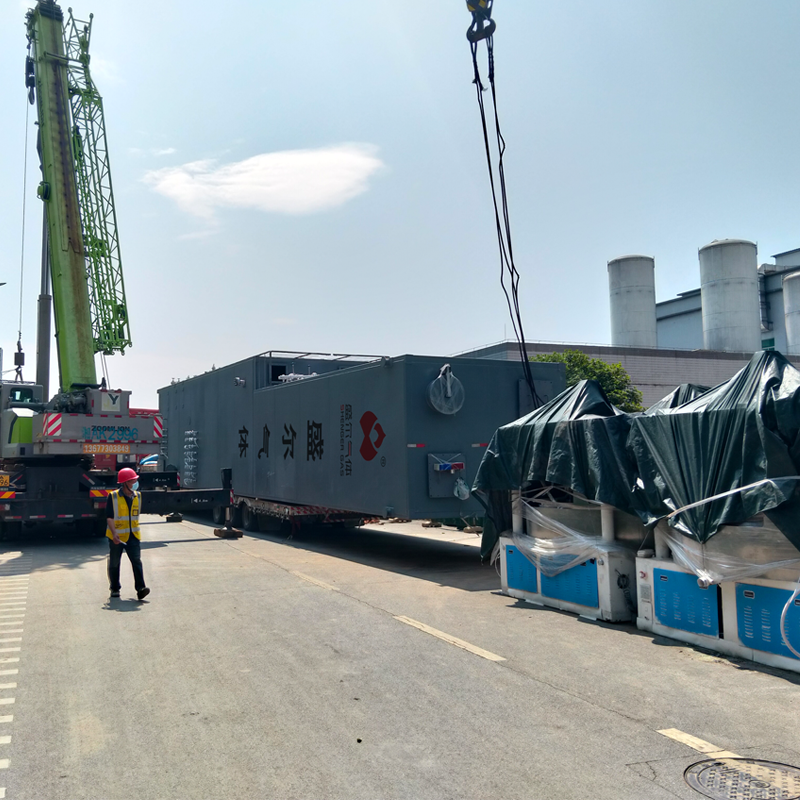
Key design features include very tall columns (often 30–50 m high) with many equilibrium stages. Modern ASUs use sieve trays or structured packing to achieve 50–100 theoretical stages while minimizing pressure drop. The entire distillation section (both columns and the inter-column exchanger) is housed in a cold box at ~80–100 K. Table 1 lists representative operating parameters and performance for a medium-scale double-column ASU.
| 范围 | 典型值 | 单位 |
|---|---|---|
| 高压柱压 | 6.0 | bar (abs) |
| 低压柱压 | 1.3 | bar (abs) |
| Cold-end heat exchanger approach | 2 | K |
| Oxygen product purity (LP column) | 99.0 | % (vol) |
| Nitrogen product purity (HP column) | 99.5 | % (vol) |
| Oxygen recovery (efficiency) | 95 | % |
| Specific energy (per tonne O₂) | 220 | kWh / tonne |
This table shows a typical HP column near 6 bar and an LP column near 1.3 bar. The cold-end approach (~2 K) highlights the tight thermal integration in the exchanger. High product purities (~99%) and oxygen recovery (~95%) are achievable, with specific power use on the order of 200–250 kWh per tonne of O₂.
Operation of the Double Column System in Cryogenic Air Separation
The double-column process follows a series of stages:
- Compression and Purification: Ambient air is drawn in and compressed by multi-stage compressors with intercooling, raising the pressure to ~6–8 bar (abs). After compression, the air passes through molecular sieve beds (4Å or 13X zeolites) to remove water, CO₂, and hydrocarbons to very low dewpoints (<–60 °C). This purification prevents freezing in the cryogenic equipment.
- Heat Exchange and Refrigeration: The purified, compressed air enters the main cold box and is precooled close to its liquefaction point by counterflow heat exchange with cold product streams. A portion of this high-pressure air is expanded through a turbo-expander (often coupled to the main compressor drive) or a Joule–Thomson valve. This expansion drastically lowers the temperature (often to ~–170 °C), and part of the air condenses. The result is a very cold feed consisting of an oxygen-rich liquid and a nitrogen-rich vapor.
- High-Pressure Column Distillation: The two-phase feed enters the HP column near mid-height. Within the HP column, nitrogen vapor rises to the top. The integrated condenser at the HP column top liquefies this high-pressure nitrogen. Liquid nitrogen is used for reflux or withdrawn as product. Oxygen concentrates in the bottom liquid. The bottom of the HP column thus accumulates an oxygen-rich liquid (typically 30–40% O₂ by volume in the HP column bottom).
- Low-Pressure Column Distillation: The oxygen-rich liquid from the HP bottom is pumped to the LP column. In the LP column, heat from condensing nitrogen (in the HP condenser) boils the liquid. This boil-up produces additional nitrogen vapor (returned as reflux) and yields nearly pure liquid oxygen in the LP column bottom. The LP column top vapor (mostly nitrogen) is typically returned to the main heat exchanger for cooling.
- Product Recovery: High-purity oxygen (liquid O₂, ~95–99.5% purity) is withdrawn from the bottom of the LP column and warmed through the heat exchangers for delivery as liquid or gas. Nitrogen product (gas, >99% purity) is taken from the top of the HP column and warmed before use. If argon is required, a sidestream of the LP column (argon-enriched liquid) is fed to an auxiliary argon column for further purification.
This multi-stage distillation recovers most of the input air into products with minimal losses. The tight heat integration between columns means condensing N₂ in the HP column provides nearly all the vaporization heat for the LP column. In practice, the temperature difference between the HP condenser and LP reboiler is only about 1–2 K, enabling very high thermodynamic efficiency.
The HP (high-pressure) column at ~6 bar and LP (low-pressure) column at ~1.3 bar share a common heat exchanger (grey) serving as both HP condenser and LP reboiler. Oxygen (LOX) exits as liquid from the LP column bottom, while gaseous nitrogen (GAN) is taken from the HP column top. This schematic highlights the flow of heat and products between the two columns. The grey box indicates the integrated heat exchanger. Notice how pure oxygen collects as liquid (LOX) at the bottom of the LP column, and pure nitrogen leaves as gas (GAN) from the HP column top. This tight coupling of the columns is the key to the double-column system’s efficiency.
Advantages of the Double Column System in Cryogenic Air Separation
The double-column configuration offers several major benefits:
- Energy Efficiency: Internal heat integration drastically reduces power needs. Condensing nitrogen in the HP column provides the reboil duty for the LP column, so very little external refrigeration is required. Modern double-column ASUs achieve low specific energy use (~200–250 kWh per tonne of O₂), which is near the thermodynamic limit for air separation.
- High Purity and Recovery: With dozens of stages and high reflux, the system can yield extremely pure products (often >99.5% O₂ and N₂) and high oxygen recovery (>90–95% of feed O₂). Operators can adjust reflux and draw-off rates to meet specific purity targets (e.g. ~95% O₂ for steelmaking, >99.5% O₂ for medical gas).
- Large Scale and Flexibility: Double-column ASUs scale well to large capacities (hundreds to thousands of tons/day of O₂). The basic HP/LP arrangement can be augmented (for example by adding an argon column) without changing the core design. These units are designed for continuous operation, making them ideal for heavy industries.
- Stable, Controllable Operation: The moderate HP column pressure and its coupling to the LP column give a robust operating point. Disturbances tend to self-balance: a fluctuation in one column is partially offset by the other. Advanced control systems ensure stable product output over a range of loads and operating conditions.
- Multiple Products: Beyond O₂ and N₂, a double-column ASU can recover argon (~1% of air) at high purity. By drawing an intermediate stream from the LP column to an auxiliary argon column, plants can produce 98–99% pure argon while still achieving full O₂/N₂ separation.
Challenges of the Double Column System in Cryogenic Air Separation
Despite its advantages, the double-column ASU has challenges:
- High Capital Cost: The dual columns require very tall vessels (often >40 m) and a complex cold box with brazed-plate exchangers and turbines. Fabrication and installation of large cryogenic columns is expensive and time-consuming. Specialized materials (stainless steels, aluminum alloys) must be used to withstand low temperatures and high oxygen levels.
- Energy Demand: Cryogenic ASUs, even with heat integration, consume substantial energy (tens of MW for a large plant). Powering the compressors and expanders is a major operating expense. Engineers continuously seek design improvements (e.g. multi-stage expanders, heat pumps) to reduce this energy use.
- Complex Process Control: Operating two interacting distillation columns adds control complexity. Changes in feed or operating conditions require coordinated adjustments of pressures, flows, and refluxes in both columns. Modern automated control and instrumentation are essential to maintain stable, safe operation.
- Cryogenic Safety: Extremely low temperatures and high-purity oxygen environments pose safety risks. All equipment must be oxygen-clean, and materials must tolerate cryogenic embrittlement. Any contamination or moisture must be strictly avoided to prevent icing. Safety systems must manage fire hazards and pressure relief.
- Maintenance Demands: Large ASUs often run continuously, so maintenance must be carefully scheduled. Molecular sieve beds need periodic regeneration, and rotating equipment (compressors, turbines) require servicing. Redundancy (e.g. spare compressors or columns) is sometimes built into design to allow service without interrupting production.
低温空气分离的工业应用
Double-column ASUs are used wherever large volumes of high-purity gases are needed. The steel industry is the largest consumer: on-site ASUs supply oxygen to blast furnaces and basic oxygen furnaces, greatly boosting furnace efficiency and throughput. The nitrogen product is used for inerting ladles and cooling. Many large steel mills operate dedicated double-column ASUs producing thousands of tonnes of oxygen per day to support their operations.
The steel industry is the largest user of ASU oxygen (for steelmaking) and ASU nitrogen (for inerting and cooling). Many steel mills have double-column cryogenic units on-site to supply these gases. The image above illustrates a typical steel complex. On-site double-column ASUs ensure a continuous supply of oxygen to improve furnace performance.
Petrochemical, chemical, and power plants also rely on cryogenic separation. For example, refinery and petrochemical furnaces and reformers often burn oxygen to achieve higher temperatures and cleaner combustion. Large steam methane reformers in ammonia and methanol plants use ASU oxygen for improved efficiency. Nitrogen from ASUs is used for reactor blanketing, purging, and as a working fluid in refrigeration cycles. In power generation, oxy-fuel combustion and gas turbine applications may use ASU oxygen, while ASU nitrogen supports turbine blade cooling. In general, any process demanding on the order of 100 tonnes/day or more of oxygen or nitrogen is most economically served by a double-column cryogenic ASU.
结论
The Double Column System in Cryogenic Air Separation is a proven, high-performance design for bulk oxygen and nitrogen production. By using two distillation columns at different pressures with an integrated condenser/reboiler, this system maximizes thermodynamic efficiency. It achieves very high product purities and recoveries while minimizing the need for external refrigeration. Although it requires substantial capital investment and power, the double-column cryogenic ASU remains the industry-standard solution for large-scale air separation. Continued refinements (better heat exchangers, advanced controls, multi-expansion cycles) build on this core design, but the double-column configuration endures as the most efficient method for industrial cryogenic air separation.