A technical walkthrough of Cryogenic Air Separation—from compression and pre-purification to refrigeration, double-column distillation, and product delivery—with practical design targets.
Industrial oxygen and nitrogen behave like infrastructure: once a plant depends on them, supply stability matters as much as purity. For large, continuous demand, Cryogenic Air Separation is the reference technology because it scales well and can produce oxygen, nitrogen, and (when configured) argon in one integrated unit. The flowsheet is familiar, but the underlying reality is a coupled system: pressure drops, exchanger approaches, and column heat duties interact, so small penalties can persist as higher kWh per unit product for years.
This article follows the physical path of air through a modern ASU and calls out the engineering levers that most affect operability and efficiency.
Process overview of Cryogenic Air Separation
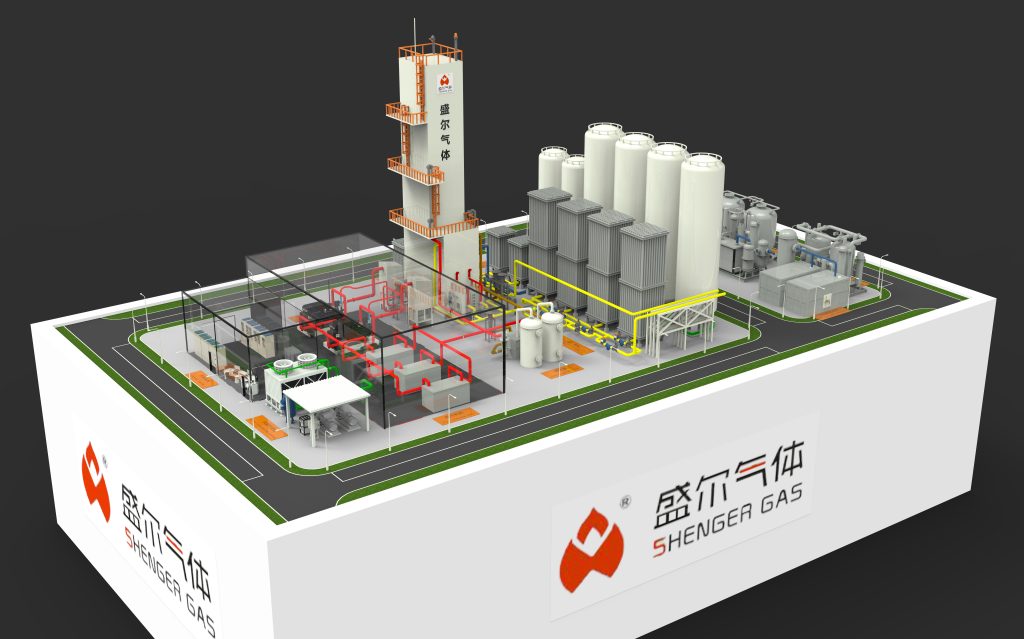
At a high level, Cryogenic Air Separation has five steps: (1) compress ambient air, (2) remove contaminants that would freeze, (3) recover cold in the main heat exchanger, (4) generate refrigeration to form liquid, and (5) distill that liquid in rectification columns. The plant’s balance point is the integrated condenser–reboiler between the high-pressure and low-pressure columns, where heat is exchanged at two cryogenic temperature levels to create reflux and boil-up.
1) Air compression: setting pressure levels and paying the power bill
Most ASUs use multi-stage centrifugal compression with inter-stage cooling to near ambient. Intercooling reduces specific work and limits discharge temperature, protecting lubricants, seals, and downstream adsorbents. The final discharge pressure is not chosen in isolation; it must support column pressures (which set saturation temperatures), main heat-exchanger pressure drop, and the refrigeration method (turboexpander and/or JT throttling).
Raising discharge pressure can improve condensation temperature levels and sometimes simplify reflux generation, but it increases compression work. Running too low can make the cold box and columns fragile: any additional ΔP from fouling or valve drift consumes operating margin and can show up as purity swings or lost capacity. A practical rule in Cryogenic Air Separation is to protect margin deliberately, because the cost of a narrow window is usually paid back many times in trips, off-spec product, and forced derates.
2) Pre-purification: keeping ice and dry ice out of the cold box
Before cooling below 0 °C, water and carbon dioxide must be removed. Ice and CO₂ solids can block plate-fin passages and destabilize column hydraulics. In Cryogenic Air Separation, the standard safeguard is a pre-purification unit (PPU) using molecular sieves (often alumina plus a CO₂-selective zeolite). Beds cycle between adsorption and regeneration, producing a dry, CO₂-lean stream suitable for cryogenic service.
For researchers, important dynamics include mass-transfer zone movement, regeneration thermal waves, and how aging changes capacity and kinetics. For operations, the practical focus is simpler: stable outlet dew point and CO₂, repeatable valve timing, and strict control of oil carryover and particulate filtration. Purification discipline is also a safety issue, since certain hydrocarbons and trace contaminants can accumulate in cold equipment if allowed to pass upstream.

3) Main heat exchanger: where integration is won or lost
The purified air enters the cold box and is cooled in a brazed aluminum plate-fin main heat exchanger (MHE) against cold returning product and waste streams. This is the plant’s cold-recovery engine: it reduces the refrigeration duty by reusing the cold already created. In modern cryogenic ASU plants, the MHE often determines whether a design is merely “theoretically efficient” or genuinely stable across seasons and load changes.
Two concepts dominate MHE performance. First is approach temperature (minimum ΔT between hot and cold composites): smaller approaches reduce required refrigeration but increase sensitivity to maldistribution and upset. Second is pressure drop: each kPa lost increases compressor work or reduces column pressure margin.
In field troubleshooting, gradual shifts in temperature profiles often signal exchanger fouling, maldistribution, or small moisture ingress. Because the MHE is highly integrated, seemingly minor cleanliness and dryness lapses during maintenance can become long-term efficiency and reliability penalties.
4) Refrigeration generation: turboexpansion plus throttling, applied strategically
To form liquid and reach cryogenic temperatures, the plant must generate refrigeration. Two mechanisms are commonly combined in Cryogenic Air Separation:
Turboexpander (work-producing expansion). A slipstream expands through a turbine, producing shaft work and a large temperature drop. This is typically the most efficient way to create cold for a given pressure ratio, and the recovered work can be absorbed in a brake compressor or coupled to a booster.
Joule–Thomson (JT) throttling. A high-pressure stream is throttled through a valve to a lower pressure, producing partial liquefaction. JT is mechanically simple and useful for creating liquid at locations that best support reflux or liquid product inventory, even if it is less efficient than a turbine for large pressure drops.
The preferred split depends on product slate, required liquid production (LOX/LIN), and the control window needed for turndown. Plants that must ride through load swings often accept a small efficiency tradeoff to gain stability and controllability in Cryogenic Air Separation operation.
5) Distillation: separating oxygen and nitrogen in a double-column system
Separation occurs by rectification: repeated vapor–liquid contacting where nitrogen (lower boiling point) concentrates in the vapor phase and oxygen concentrates in the liquid phase. A common industrial configuration uses a high-pressure (HP) column for the first split and a low-pressure (LP) column for final purification.
The HP overhead nitrogen condenses in the integrated condenser–reboiler, creating reflux. On the other side, oxygen-rich liquid boils to generate LP column vapor (boil-up). This device strongly couples column pressures, heat duties, and composition profiles, and it is one reason Cryogenic Air Separation behaves like a single system rather than independent unit operations.
For engineers, two operational realities matter. First, pressure control is unusually influential: at cryogenic conditions, saturation temperatures shift rapidly with pressure, so small pressure drifts can move internal temperature profiles and change product composition. Second, hydraulics (packing wetting, flooding margin, and pressure drop) can dominate stability long before purity specs are violated.

6) Product warm-up, delivery, and recovery tradeoffs
Cold products leave the LP column and are warmed in the MHE to recover refrigeration. Oxygen can be delivered as GOX with a product compressor, or as LOX pumped to pressure and vaporized (often attractive for high-pressure oxygen due to pump efficiency). Nitrogen may be delivered as low-pressure GAN or compressed to higher pressure as required.
Recovery (capturing more of the oxygen in the feed as product) improves material efficiency but can narrow operating margin and increase sensitivity to disturbances. The best recovery target is therefore economic and operational, not purely thermodynamic.
Typical operating targets and design ranges
The ranges below are representative for modern industrial ASUs and are best treated as starting points; actual values depend on size, scheme, and ambient conditions.
| 范围 | 典型范围 | Engineering note |
|---|---|---|
| Air to PPU pressure | 0.55–0.70 MPa(a) | Balances compressor work vs. column pressures and ΔP |
| PPU outlet dew point | ≤ −70 °C (H₂O dp) | Freezing protection in cold box |
| CO₂ after PPU | < 1 ppmv | Prevents CO₂ freeze-out |
| 高压柱压力 | 0.50–0.65 MPa(a) | Sets condenser–reboiler temperature level |
| 低压塔压力 | 0.12–0.20 MPa(a) | Lower pressure improves relative volatility |
| Typical GOX purity | 99.5–99.7% O₂ | Common industrial specification |
| Typical GAN purity | 99.9–99.999% N₂ | Higher purities need stricter contamination control |
| Specific power (indicative) | 0.35–0.60 kWh/Nm³ O₂ | Strongly scheme- and size-dependent |
| MHE approach (warm end) | 3–8 K | Smaller approach reduces power, increases sensitivity |
| 扩展器等熵效率 | 75–88% | Major lever on refrigeration effectiveness |
What most strongly drives efficiency in Cryogenic Air Separation
If you want measurable levers, focus on losses that map to plant tags:
- System pressure drop: rising ΔP across filters, the MHE, or columns increases compressor work and erodes column margin. Pressure-drop audits often return fast payback.
- Exchanger approach temperature: worsening approach raises refrigeration duty; profile trending is more informative than single-point snapshots.
- Condenser–reboiler health: reduced conductance often forces pressure shifts, typically at an energy penalty.
- Expander condition: efficiency loss or inlet quality change reduces cold generation and pushes compensating moves elsewhere.
- Purification stability: short contaminant excursions can create long reliability tails in the cold box, especially if moisture control slips during shutdowns or turnaround work.

Closing perspective
Cryogenic Air Separation remains central to industrial gas supply because it is scalable and can deliver tightly controlled purity for long campaigns—provided integration details are respected. For researchers, the most productive work often targets reduced irreversibility (exchanger architecture, expander integration) and improved operability (control strategy, disturbance rejection). For plant engineers, the fastest gains usually come from unexciting disciplines: pressure-drop management, purification performance, and stable column pressure control.