介绍
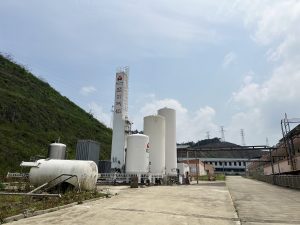
低温空气分离装置 (ASU) 是一种专门的工业设备,通过将空气冷却至极低的(低温)温度,将其分离成主要成分——氧气 (O₂) 和氮气 (N₂)。低温 ASU 被认为是生产大量高纯度氧气和氮气的先进技术。在本白皮书中,我们将探讨这些系统的运行原理及其在各个行业中的关键作用。我们还将讨论用于工业应用的氧气和氮气生产的低温 ASU 如何支撑钢铁制造、半导体制造和新兴可再生能源系统等领域的工艺流程。
低温空气分离的工作原理
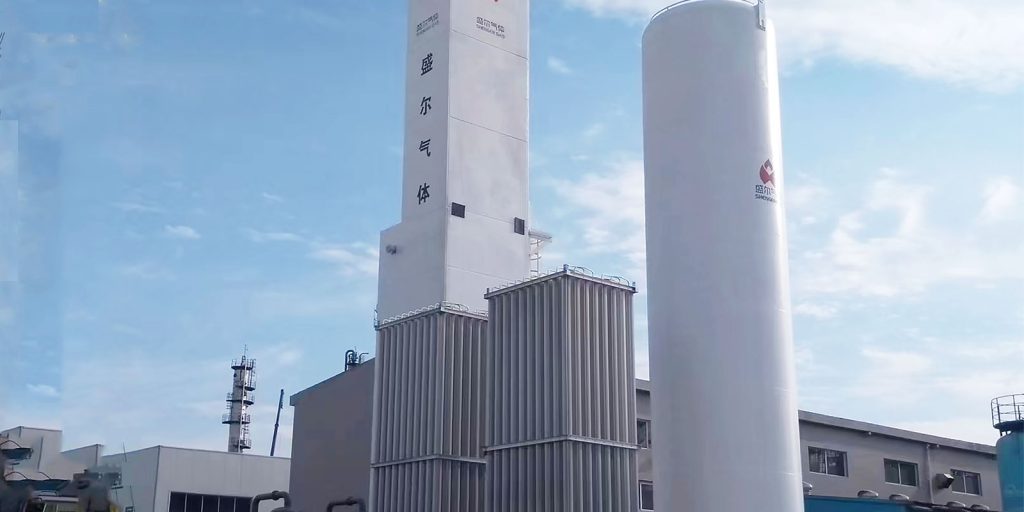
从根本上讲,用于工业应用中生产氧气和氮气的低温空气分离装置(低温空分装置)的运行原理是不同气体在不同的低温下会液化。环境空气(约含 78% 的氮气、21% 的氧气,以及氩气和微量气体)首先经过过滤并压缩至约 6-10 巴。然后,加压空气通过热交换器和膨胀涡轮机冷却至低温(约 -180°C),使大部分空气冷凝成液气混合物。
这种超低温混合物进入精馏系统,根据沸点进行分离。氮气(沸点为-196°C)汽化并上升到塔顶,而氧气(沸点为-183°C)则以液态形式聚集在塔底。现代空气分离装置通常采用双塔设计:高压塔产生富氧液体和接近纯净的氮气,然后将它们送入低压塔。低压塔底部产出高纯度(约99%或更高)的液氧,顶部则产出额外的纯氮气。如果需要生产氩气,则可以使用第三个塔从中间阶段提取氩气(沸点为-186°C)。最后,分离出的氧气和氮气被取出,加热至环境温度,并在所需的输送压力下以气态形式输送(或以低温液体的形式储存)。
关键绩效参数
每套低温空气分离装置 (ASU) 都根据特定的产品需求进行设计。关键性能参数包括产品纯度、产量(流量)、输送压力和单位能耗。表 1 列出了现代大型低温空气分离装置在工业应用中生产氧气和氮气时的典型氧气和氮气产量值:
| 范围 | 氧气 (O₂) | 氮气 (N₂) |
|---|---|---|
| 纯度(体积百分比) | 约99.5%(高纯度) | 约 99.999%(超高) |
| 流量 (Nm³/h) | 50,000(大型工厂) | 60,000(大型工厂) |
| 输送压力(巴) | 5-6巴(典型值) | 5-6巴(典型值) |
| 供应形式 | 气态或液态氧 | 气态或液态氮 |
| 比功率(千瓦时/立方米) | 0.4(每立方米氧气) | 0.3(每立方米氮气) |
表 1:生产高纯度氧气和氮气的低温空气分离装置的典型输出规格。(Nm³ = 标准条件下正常立方米;bar 指近似输送压力。)
如上所述,低温空气分离装置 (ASU) 可以提供纯度约为 99.5% 的氧气(剩余部分主要为氩气)和纯度高达 99.999% 的氮气,以满足对纯度要求较高的应用。流量可达数万 Nm³/h,这体现了这些装置的巨大规模——氧气产量约为每天 1000 至 2000 吨,氮气产量也与此成比例。管道输送的供气压力通常比大气压高几个巴,但也可以通过泵送液态产品然后将其汽化来获得更高的压力。单位氧气产量的比能耗(约为每 Nm³ 氧气 0.3-0.5 kWh)反映了所需的巨大能量输入。提高能源效率是工业应用中低温空气分离装置设计和运行的主要重点。
Steel Manufacturing Applications
The steel industry is one of the largest consumers of oxygen, and it relies heavily on on-site cryogenic ASU installations. In an integrated steel mill, a cryogenic ASU for oxygen and nitrogen production in industrial applications supplies oxygen for both the blast furnace and the basic oxygen furnace (BOF). Enriching the blast furnace’s hot air blast with pure oxygen raises flame temperatures and boosts combustion, which increases throughput and can reduce the coke needed per ton of iron produced. In the BOF, high-purity oxygen is blown at supersonic speeds into molten iron to oxidize excess carbon and other impurities, turning iron into steel. These oxygen-intensive steps demand a huge, steady flow—large steel plants often require several thousand tons of O₂ per day, which only a cryogenic ASU can economically provide.
For perspective, a single basic oxygen furnace can consume several thousand cubic meters of O₂ per minute during its blow, illustrating why only an on-site ASU can meet this intense demand.
Nitrogen from the ASU is also widely used throughout steel production. Nitrogen is inert, making it ideal for purging and blanketing to protect equipment and materials from oxidation. For example, torpedo ladles that transport molten iron are often filled with nitrogen gas to prevent unwanted reactions during transit. Nitrogen gas is also used to stir and homogenize molten steel in ladle metallurgy (sometimes in combination with argon) and to cool materials or refractory linings. The availability of abundant nitrogen as a co-product of oxygen generation means steelmakers have a convenient supply for these purposes. By using a cryogenic ASU for oxygen and nitrogen production in industrial applications on-site, steel facilities ensure both gases are available at the required rates and purities continuously. Excess production of either gas can be stored as liquid in insulated tanks to handle peak demands or maintenance periods, ensuring that the steelmaking process is never interrupted by gas shortages.
Semiconductor Manufacturing Applications
Semiconductor fabrication plants require extremely pure gases and highly reliable delivery systems. Many fabs leverage a cryogenic ASU for oxygen and nitrogen production in industrial applications to obtain a constant supply of ultra-high-purity nitrogen gas. Nitrogen at 99.999% purity (five nines) is used to purge process chambers, create inert atmospheres for sensitive deposition and etching processes, and to dry wafers, since any trace of oxygen or moisture can destroy delicate microelectronic features. Cryogenic air separation is one of the few technologies capable of producing nitrogen at both the purity and volume that large semiconductor facilities demand. Fabs also use liquid nitrogen (LN₂) from the ASU for tasks such as cooling equipment and maintaining low-humidity, ultra-clean environments.
Although nitrogen is the primary need, oxygen also plays a role in chip manufacturing. High-purity oxygen is used in processes such as thermal oxidation (to grow silicon dioxide layers on silicon wafers) and in certain plasma etching or cleaning steps. These steps may not consume oxygen in bulk quantities like steelmaking does, but they still require consistent purity and availability. An on-site cryogenic ASU allows a semiconductor manufacturer to have both gases on hand: nitrogen for general inerting and purging, and oxygen for specific process steps. The reliability of a cryogenic ASU for oxygen and nitrogen production in industrial applications is a huge benefit here—any disruption in nitrogen supply, for instance, could force a fab to halt production, which would be extremely costly. To mitigate risks, these systems often include backup storage (like liquid nitrogen tanks) and redundancy. In summary, incorporating a cryogenic ASU for oxygen and nitrogen production in industrial applications into a semiconductor facility’s utility systems ensures that these critical gases are delivered ultra-clean and without interruption, supporting high production yields and safe operations.
Renewable Energy and Sustainability Applications
Cryogenic ASU technology is increasingly intersecting with renewable energy and sustainability initiatives. One promising application is in energy storage and grid management. A cryogenic ASU for oxygen and nitrogen production in industrial applications can be operated flexibly to take advantage of surplus renewable electricity. During times of high wind or solar output, an ASU can ramp up production of liquid oxygen and nitrogen, effectively storing excess energy in the form of cryogenic liquids. Later, when the grid is under-supplied, these liquids can be gasified and used—either in industrial processes or even to generate electricity via expansion turbines (an approach known as liquid air energy storage). By adjusting power consumption based on renewable availability, such flexible ASUs can help balance the grid while still producing valuable products. For example, new installations have demonstrated the ability to modulate an ASU in response to wind farm output, showcasing a synergy between industrial gas production and renewable power sources.
Cryogenic ASUs also support the production of cleaner fuels and chemicals. A key example is green ammonia: combining hydrogen produced from water electrolysis (using renewable electricity) with nitrogen from air. A large-scale green ammonia plant will incorporate a cryogenic ASU to supply high-purity nitrogen for the Haber-Bosch synthesis of ammonia. Oxygen is then obtained as a byproduct, which can be sold or used elsewhere (for instance, in gasification of biomass or waste to create syngas for power generation or biofuels). In oxy-fuel combustion and gasification processes, using oxygen from an ASU instead of air allows for higher efficiency and easier CO₂ capture, aiding emissions reduction in power generation. These developments illustrate how a cryogenic ASU for oxygen and nitrogen production in industrial applications is becoming an enabling technology for the energy transition—providing the gases needed for new low-carbon processes, while efforts continue to improve the ASU’s own energy efficiency.
结论
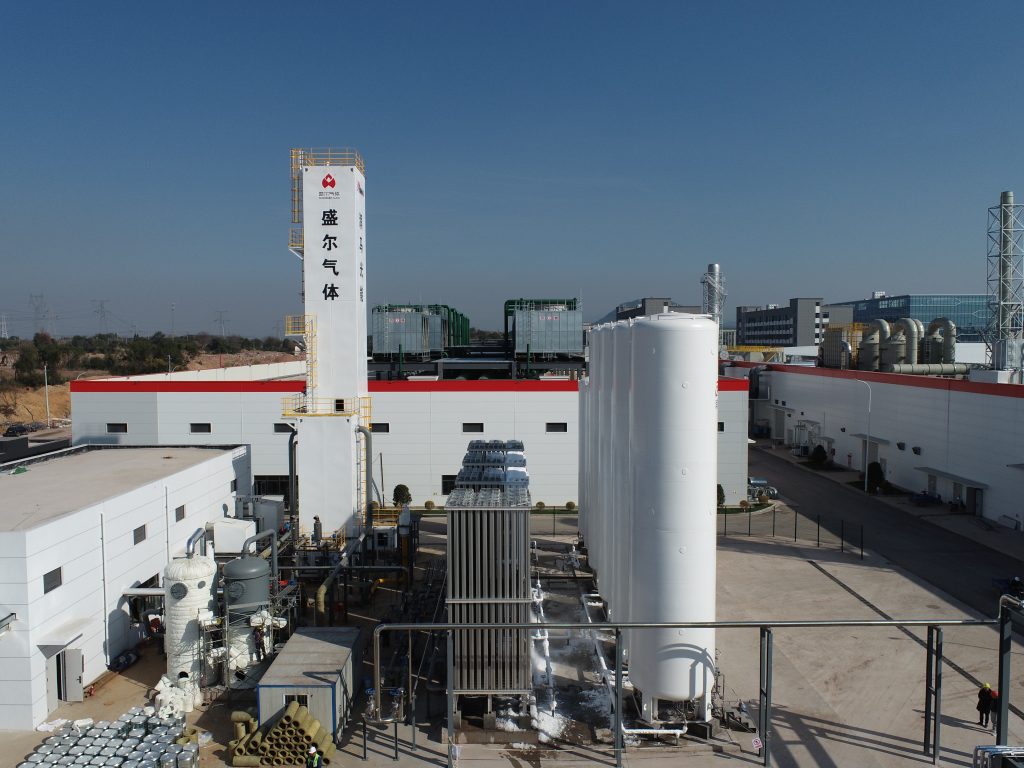
In conclusion, cryogenic ASUs have proven to be a cornerstone of modern industry by supplying massive quantities of oxygen and nitrogen with exceptional purity and reliability. These plants enable higher productivity in steelmaking, ultra-clean environments in semiconductor production, and new possibilities in the energy sector. The technology’s major challenges include high energy usage and significant capital investment, but continuous engineering advancements are steadily mitigating these drawbacks. Efforts such as improving heat exchanger efficiency, compressor performance, and smart process controls are gradually reducing the power consumption per unit of gas produced, while also increasing operational flexibility.
As industrial processes evolve toward greater efficiency and sustainability, the role of cryogenic ASU systems is poised to grow even further. They are extending beyond traditional applications to support renewable energy storage, green hydrogen and ammonia production, and carbon capture initiatives. With its unmatched capacity and purity output, the cryogenic ASU for oxygen and nitrogen production in industrial applications will remain an indispensable asset for years to come.