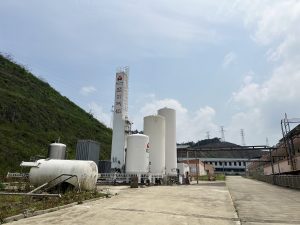
工业氮气发生器简介
节能型工业制氮机是一种现场系统,旨在利用压缩空气制取氮气,为各种工业应用提供可靠的氮气供应。与传统的散装氮气供应方式(液氮罐或高压气瓶)不同,现场制氮机无需依赖配送,并可按需制氮。节能型工业制氮机的关键优势在于能够显著降低运营成本和碳排放。由于制氮过程需要空气压缩机和分离装置的持续运行,因此能源效率至关重要。对于食品包装、电子制造或化学加工等行业而言,提高能源效率能够直接影响其盈利能力和可持续性。本文将探讨节能型工业制氮机的工作原理,以及为何能源效率已成为其设计和运行的核心要素。
氮气约占空气的78%,工业制氮机将氮气从氧气和其他气体中分离出来,为工业用途提供高纯度氮气。目前最常用的节能型工业制氮机现场制氮方法是变压吸附(PSA)和膜分离。这两种方法提取氮气的机制不同,但近年来都经过改进,效率得到了提升。相比之下,大型低温分离(将空气冷却至液化并蒸馏氮气)适用于极高产量和纯度的氮气。低温制氮设备可以实现超高纯度(高达99.999%的氮气)和巨大的流量,但其能耗高且结构复杂,因此不太适合典型的现场需求。对于大多数每小时需要几立方米到几千立方米氮气的工业场所而言,PSA和膜分离制氮机在纯度、产能和能效之间取得了更好的平衡。
在接下来的章节中,我们将比较PSA和膜分离技术,探讨影响其能效的因素,分析生命周期成本,探索行业应用,并讨论未来趋势。通过了解这些方面,工程师和设施管理人员在选择节能型工业制氮机时,可以做出明智的决策。
PSA和膜分离技术概述
PSA和膜分离技术概述
变压吸附(PSA)
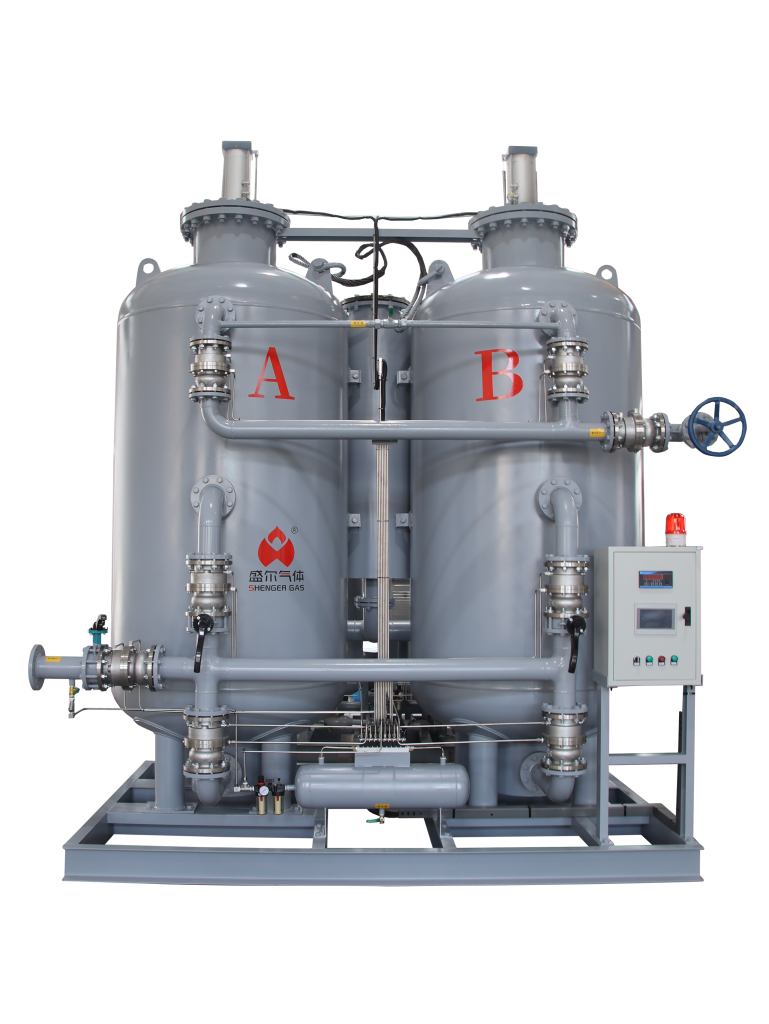
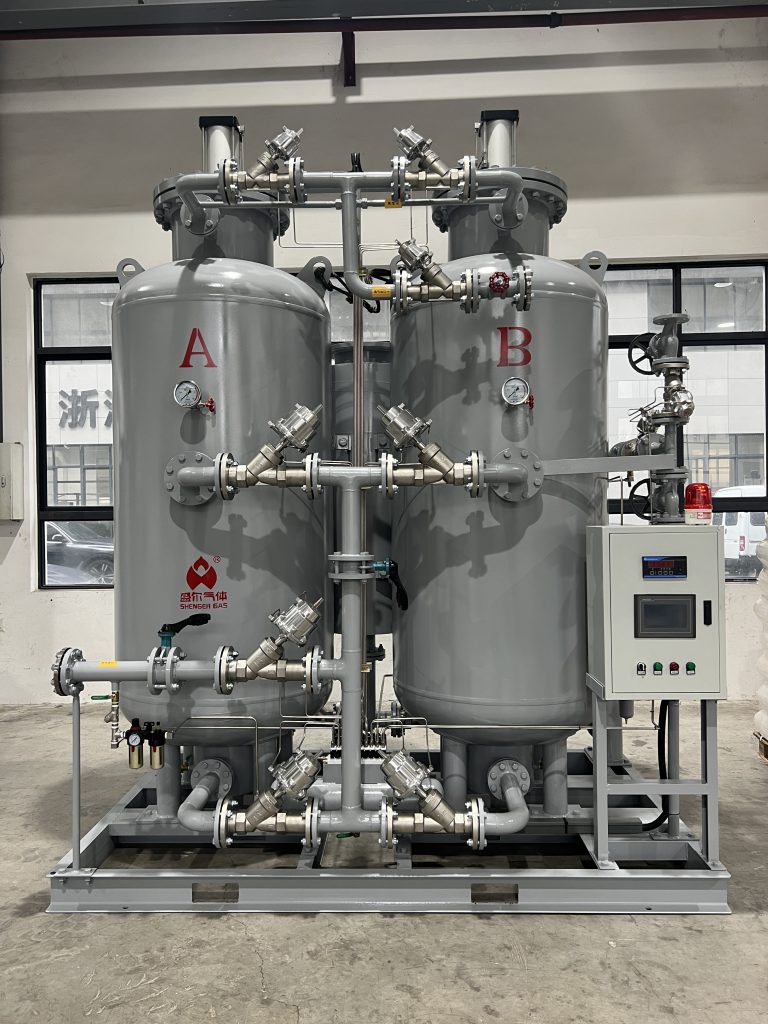
变压吸附 (PSA) 是一种利用特殊吸附材料分离气体的技术。在 PSA 制氮机中,压缩空气通过装有碳分子筛 (CMS) 吸附剂的容器。CMS 具有微小的孔隙,在压力下优先捕获氧气、水分和其他痕量气体,而氮气则作为产物气体通过。PSA 系统通常由双(或多)个吸附塔组成,这些吸附塔交替进行吸附和再生循环:
- 吸附阶段 压缩过滤后的空气(通常压力为 0.6–0.8 MPa)进入第一塔。氧气和其他分子被吸附到 CMS 上,而吸附较弱的氮分子则以高纯氮气的形式流出。此过程持续进行,直至该塔中的 CMS 接近氧气饱和。
- 解吸/再生阶段:在第一塔完全饱和之前,气流被重新导向第二塔。然后对第一塔进行减压,释放出滞留的氧气和杂质(以废气形式排出)。部分产品氮气也可用于吹扫床层。由此,CMS完成再生,并准备进入下一个循环。两塔交替运行,始终保持一个塔在生产氮气的同时,另一个塔在进行再生。
采用变压吸附 (PSA) 技术的节能型工业制氮机可通过调节循环时间和压力来控制氮气纯度。PSA 制氮机默认生产高纯度氮气,典型纯度范围为 95% 至 99.999%。PSA 的一大优势在于其能够实现极高的纯度(99.99% 以上),适用于电子、制药和其他对纯度要求较高的行业。然而,生产超高纯度氮气需要消耗更高的能量(因为需要更多的空气,且循环时间可能更长)。PSA 制氮机启动速度相对较快(通常冷启动后 15-30 分钟即可达到指定纯度),并且可以根据需求灵活调节产量。
在设备方面,PSA制氮装置包括空气压缩机、预处理过滤器和干燥器(用于提供洁净干燥的空气)、配备CMS吸附剂的双塔吸附器、用于循环切换的自动阀门以及控制系统(PLC)。维护工作包括定期更换过滤器和阀门,以及最终更换CMS吸附剂(通常每5-10年更换一次)。PSA制氮装置确实包含运动部件(阀门在每次吸附/解吸切换时循环运动),因此维护工作量适中,并不繁琐。总体而言,PSA系统因其可靠性、能够达到高纯度以及在中等纯度下高效利用压缩空气而备受青睐。
膜分离
膜式制氮机常用于节能型工业制氮机中,它利用可渗透纤维膜,通过气体扩散速率的差异将氮气从压缩空气中分离出来。在膜系统中,压缩空气(通常为 0.7–1.0 MPa)被送入由选择性聚合物制成的中空纤维束中。当空气流经这些纤维时,氧气、二氧化碳和水蒸气等“快扩散”气体比氮气更快地透过膜壁。而氮气的渗透速度较慢,因此在纤维核心区域保持较高的浓度,并作为产物气体排出。简而言之,富氧空气被排出(渗透侧),而产物氮气(氧气含量较低)则从膜组件的另一端流出。这种高效的工艺是现代节能型制氮系统的关键特征,使其成为以节能为首要考虑因素的应用的理想选择。
高效节能的工业制氮机采用膜分离技术,其分离过程中没有移动部件,因此维护成本低、可靠性高,结构简单且非常坚固耐用。这些高效节能制氮系统通常包括空气压缩机、过滤器(用于去除油、颗粒物和水分,防止膜污染)以及一个或多个并联或串联的膜组件,以达到所需的流量和纯度。基于膜技术的高效节能制氮机的主要特点包括:
- 快速启动:膜分离系统几乎可以瞬间响应。启动后,它们可以在几分钟内(通常不到 5 分钟)开始生产目标纯度的氮气。这使其成为需要间歇性或紧急供氮应用,或系统频繁启停的应用的理想选择。
- 纯度限制:膜式氮气发生器的一个缺点是难以实现极高的纯度或效率低下。膜式装置通常在纯度为 95%–99% 的范围内最经济。要将氮气纯度提高到 99% 以上,通常需要多级膜分离或显著增加膜表面积,这会大幅增加成本并降低系统的整体效率。许多膜式系统用于中等纯度需求(例如,用于储罐保护或防火的 95%–98% 氮气),在这些应用中,它们的优势在于结构简单且维护成本低。
- 可扩展性:膜组件可以并联以提高产能。单个膜组件的流量可能较小(几十 Nm³/h),但可以通过并联多个组件来满足更高的需求。然而,对于高纯度的大流量应用,PSA 或低温系统通常更为合适。膜发生器常见于中小流量应用(每个撬装设备的典型流量为几 Nm³/h 到几百 Nm³/h,尽管模块化系统可以达到更高的流量)。
- 维护成本低:由于分离过程中没有切换阀或移动部件,维护主要包括保持空气供应清洁和更换过滤器。膜纤维本身的使用寿命有限(渗透性随时间逐渐降低),通常在连续使用3-5后需要更换。尽管如此,维护要求仍然很低——无需大修,只需根据需要更换过滤器和膜筒——而且通常不需要经过专门培训的人员。
PSA 与膜分离制氮机 – 总结: 一般而言,PSA 制氮机适用于纯度要求较高或产量较大的应用,而膜分离制氮机则适用于操作简便、启动迅速且纯度要求较低的应用。由于压缩空气利用率更高(优化后空气与氮气的比例更低),PSA 制氮机在高纯度氮气生产中单位能耗可能略低;而膜分离制氮机则在纯度要求约为 95%–98% 且在此纯度下需要最低能耗的应用中表现出色。两种制氮机都受益于工程技术的改进,使其更加节能可靠。许多现代节能型工业制氮机都采用了智能控制系统和先进材料(PSA 采用更高效的吸附剂,膜分离制氮机采用更高效的聚合物)来提升性能。
(注:第三类是低温氮气发生器,用于大规模、高纯度氮气生产。低温系统可以生产纯度为 99.999% 或更高的氮气,处理量可达数万立方米/小时,但由于其能耗高(纯度为 99.999% 时,每立方米氮气的能耗约为 0.6–0.8 千瓦时)且操作复杂,通常仅用于超大型工业设施。本文重点介绍变压吸附 (PSA) 和膜分离系统,这两种系统在大多数行业的现场制氮中更为常见。)
影响氮生成能源效率的关键因素
设计节能型氮气发生系统需要了解哪些因素对能耗影响最大。对于节能型工业氮气发生器而言,氮气生产的能源成本主要取决于压缩空气所需的电力以及分离过程的固有效率。以下是影响工业氮气发生器能源效率的关键因素:
- 所需氮气纯度:这或许是节能型工业制氮机中最重要的因素。更高的氮气纯度(>99.5% N₂)意味着需要去除更多的氧气,这通常会使能耗呈指数级增长。在PSA节能型制氮机系统中,实现更高的纯度需要更长的吸附周期或额外的吸附塔,从而导致每立方米氮气需要消耗更多的压缩空气。在膜式节能型制氮机中,更高的纯度意味着更大比例的空气作为废液(渗透液)排出,因此在给定氮气产量的情况下,需要供应更多的空气。例如,生产纯度为99.9%的氮气比生产纯度为98%的氮气每立方米消耗的压缩机功率要高得多。根据实际应用需求优化纯度(而不是过度追求纯度)对于节能型制氮系统的能效至关重要。如果一个工艺流程使用 95% 的氮气就能成功,那么使用 99.999% 的氮气就没有任何好处——只会浪费能源。
- 空气压缩效率:空气压缩机是任何氮气发生器系统的核心部件。压缩机的效率(设计、电机效率、输出压力等)直接影响每立方米氮气的能量消耗。现代系统采用高效旋转螺杆压缩机或其他具有节能特性的设计,例如变频驱动器 (VSD/VFD)。变频压缩机可以根据氮气发生器的需求调节其输出,避免在需求低时全速运行造成的能量浪费。合理选择压缩机尺寸(既不过大也不过小)并保持最佳输出压力(产生分离过程所需的压力,而不是过高的压力)将提高氮气发生的整体能量效率。
- 空气/氮气比: 空气/氮气比是指产生一单位氮气所需的空气量与氮气体积之比。空气/氮气比越低,分离效率越高。与单级膜分离系统相比,PSA 系统在高纯度下通常具有更低的空气/氮气比。例如,一台优化良好的 PSA 发生器在 99% 纯度下,产生一单位氮气可能需要约 2.2-2.5 单位体积的空气,而膜分离系统可能需要更多的空气才能达到相同的纯度。选择一种(或组合)能够以最佳空气利用率实现所需纯度的技术,可以降低能耗(因为压缩的空气越少,能量就越少)。
- 系统设计与容量规划:合理的系统设计对提高效率至关重要。一个常见的错误是安装容量过大的氮气发生器,以“以防万一”未来需要——但让发生器远低于其容量运行会降低效率,尤其是在变压吸附 (PSA) 系统中,无论需求如何,系统都会循环运行。最节能的工业氮气发生器是那些容量与用户平均消耗量相匹配,并预留一定峰值容量(通常由氮气储罐缓冲)的发生器。此外,诸如自动关机或待机模式之类的功能可以在需求为零时节省能源(例如,当下游氮气接收器已满且没有消耗时,停止空气压缩机并关闭阀门)。
- 维护与空气质量:维护对能源效率起着间接但重要的作用。维护良好的系统能够更接近其最佳设计效率运行。例如,如果过滤器堵塞,压缩机需要更费力地推动空气通过,从而增加能源消耗。如果PSA装置的阀门泄漏或正时错乱,或者吸附剂受到污染,效率就会下降。定期维护压缩机(确保适当的润滑和冷却)、更换滤芯以及保持吸附剂和膜的良好状态,可以长期保持发生器的能源效率。空气质量也至关重要——过多的油或水分进入PSA装置或膜会损坏分离介质并降低效率,因此,维护过滤和干燥器可以长期保持系统高效运行,从而节省能源。
- 运行压力和工况: PSA 和膜分离式制氮机都有其最佳运行压力范围。系统运行压力高于所需压力会造成能源浪费(因为压缩到更高压力会消耗更多千瓦时)。此外,环境温度和进气温度也会影响性能——例如,过高的进气温度会降低 PSA 的吸附能力,这意味着需要更多的空气(从而消耗更多能源)才能产生相同的氮气产量。将系统设计为在有利条件下运行(例如,对压缩机进行适当冷却,或使用热交换器冷却进气)可以提高效率。一些系统甚至采用了压缩机热回收技术(将废热用于其他工艺或设施供暖)——虽然这不会减少制氮过程的能耗,但可以提高整个工厂的能源利用率。
- 智能控制与监测:现代制氮机通常配备智能控制系统,以优化运行。这些系统可以根据实时需求调整循环时间、在线模块数量或压缩机转速。通过避免氮气过量生产并在不需要时关闭设备,这些智能系统可以消除不必要的能源消耗。此外,传感器可以持续监测纯度和流量,以确保系统不会过度运转。例如,如果需求下降,智能PSA系统可能会略微延长其吸附循环时间(允许略微降低处理量)以节省能源,直到需求再次回升;或者,膜分离系统可能会在低需求时自动关闭部分膜组件,以避免过度消耗空气。
通过在设计和运行过程中仔细考虑这些因素,工厂可以显著提高氮气发生器的能源效率。高效节能的工业氮气发生器不仅仅在于拥有合适的技术,还在于如何操作和维护。下一节将探讨能源效率如何在系统生命周期内转化为成本节约。
Lifecycle Cost Analysis and Operational Efficiency
When evaluating industrial nitrogen generators, it’s important to look beyond just the purchase price. The lifecycle cost of a nitrogen generation system includes initial capital cost, energy costs, maintenance, and the operational efficiencies gained (or lost) over time. Energy-efficient designs often have a higher upfront cost but provide significant savings throughout their lifespan.
Initial Investment vs. Operating Cost: PSA and membrane generators typically involve a substantial initial investment in equipment (air compressor, generator unit, storage tanks, etc.). However, once installed, the operating cost per Nm³ of nitrogen is relatively low compared to delivered liquid or bottled nitrogen. The primary operating expense is electricity to run the air compressor. For example, a mid-sized PSA or membrane system might consume on the order of 0.3–0.5 kWh of electricity to produce 1 Nm³ of nitrogen (at moderate purity). If electricity costs around $0.10 per kWh, that translates to roughly $0.03–$0.05 per Nm³. In contrast, liquid nitrogen delivery not only carries a commodity cost but also includes losses (evaporation) and transportation energy. Studies have shown that generating nitrogen on-site can cut the per-unit cost by 30–50% compared to purchasing liquid nitrogen, especially when usage is consistent and high.
Energy Efficiency and Cost Savings: An energy-efficient industrial nitrogen generator will have a lower cost of ownership due to reduced power consumption. Even small improvements in kWh/Nm³ add up significantly over time. For instance, consider a generator producing 100 Nm³/h running continuously. If you improve its efficiency from 0.5 kWh/Nm³ to 0.4 kWh/Nm³, at 100 Nm³/h that saves 10 kWh every hour. Over a year (8000 hours of operation), that’s 80,000 kWh saved. At $0.10/kWh, that’s $8,000 less in annual electricity cost. Over a typical 10-year equipment life, energy savings alone could be tens of thousands of dollars, often paying back any premium spent on higher-efficiency equipment.
Maintenance and Downtime: Another aspect of lifecycle cost is maintenance and reliability. PSA generators have more mechanical components that may require service (e.g. valve replacements, adsorbent renewal), whereas membrane systems have fewer moving parts but the membranes gradually degrade. Both types generally have low maintenance costs relative to their output. Filter changes and routine checks are minor expenses. However, if a system is poorly maintained and operates below optimal efficiency (e.g., due to leaks or fouled adsorbent), the energy cost per Nm³ rises, effectively increasing operating expenses. Thus, investing in good maintenance practices keeps the operational efficiency high and lifecycle costs low. Downtime can be very costly if nitrogen supply is interrupted, so reliable, well-maintained generators also save money by preventing production stoppages. In terms of lifecycle analysis, many companies find that on-site generation has a payback period of only 1–3 years compared to buying delivered nitrogen, after which the ongoing savings accrue directly.
Operational Efficiency and Workflow Benefits: Beyond dollar costs, having an on-site energy-efficient industrial nitrogen generator can streamline operations. There’s no need to coordinate deliveries or handle heavy cryogenic tanks, which reduces labor and improves safety. The ability to generate nitrogen as needed means you can avoid over-purging or excessive usage just to “use up” delivered supply – instead, the Energy-efficient nitrogen generator produces what you need, when you need it, which is inherently efficient. Additionally, advanced Energy-efficient nitrogen generation systems today often come with remote monitoring and optimization algorithms, ensuring they run at peak efficiency with minimal operator intervention. Such features enhance overall operational efficiency and can extend the life of the equipment.
In summary, lifecycle cost analysis strongly favors energy-efficient nitrogen generators, especially for users with continuous or high nitrogen demand. The combination of lower energy consumption, reduced dependency on deliveries, and manageable maintenance makes on-site generation an economically attractive option. The next section will discuss how these generators are applied across different industries, each with their specific requirements.
Applications in Different Industries
Nitrogen is a versatile inert gas used in a wide range of industries. Energy-efficient nitrogen generators have enabled more industries to generate their own nitrogen on-site, tailored to their purity and volume needs. Below are some major industry applications and the role of on-site nitrogen generation in each:
- Food and Beverage Packaging: Many food products (snack foods, coffee, fresh produce, packaged meats, etc.) are packaged in a nitrogen atmosphere to displace oxygen and extend shelf life. On-site nitrogen generators (often PSA systems or membranes for lower purities) provide a continuous supply of food-grade nitrogen for modified atmosphere packaging (MAP). Purity requirements here are typically in the 98–99.5% range – enough to suppress oxidation. Generators in this sector must be reliable and often need stainless steel piping and food-safe components. The energy efficiency of modern generators helps food processors reduce costs, important in an industry with tight margins. Additionally, having an in-house generator ensures the packaging line is never halted due to gas delivery delays.
- Electronics and Semiconductor Manufacturing: The electronics industry requires extremely high-purity nitrogen (99.99% to 99.999% or higher) for processes such as wave soldering, reflow ovens, PCB manufacturing, and semiconductor fabrication. PSA nitrogen generators are common in this field because of their ability to achieve ultra-high purities. These industries value energy efficiency because the generators often run 24/7 to maintain a continuous purge in equipment. Even small improvements in energy use per cubic meter can significantly lower the facility’s utility bills. On-site generation also allows electronics manufacturers to control quality and avoid impurities that could come from delivered liquid nitrogen. For semiconductor fabs with very large consumption, a combination of on-site generation methods might be used (some even have small cryogenic plants), but PSA systems have become standard for many due to lower operating costs and quick response in ramping up or down with production needs.
- Chemical and Petrochemical Plants: Nitrogen is widely used for blanketing flammable chemicals, purging reactors, and pressure transferring liquids in chemical manufacturing. Refineries and petrochemical plants often have huge nitrogen demands, and reliability is paramount. These facilities might use large PSA units or even cryogenic generators for high volume. Purity needs can vary: for inerting and purging, 95–98% may be sufficient to prevent combustion (a small O₂ content can be acceptable), which means membrane generators can sometimes be used (for example, in remote oilfield operations, portable membrane nitrogen generators provide 95–97% N₂ for well purging and pipeline commissioning). Energy-efficient generators reduce the operating cost of providing nitrogen across large plants, which is significant as nitrogen is often used in massive quantities. Also, by producing nitrogen on-site, these industries minimize truck deliveries of liquid nitrogen, improving safety (less handling of cryogenic liquids) and reducing greenhouse gas emissions from transportation.
- Pharmaceutical and Biomedical: Pharmaceutical manufacturing uses nitrogen for blanketing reactive ingredients, purging storage tanks, and packaging medicines under inert atmosphere. Labs and biotech processes also use nitrogen to control environments or run instruments. Purity requirements here are usually high (99–99.999%) since products must not be contaminated. PSA generators are frequently installed in pharmaceutical plants for their purity capability. A key concern in pharma is also the quality of the nitrogen (it may need to be sterile or have low moisture content), so generators might be equipped with additional purification steps like bacterial filters or catalytic oxygen removal for ultra-purity. Energy efficiency in this context helps pharma companies meet sustainability goals and reduce heat output (important in temperature-controlled manufacturing areas). For smaller labs or medical facilities, compact PSA or membrane units can supply nitrogen for uses like operating laboratory analytical instruments (e.g., LC-MS, GC) or preserving biological samples.
- Metal Fabrication and Laser Cutting: In metal fabrication, nitrogen is often used as a laser cutting assist gas, especially for stainless steel and aluminum, to blow away molten metal and prevent oxidation of cut edges. Laser cutting operations can require high flows of nitrogen at purities around 95–99.99%, depending on the material and desired cut quality. Traditionally many shops used liquid nitrogen, but on-site generators (either PSA for higher purity or membrane for moderate purity) are increasingly popular to avoid the recurring costs of delivered liquid. These generators need to deliver high flow rates on demand (when the laser is operating) and may idle in between jobs – a scenario where a quick-start membrane system can be useful. Welding applications also use nitrogen in some specialized shield gas mixtures, and nitrogen generators can supply those needs too. Energy-efficient generators in this field allow fabricators to cut operating costs and have more predictable expense planning (no price volatility of bulk gases). They also free the operation from dependence on suppliers and the logistics of storing cryogenic tanks.
- Oil & Gas and Fire Prevention: In oil and gas exploration, nitrogen is used for inerting wells, pressure testing pipelines, and enhanced oil recovery techniques. Portability and fast response are key, so skid-mounted membrane nitrogen generators are often deployed at well sites to provide 95–98% nitrogen on demand. These membrane units are valued for their ruggedness and rapid startup. Energy efficiency translates to being able to run off portable power sources more effectively and reduce fuel consumption in remote locations. In fire prevention, nitrogen generators are used to produce nitrogen-enriched air for reducing oxygen in protected spaces (like data center fire prevention systems that keep the atmosphere at ~15% O₂). These systems often run constantly to maintain low oxygen, so energy-efficient operation is crucial for long-term feasibility. On-site generation is the only practical method here, as you cannot practically supply such systems with delivered nitrogen.
Across all these industries, the common theme is that on-site nitrogen generators provide control, continuity, and often cost savings. The specific generator setup may vary (PSA vs membrane, large vs small, single vs multiple units) based on the purity and volume needs. Energy efficiency remains a selling point and operational advantage in each case: companies can achieve the nitrogen purity they need without wasteful energy overhead. Many industrial users also cite environmental benefits – by using efficient on-site systems, they eliminate the emissions associated with trucking in liquid nitrogen and reduce overall electricity usage through optimized production.
Future Trends and Innovations
The field of industrial gas generation is continuously evolving, and several emerging trends aim to make nitrogen generation even more efficient, smart, and adaptable. Here are some future directions and innovations for energy-efficient industrial nitrogen generators:
- Advanced Materials and Adsorbents: Research is ongoing into new adsorbent materials for PSA systems (and even new membrane materials). Improved carbon molecular sieves or alternative adsorbents can increase adsorption capacity or selectivity, allowing more nitrogen to be produced per cycle with less energy. For instance, next-generation adsorbents might enable effective nitrogen capture at lower pressures or offer faster cycling, directly cutting energy consumption. Similarly, membrane technology is benefiting from advances in polymer science – new membrane fibers with higher selectivity (better at blocking oxygen) and durability can achieve higher nitrogen purities without multi-stage setups, thus improving efficiency.
- Hybrid Systems: One innovation is combining technologies to leverage the strengths of each. Hybrid nitrogen generators might use a membrane as a first stage to get nitrogen from 80% up to ~98%, then polish it to 99.999% with a small PSA unit. This can be more efficient than running a large PSA alone to do the whole separation, because the membrane reduces the load (especially the bulk of oxygen) in an energy-efficient way, and the PSA only has to remove the last couple percent of O₂. Another hybrid approach is using cryogenic and PSA in tandem at large plants: e.g., a cryogenic plant provides base load high-purity nitrogen, but during peak demands a PSA kicks in to supply additional gas – this avoids oversizing the cryogenic plant for rare peaks. These approaches illustrate how innovation isn’t limited to one technology, but in how systems are integrated for efficiency.
- Energy Recovery and Heat Integration: Future generators may incorporate more clever ways to reclaim energy. For example, the expansion of waste gas (like the oxygen-rich off-gas from a PSA or membrane) could potentially be used to perform work (though this is challenging at the scales in question). More practically, waste heat from compressors and PSA adsorption beds (which release heat during adsorption) can be captured. Some modern compressor systems already recover waste heat for facility heating or pre-heating boiler feedwater. We may see nitrogen generators integrated into plant energy systems, where the byproducts (heat, or even the waste oxygen in some contexts) are utilized, improving overall energy efficiency beyond the generator itself.
- Smart Controls and Industry 4.0 Integration: The next wave of improvement is digital. Nitrogen generators are getting smarter, with PLCs and sensors being supplemented by IoT connectivity and advanced analytics. Predictive maintenance algorithms can monitor performance (purity trends, pressure drops, valve cycle counts, etc.) and predict when maintenance is needed, keeping the system running at optimal efficiency and avoiding the energy drag of a malfunctioning component. Integration with plant SCADA systems means the nitrogen generator can dynamically adjust to plant conditions — for instance, ramping up production when a certain process starts and idling when it’s not needed, all automatically. This ensures no energy is wasted producing excess nitrogen that isn’t used. Additionally, user-friendly dashboards and remote monitoring allow engineers to fine-tune settings for efficiency and get alerts if the system starts to deviate from optimal performance (like an increase in air consumption per Nm³ of N₂ indicating a possible leak or issue).
- Lower Pressure and Vacuum Swing Adsorption: Traditional PSA operates by swinging pressure from high (adsorption at ~5–8 bar) to near atmospheric. Some newer systems use vacuum swing adsorption (VSA or VPSA for nitrogen) where the adsorption happens closer to atmospheric pressure and desorption is aided by pulling a vacuum. VPSA is already common in oxygen generation; for nitrogen, it’s a bit more complex but some larger systems use it. The advantage is eliminating the need for very high compression, thereby saving energy, especially for moderate purity needs. We may see more VPSA nitrogen generators for certain scales, which can significantly cut kWh consumption by using vacuum pumps in place of part of the compression energy.
- Modular and Decentralized Generation: As efficiency and control improve, the concept of decentralizing nitrogen generation within a facility is emerging. Instead of one large generator feeding the whole plant (with long piping that can cause pressure losses and leaks), future facilities might use several smaller, point-of-use generators located near consumption points. These modular generators can be turned on only when that section of the plant is active, saving energy during downtime. They also allow tailored purity for different processes (one area might need 99.9%, another only 95%), so each generator can be optimized for lower energy use rather than one unit producing a uniform high purity for all. Modular systems, combined with smart controls, can self-balance and share load efficiently. This trend is akin to microgrids in electricity – a more localized, demand-driven approach.
- Sustainability and Renewable Integration: With global emphasis on reducing carbon emissions, there’s interest in powering nitrogen generators with renewable energy or integrating them into facilities aiming for net-zero operations. An energy-efficient nitrogen generator pairs well with solar or wind power sources: for example, running more during times of excess renewable energy and throttling down when power is scarce. Some industrial sites use energy management systems that coordinate all equipment – in such scenarios, the nitrogen generator might adjust its production schedule (if possible) to coincide with lower electricity tariff periods or renewable availability. Moreover, replacing delivered nitrogen (which has a hidden carbon cost in liquefaction and transport) with on-site generation helps companies reduce their Scope 3 emissions. Future nitrogen generators might come with energy ratings or certifications indicating their efficiency and environmental impact, much like appliances do today.
In conclusion, the future of industrial nitrogen generation is geared toward smarter, cleaner, and more energy-efficient industrial nitrogen generators. Engineers and researchers are continuously refining these systems to deliver required performance at lower energy costs. Whether through better materials, integrated systems, or digital intelligence, the goal is to make on-site nitrogen supply as economical and seamless as possible. For industrial end-users, these innovations promise easier operation, reduced costs, and alignment with sustainability objectives. By staying informed about these trends, companies can plan upgrades or new installations that will serve them efficiently for the next decade and beyond.
氮气发生器技术比较
To summarize the technical differences, the table below provides a neutral comparison of the main types of industrial nitrogen generation technologies (PSA, membrane, and cryogenic), highlighting their typical capabilities and costs:
| Technology Type | 氮气纯度范围 | Energy Consumption (kWh per Nm³) | Typical Flow Rate Range (Nm³/h) | Maintenance Requirements | Operational Cost per Nm³* |
|---|---|---|---|---|---|
| PSA(变压吸附) | ~95% to 99.999% | ~0.3–0.6 kWh/Nm³ | ~5 to 3,000 Nm³/h (scalable to larger systems) | Moderate – periodic filter changes, valve maintenance, adsorbent replacement (~5–10 year life) | Approx. $0.04–$0.06 per Nm³ |
| 膜分离 | ~95% to 99% (single stage) (up to ~99.5% with multiple stages) | ~0.2–0.5 kWh/Nm³ (for 95–98% purity; higher for >99%) | ~1 to 500 Nm³/h per module (modular systems can reach >1000 Nm³/h) | Low – minimal moving parts; mainly regular filter replacement and occasional membrane cartridge replacement (3–5 year life) | Approx. $0.05–$0.08 per Nm³ |
| 低温蒸馏 | 99.9% to 99.999%+ | ~0.6–0.8 kWh/Nm³ (for 99.999% purity; higher at smaller scales) | >1000 Nm³/h up to tens of thousands Nm³/h (best for large volumes) | High – complex machinery (compressors, expanders, distillation column); requires specialized maintenance | Approx. $0.08–$0.12 per Nm³ |
*Estimated operational costs assume typical electricity pricing and include only energy and basic maintenance, not labor or depreciation. Actual costs vary by region and scale.
As shown in the table, PSA and membrane generators are generally more energy-efficient and cost-effective for small to medium scale needs, while cryogenic systems, though capable of ultra-high purity and massive flow rates, incur higher energy usage and complexity, making them suitable mainly for large-scale production. Users aiming for an energy-efficient industrial nitrogen generator should match the technology to their purity and flow requirements: use PSA or membrane for on-site generation up to the mid range, and reserve cryogenic for when ultra-high purity at huge volume is indispensable.
By understanding the differences in technologies, the factors affecting efficiency, and the total costs involved, industries can optimize their nitrogen supply strategy. Energy efficiency is a central theme in modern nitrogen generation – improving not only the bottom line for businesses but also contributing to broader environmental and sustainability goals.