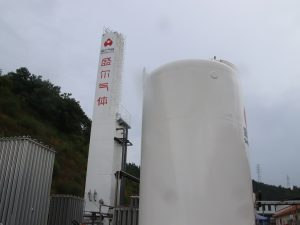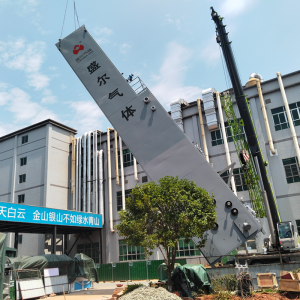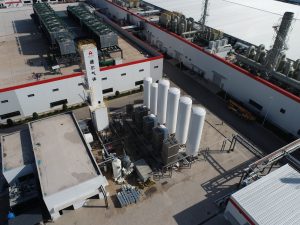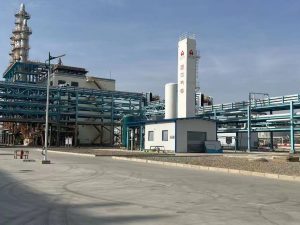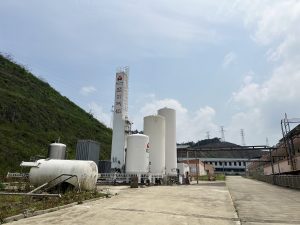
The cryogenic air separation process uses cascaded refrigeration and distillation to produce high-purity O₂, N₂, and Ar at industrial scale. Cryogenic air separation is the industrial method for producing large quantities of oxygen, nitrogen and argon by cooling filtered air to very low temperature. In this process, ambient air is first compressed (typically to ~0.5–1.0 MPa or 5–10 bar) and purified, then cooled to cryogenic temperatures (around –180 °C) so that it partially liquefies. The resulting liquid and vapor are fed into distillation columns, where nitrogen (bp –196°C) is separated from oxygen (bp –183°C) and argon (bp –186°C). Modern ASUs can output thousands of tonnes per day of gas: for example, large units produce on the order of 10³–10⁵ Nm³/h of air feed and yield oxygen purities up to ~99.5% and nitrogen up to 99.999%. Producing such cold temperatures is energy-intensive: typical specific energy consumption is on the order of 200–250 kWh per ton of O₂ produced. The rest of this article reviews the key steps and configurations of the cryogenic air separation process, including single- and double-column designs and high-pressure internal-compression systems.This overview clarifies scope, operating ranges, and terminology used in the cryogenic air separation process.
Cryogenic ASUs share a few basic blocks: air compression and purification, pre-cooling/refrigeration, cryogenic distillation, and product compression. A typical cryogenic ASU process follows these steps:
- Compression and Pre-cooling: Ambient air is drawn through filters and multistage compressors (with intercoolers) to raise its pressure, typically to 0.5–1.0 MPa (5–10 bar gauge). Inter-stage cooling removes much of the heat of compression, and water vapor is condensed and drained as the air cools.
- Purification: The compressed air passes through molecular-sieve beds to scrub out residual moisture, CO₂, and hydrocarbons. Even trace CO₂ or H₂O would freeze at cryogenic temperatures and clog the cold box, so this step is critical to the process.
- Cryogenic Refrigeration/Liquefaction: The purified air is then cooled toward ambient via plate-fin heat exchangers or indirect refrigeration, often using waste cold from the process streams. Final cooling is achieved by expansion (via turbo-expander turbines or Joule–Thomson valves) that liquefies a fraction of the air. This refrigeration brings the air to roughly –170 to –185 °C.
- Distillation: The cold two-phase (liquid+vapor) air enters one or more distillation columns. In the columns, nitrogen (the more volatile component) boils off from the top, while oxygen (and argon) collect at the bottom as liquid. By heat integration (using the cold nitrogen to reboil the column bottoms) and reflux, the column(s) separate the stream into oxygen-rich and nitrogen-rich fractions. For example, in a dual-column ASU the high-pressure (HP) column produces nearly pure nitrogen overhead and an oxygen-rich liquid bottoms, which feeds a low-pressure (LP) column that yields >99% O₂ at its bottom and additional nitrogen overhead. Argon, present at ~1% in air, concentrates in the middle of the LP column (“argon-belly”) and can be drawn off to a separate argon purification column if high-purity argon is required.
- Product Compression & Warming: Finally, the separated gaseous products are warmed back to near-ambient temperature against incoming feed air, and may be routed directly to consumers or stored. Often, product gas compressors (or vaporizer-distribution systems) bring the gas to pipeline pressure. In high-pressure designs (see below), however, product gas is delivered at elevated pressure directly from the ASU.
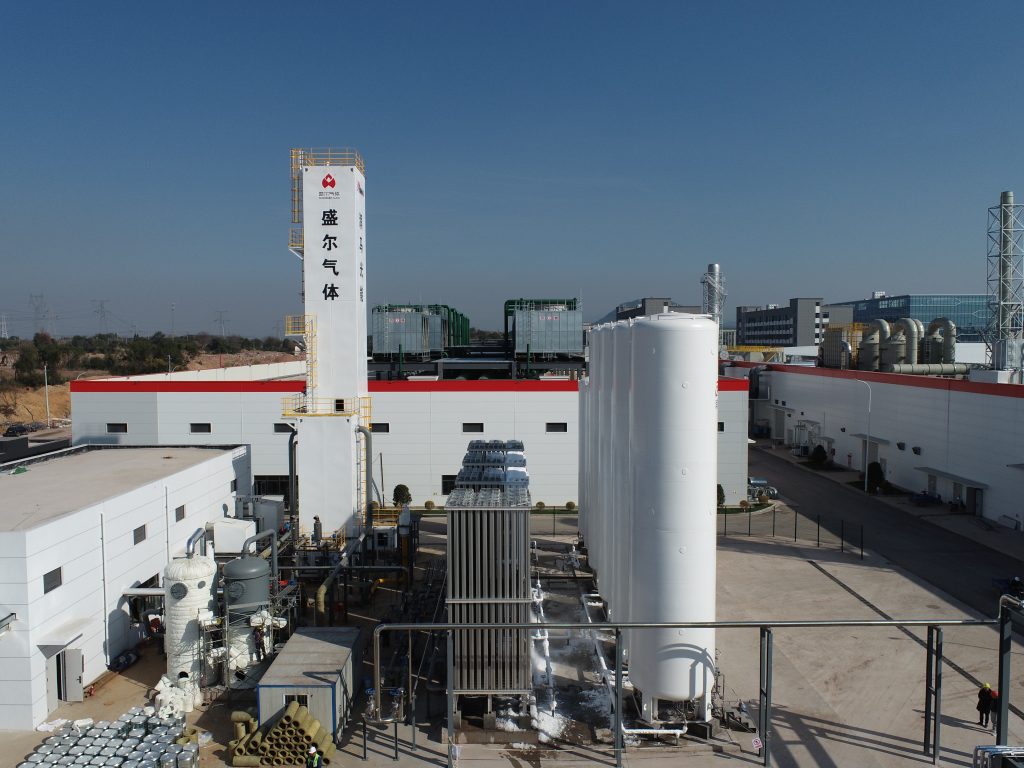
Single-Column ASUs
In a single-column cryogenic air separation process, all distillation takes place in one main column (sometimes with one or more internal or side reboilers). The purified, cooled air is fed into the column and partially condensed. Oxygen-enriched liquid collects at the column bottom and is vaporized (often by reheating in the main heat exchanger) to give the oxygen product, while nitrogen-rich vapor is withdrawn from the top. This configuration was the first used by Carl von Linde in 1902assets.linde.com and is still used for moderate-capacity or flexible plants. A single-column ASU can deliver one high-purity product (typically O₂) and a lower-purity byproduct (N₂ containing several percent O₂). Oxygen product from a single-column unit typically reaches ~90–95% purity. The oxygen recovery (yield) is limited – often only about 60–70% of the incoming oxygen is recovered as product – because the single column cannot take full advantage of multistage heat integration. The main advantages of the single-column process are mechanical simplicity and lower capital cost (fewer columns and heat exchangers). These units also have relatively fast startup and turndown flexibility. In practice, however, nearly all large-scale ASUs use double-column configurations for higher efficiency (see below).Single-tower layouts remain useful where simplicity is valued over peak efficiency in the cryogenic air separation process.
Double-Column ASUs
The standard large-scale cryogenic air separation process uses a double-column (dual-column) configuration, consisting of a high-pressure (HP) column and a low-pressure (LP) column connected by a common heat exchanger (condenser/reboiler). In this arrangement, compressed air (around 0.5–1.0 MPa) is pre-cooled and partially liquefied before entering the columns. The oxygen-enriched liquid flows to the bottom of the HP column, while the nitrogen-rich vapor goes to its top. The HP column is operated at higher pressure (typically 3–10 bar), so its top produces pure nitrogen gas which is partially recondensed and returned as reflux via the shared heat exchanger. The bottom of the HP column yields an oxygen-rich liquid, which is fed into the LP column (operating at ~0.1–0.2 MPa, e.g. 1.5 bar absolute). The LP column then separates this stream, producing nearly pure oxygen (usually 99–99.5% for gaseous oxygen) at its bottom and additional high-purity nitrogen at its top. All cooling and reflux between the two columns is handled in the integrated condenser/reboiler heat exchangerassets.linde.com. Because the LP column’s reboiler is the HP column’s condenser, the HP and LP sections run at slightly different temperatures (just ~1–2 K apart). This two-stage design greatly improves efficiency: typical oxygen recovery can exceed 90–95%, and product purities are very high (e.g. >99.3% O₂; N₂ often >99.9%). Double-column ASUs can also draw argon from the LP column and route it through additional rectifiers if required. Modern plants use structured packing or advanced trays to minimize pressure drop and achieve tight temperature approach in the cold box.Tight condenser/reboiler coupling explains the benchmark efficiency of the cryogenic air separation process in dual-column designs.
High-Pressure (Internal Compression) Systems
Some cryogenic ASU configurations incorporate internal mechanical compression of products to achieve high product pressures. In these high-pressure ASUs, pump devices located in the cold box raise the pressure of liquid streams (typically oxygen or nitrogen) before they are vaporized. For example, a cryogenic pump can pressurize liquid oxygen to 5–30 bar (even up to ~100 bar in extreme cases) inside the cold boxassets.linde.comassets.linde.com. The elevated-pressure liquid is then evaporated against the warm feed to deliver gaseous O₂ at pipeline pressure, all without using an external discharge compressor. In practice, this means the ASU’s air compressor must deliver feed air at a much higher pressure (often 10–20 bar), but separate oxygen compressors are eliminated. Similarly, liquid nitrogen pumping can deliver high-pressure N₂. The benefits of internal compression include simpler configuration (fewer external compressors), reduced maintenance, and improved safety (since liquid O₂ is pumped, there is less chance of explosive mixtures in compressorsassets.linde.com). High-pressure internal-compression ASUs are common for large integrated plants that need high-pressure O₂ for chemical processes or LNG applications.Cold-box pumping is often the most economical route to high delivery pressures in the cryogenic air separation process.
Typical Operating Parameters
Typical operating ranges in the cryogenic air separation process (SI units).
| Parameter | Typical range/value |
|---|---|
| Air feed pressure | ~300–900 kPa (approx. 3–9 bar) |
| Air flow rate (input) | ~1,000–100,000 Nm³/h (depending on plant capacity) |
| Oxygen product purity (gaseous) | ≈95% (single-column) up to 99.3–99.5% (double-column) |
| Nitrogen product purity (gaseous) | ≈99% up to 99.999% (depending on specification) |
| Argon product purity (liquid) | ≈95% (when recovered from side draw) |
| Specific energy consumption (O₂) | ~200–250 kWh per ton O₂ (electricity) |
| Typical column pressures | HP column ~0.5–1.0 MPa (5–10 bar); LP ~0.1–0.2 MPa (1–2 bar) |
These values are illustrative: actual figures depend on plant design, production rate, and purity requirements.
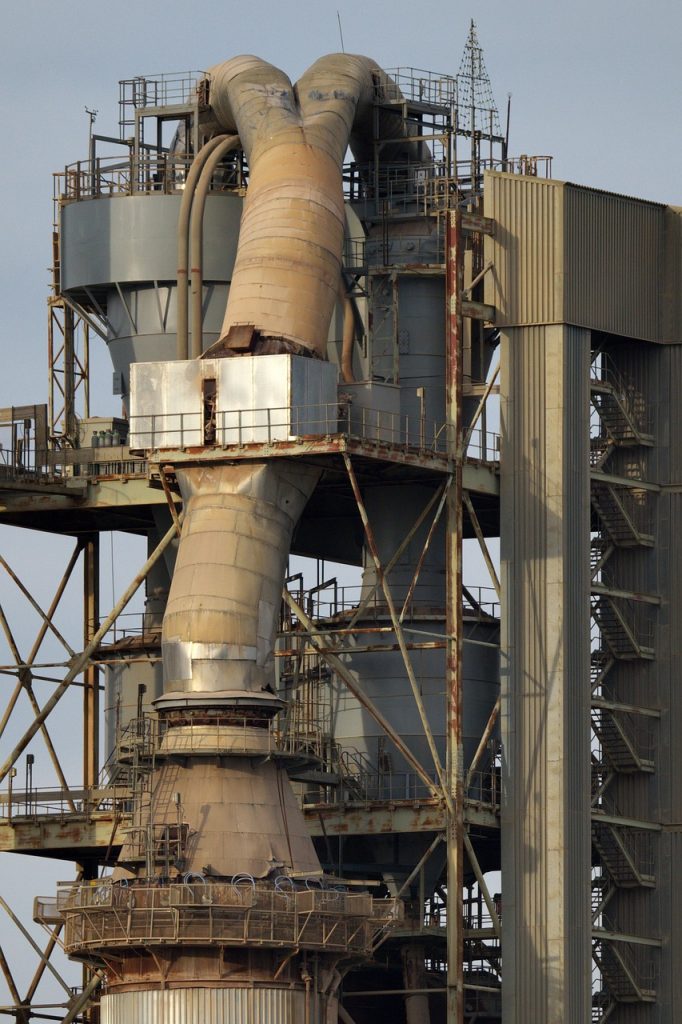
Industrial Applications
Across steel, petrochemicals, LNG and electronics, the cryogenic air separation process supplies large, stable, high-purity flows.Cryogenic ASUs are essential in many industries that demand large volumes of high-purity gases:
- Steelmaking: Modern steel furnaces and converters rely on pure oxygen for combustion and refining. For instance, basic oxygen furnaces consume roughly 2 tonnes of O₂ per tonne of steelen.wikipedia.org. Large integrated steel mills have on-site ASUs supplying high-pressure O₂ to blast furnaces and basic oxygen furnaces, boosting efficiency and reducing fuel use. High-purity nitrogen from ASUs is also used in blanketing and cooling in metallurgical processes.
- Petrochemicals & Chemicals: Cryogenic ASUs supply oxygen and nitrogen for chemical synthesis. Oxygen from ASUs is used in processes like partial oxidation, steam reforming (syngas production for ammonia/methanol), and oxidizing furnaces. Nitrogen is used as an inerting or purge gas in reactors, and to strip chlorine in ethylene plants. The large-scale, continuous demand in petrochemical facilities makes on-site cryogenic ASUs the preferred source for ultra-pure gases.
- LNG and Gas Processing: ASUs integrate with natural gas liquefaction or regasification systems. For example, some LNG plants use ASU-produced nitrogen for mixed-refrigerant cycles or as a heating medium, taking advantage of the cold energy. High-pressure ASUs are also used on liquefied gas carriers and peak-shaving terminals to provide boil-off gas management. In LNG regasification, ASUs can provide vaporized nitrogen for turbines and pipelines, and the cold streams can pre-cool boil-off gas.
- Electronics and Semiconductors: The semiconductor and photovoltaic industries require ultra-high-purity process gases. Cryogenic ASUs (or smaller on-site units) deliver nitrogen with purities of 99.999% or higher for wafer manufacturing, chip fabrication, and cleanroom environments. Pure oxygen is used in thermal oxidation and deposition processes on silicon wafers. The reliability and ultra-high purity of cryogenic separation make it the technology of choice for these precision industries.
Other applications include medical oxygen supply (in emergency and long-term care), glassmaking (O₂-fuel glass furnaces), and environmental engineering (such as gasification processes). In all these uses, the cryogenic air separation process provides a steady supply of very clean, high-pressure industrial gases that cannot be economically matched by alternative methods.
Summary
Cryogenic air separation remains the workhorse for large-scale gas production. Its fundamental steps – multi-stage compression and purification followed by cryogenic cooling and fractionation – enable extremely pure products. Single-column ASUs offer simpler, lower-capital solutions (usually for moderate purity), whereas double-column ASUs are used for maximum purity and efficiency by operating in two pressure levels. High-pressure internal-compression designs add flexibility to deliver O₂/N₂ at pipeline pressures without external compressors. Typical ASUs today run with air feed pressures on the order of several bar, flows from thousands to tens of thousands Nm³/h, and oxygen energy usage around 200–250 kWh/ton. Engineers continuously work on improvements (better heat integration, advanced internals, hybrid cycles) to further lower this energy. Understanding these configurations and ranges is crucial for designing and optimizing cryogenic ASUs for steel, petrochemical, LNG, electronics and other demanding applications.Grasping these interactions is central to optimizing any cryogenic air separation process.