Cryogenic oxygen production is the primary industrial method for obtaining high-purity oxygen from air through extremely low-temperature distillation. In industrial air separation units (ASUs), atmospheric air is cooled and liquefied so that its components can be separated based on their different boiling points. This process enables the production of large volumes of oxygen (along with co-products like nitrogen and argon) at high purities, which are crucial for industries ranging from steelmaking and chemicals to healthcare and rocket propulsion. In what follows, we break down the fundamentals of air composition and cryogenic processes, then explain step-by-step how a modern cryogenic ASU produces oxygen, describing its main components, heat exchange system, distillation columns, and product recovery methods.
Principles of Cryogenic Oxygen Production
From first principles, separating oxygen from air relies on the fact that air is a mixture of gases with distinct physical properties. Dry air is composed of approximately 78% nitrogen, 21% oxygen, and about 1% argon by volume (with trace amounts of other gases). Each of these components has a unique liquefaction (boiling) point at atmospheric pressure: nitrogen boils at around –196 °C, oxygen at –183 °C, and argon at about –186 °C. Cryogenic oxygen production takes advantage of these differences. The principle is simple: if air is cooled to sufficiently low temperatures (in the cryogenic range, roughly –180 to –200 °C) it will liquefy, and then the liquid air can be distilled to allow each component to evaporate or condense at its own boiling point. Oxygen, having a higher boiling point than nitrogen, will tend to remain in liquid form longer as the mixture boils, making it possible to obtain oxygen-enriched liquid separate from nitrogen-rich vapor. By using fractional distillation at cryogenic temperatures, an ASU can thus isolate oxygen from nitrogen and other gases. This cryogenic distillation technique, pioneered by Carl von Linde in the 1890s, remains the most effective method for producing high-purity oxygen on an industrial scale. It is energy-intensive due to the refrigeration required, but it yields very pure gases and is unrivaled for large-scale oxygen production needs.
Air Compression and Purification
To begin the process, ambient air is first drawn into the ASU and compressed to an elevated pressure. Multi-stage air compressors (with intercoolers between stages) raise the air pressure typically to about 5–10 bar (gauge). Compressing the air serves two key purposes: it heats the air (allowing easy removal of moisture by condensation in the intercoolers) and it provides the high pressure needed for efficient cooling and distillation later on. After compression, the air is passed through a purification system to remove impurities such as water vapor, carbon dioxide, and hydrocarbons. This is usually accomplished with molecular sieve adsorbers (desiccant beds) that trap H₂O and CO₂, which must be removed because they would freeze solid at cryogenic temperatures and clog the equipment. The adsorbers also capture any trace hydrocarbons for safety, since enriched oxygen in the cold conditions could react with them. The purification step ensures the air entering the cold box is clean, dry, and free of anything that could freeze or cause hazardous reactions. Typically, two sieve beds are used in parallel: one is actively purifying the incoming air while the other is being regenerated (using warmed waste gas from the process to drive off the accumulated moisture and CO₂). After this step, the process stream is essentially pure, dry air at high pressure, ready for cryogenic cooling.
Cryogenic Cooling and Heat Exchange
Following purification, the pressurized air enters the cold box – an insulated enclosure that contains the cryogenic heat exchangers and distillation columns. Here, the air is cooled from near ambient temperature down to around –170 °C or colder. Cooling is achieved by an integrated heat exchange system, typically using plate-fin heat exchangers that provide a large surface area for efficient thermal exchange. The incoming high-pressure air is passed through these heat exchangers in counter-current flow with outgoing cold product and waste streams. As the warm air gives up heat to the returning cold gases, it becomes progressively colder. By the time it reaches the cold end of the exchanger, a significant portion of the air may have condensed into liquid.
To reach the final cryogenic temperature required for liquefaction, modern ASUs employ an expansion turbine (turbo-expander) as part of a refrigeration cycle. A portion of the high-pressure air is expanded through the turbine, which rapidly drops its temperature via the Joule–Thomson effect. This expansion cools the air to cryogenic temperatures and produces the necessary refrigeration effect. The work extracted by the expansion turbine is often recycled – for example, the turbine may be connected to assist in driving the air compressor, improving overall energy efficiency. The net result of the heat exchange and expansion cooling is that the air is now a very cold mixture of liquid and vapor (around the liquefaction point of air). At this stage, the air has been transformed into a two-phase cryogenic fluid: an oxygen-enriched liquid and a nitrogen-rich gas. This cold fluid is then ready to be fed into the distillation system for separation. Notably, all the cooling equipment is housed in the insulated cold box to minimize heat loss; maintaining these extreme low temperatures requires careful insulation and heat integration so that the cold energy is effectively reused within the process.
Distillation Columns and Separation
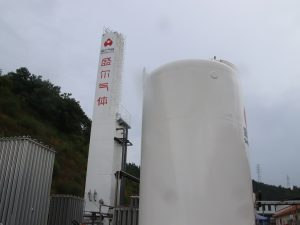
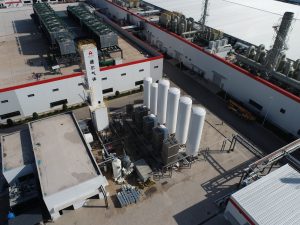
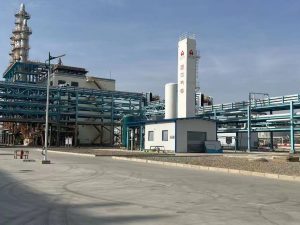
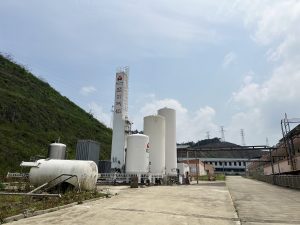
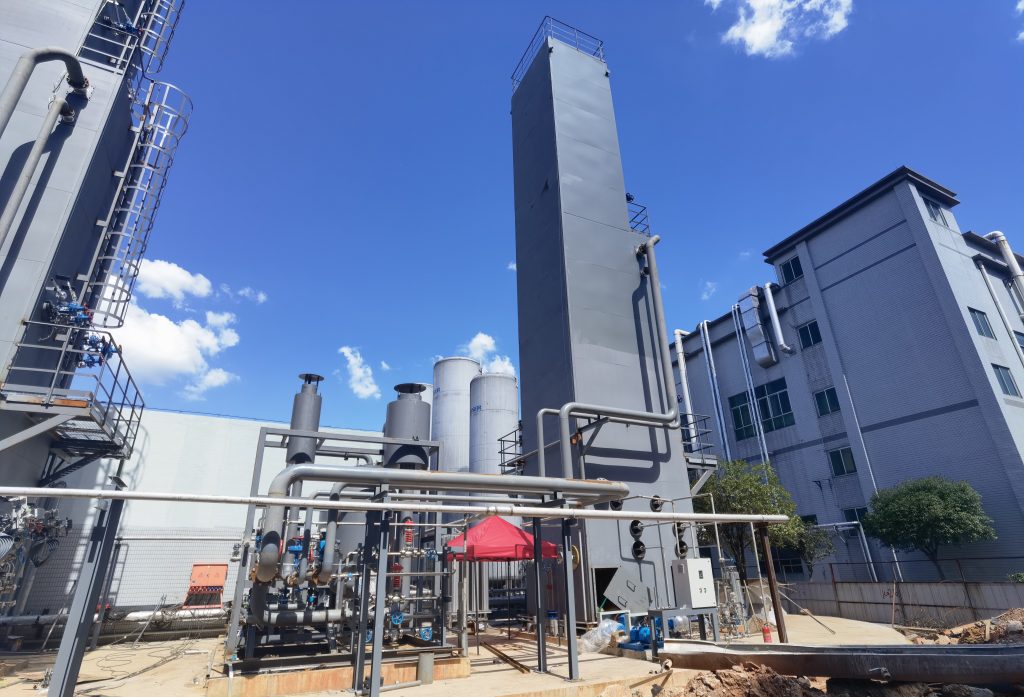
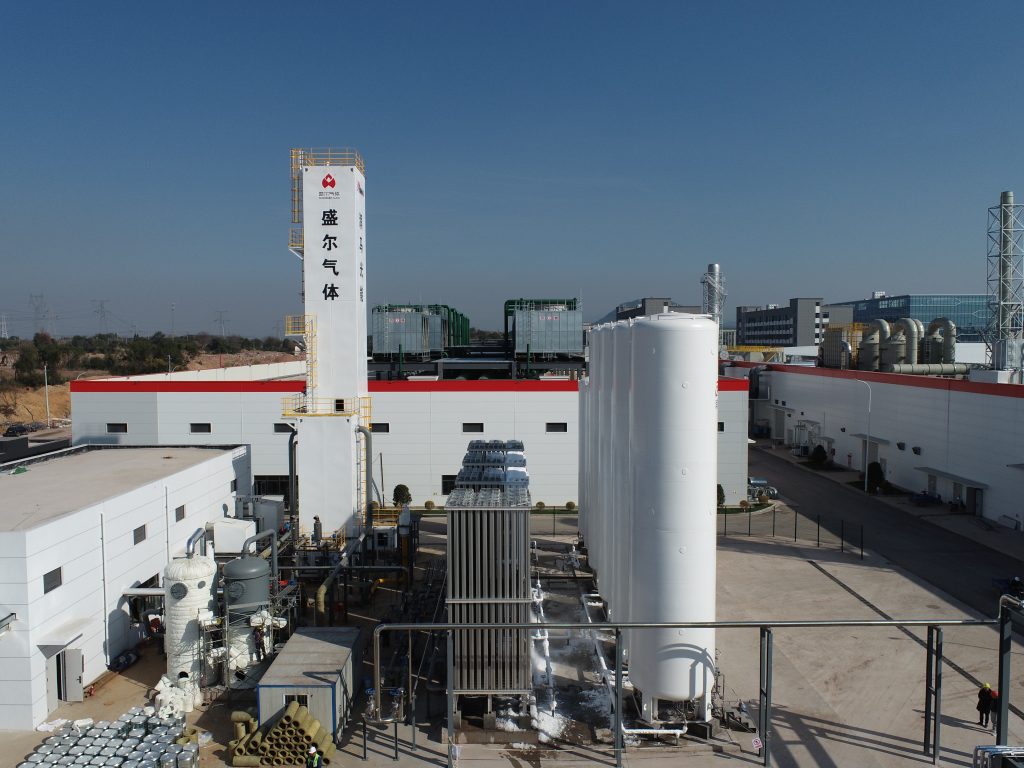
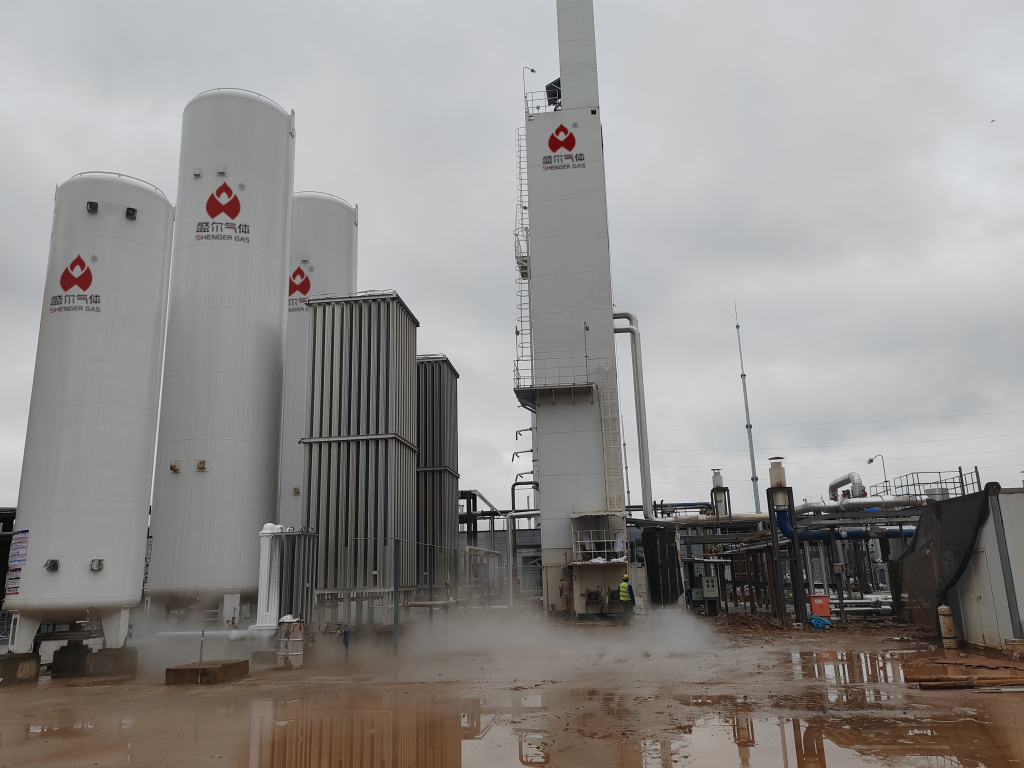
A cryogenic air separation unit typically includes a tall insulated cold box (white rectangular tower in the image) that houses the distillation columns, with large storage tanks for liquid products nearby. Inside the cold box, high-pressure and low-pressure distillation columns work together to separate air into oxygen, nitrogen, and argon. The columns contain multiple trays or structured packing to facilitate contact between rising vapor and falling liquid, enabling efficient fractionation by repeated condensation and evaporation.
In a standard cryogenic oxygen plant, air separation is accomplished by a two-column distillation system operating at different pressures. First, the liquefied air (or partially liquefied air) is introduced into the high-pressure (HP) distillation column, which typically operates at around 5–6 bar absolute. In the HP column, the mixture begins to separate: as the fluid moves up the column, the lighter nitrogen (with the lower boiling point) vaporizes and rises, while the heavier oxygen tends to remain in the liquid phase and collects toward the bottom. The top of the high-pressure column produces nearly pure nitrogen gas (often <1 ppm O₂ impurity), and the bottom of the column yields a liquid that is rich in oxygen (but still containing some nitrogen and argon).
The oxygen-enriched liquid from the base of the HP column is then sent to the low-pressure (LP) distillation column, after being expanded to near atmospheric pressure (approximately 1.2 bar abs). The LP column provides further refining of the mixture at lower pressure (which means a lower boiling temperature for the liquids). In the LP column, final separation occurs: high-purity oxygen is obtained as a liquid at the bottom, and high-purity nitrogen gas is obtained at the top. The two columns are thermally linked by a reboiler-condenser heat exchanger: the boiled-off nitrogen vapor from the top of the high-pressure column is condensed (at ~–180 °C) by providing boil-up heat to the bottom of the low-pressure column. In essence, the condenser of the HP column doubles as the reboiler for the LP column. This clever integration allows the heat released by condensing nitrogen (from the HP column) to supply the heat required to vaporize oxygen in the LP column, greatly improving energy efficiency. The temperature difference across this interchanger is only a few degrees (typically 1–3 K), reflecting how closely the two columns’ operating temperatures are matched.
Inside each distillation column, a series of tray stages or packed beds enables repeated contacts between liquid and vapor, effecting a near-complete separation of oxygen and nitrogen by the time the fluids reach the ends of the column. Argon, which has a boiling point intermediate between oxygen and nitrogen, tends to accumulate in the middle of the low-pressure column. In many ASUs, a side stream is drawn off at an appropriate height of the LP column to recover argon. This stream (rich in argon with some oxygen) is fed to a third column—an argon distillation column—where it is distilled under conditions that yield nearly pure argon (often 99.99% Ar) as a product. The argon extraction requires a high reflux ratio and is energy-intensive (since argon is only ~1% of air), but it is worthwhile when high-purity argon is needed. The residual nitrogen-oxygen vapors after argon removal are returned to the main columns.
By the end of the distillation process, the bottom of the low-pressure column contains liquid oxygen at purities typically between 95% and 99.5% (depending on design and desired output), and the top of the column produces gaseous nitrogen that can be 99.999% pure. The system is designed such that a small fraction of the incoming air (mostly nitrogen with trace oxygen) remains unliquefied and is removed as a waste gas from the upper section of the LP column. This waste stream is often used to regenerate the molecular sieves in the purifier and then vented. Overall, the double-column configuration and tight heat integration enable the efficient separation of air into its components at cryogenic temperatures.
Oxygen Product Recovery and Purity
Once separation is complete, the oxygen product is extracted from the low-pressure column and delivered to its end use or storage. In many plants, the oxygen is withdrawn as a liquid oxygen (LOX) product from the bottom of the LP column. This LOX may be sent to a cryogenic storage tank (as liquid) or pumped and vaporized to supply gaseous oxygen. For gaseous product, the cold oxygen (and nitrogen) streams from the distillation columns are routed back through the main heat exchanger where they absorb heat from incoming air. By warming these product streams to ambient temperature in the heat exchanger (while cooling the next batch of incoming air), the ASU efficiently recovers cold energy. The gaseous oxygen (GOX) emerging from the cold box is typically around room temperature and can be delivered at pipeline pressure. If higher delivery pressure is needed, operators often employ cryogenic pumps to pressurize the liquid oxygen and then evaporate it, which is more energy-efficient than compressing oxygen gas. In either case, the resulting oxygen can be fed to downstream processes (for example, into steelmaking furnaces, chemical reactors, or hospital pipelines). Oxygen produced via cryogenic distillation is very pure – commonly 99.5% O₂ for industrial applications, and it can be made even purer if required. In some scenarios, slightly lower purity (~95% O₂) is produced intentionally to save energy, since achieving the last few percent of purity requires additional reflux and power. Such lower-purity oxygen may be acceptable for certain uses (like some combustion processes) and allows significant energy savings in the ASU.
Meanwhile, high-purity nitrogen gas from the top of the low-pressure column is also available as a valuable co-product. This nitrogen can be sent to its own storage tank as liquid nitrogen (LIN) or delivered as gas for uses such as inerting, blanketing, or as a feed for ammonia production. If an argon recovery system is present, argon is drawn off, purified in the argon column, and collected (often as liquid argon in storage). Argon from cryogenic separation is extremely pure (typically 99.99% or better) since it comes from the middle of the oxygen distillation process and undergoes its own distillation refining.
Finally, the ASU process handles the energy and material balances in a closed-loop manner: after the products are extracted, any remaining waste gas (mostly nitrogen) is warmed to ambient temperature and released, and the cycle continues with new air being drawn in. Modern control systems ensure that the heat exchange and distillation remain in balance, and they manage the periodic switching of purifier beds and other dynamics without disturbing product purity. The end result of cryogenic oxygen production is a reliable supply of high-purity oxygen gas or liquid, delivered efficiently by taking full advantage of thermodynamic principles and clever engineering integration.
Typical Operating Parameters for Cryogenic Oxygen Production
The table below highlights some key process parameters and typical values for a large industrial cryogenic air separation unit:
| Parameter | Typical Value | Notes |
|---|---|---|
| Dry Air Composition (N₂/O₂/Ar by vol.) | ~78% N₂, 21% O₂, ~1% Ar | Major constituents of atmospheric air |
| Feed Air Compression Pressure | 5–10 bar (gauge) | Multi-stage compression of intake air |
| High-Pressure Column Pressure | ~6 bar (absolute) | HP distillation column operating pressure |
| Low-Pressure Column Pressure | ~1.2 bar (absolute) | LP distillation column (near atmospheric) |
| Boiling Point of Nitrogen (1 atm) | –196 °C (77 K) | Lowest boiling major component (most volatile) |
| Boiling Point of Oxygen (1 atm) | –183 °C (90 K) | Higher boiling point than N₂ (less volatile) |
| Boiling Point of Argon (1 atm) | –186 °C (87 K) | Between O₂ and N₂ (requires separate argon column) |
| Oxygen Product Purity | 95% – 99.5% O₂ | Typical range (lower end saves energy, upper end for high purity) |
| Nitrogen Product Purity | 99.9% – 99.999% N₂ | Very high purity nitrogen output (often <1 ppm O₂) |
| Argon Product Purity | ~99.99% Ar | Argon if recovered (requires additional distillation) |
Conclusion
In summary, cryogenic oxygen production in an industrial air separation unit works by cooling air to cryogenic temperatures and using fractional distillation to segregate oxygen from other components. The process involves compressing and purifying air, extracting refrigeration through heat exchangers and expansion turbines, and utilizing a double distillation column system (plus an argon side-column if needed) to obtain high-purity oxygen. Thanks to this engineering, industries can access a dependable supply of oxygen (as well as nitrogen and argon) at the scales and purities they require. While energy intensive, cryogenic air separation remains the most efficient and widespread technique for producing large volumes of oxygen. Its fundamental reliance on the distinct boiling points of air’s constituents and its sophisticated heat integration make it a marvel of chemical engineering – one that continues to play a vital role in modern industry by delivering the gases that many processes depend on.