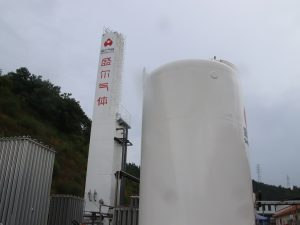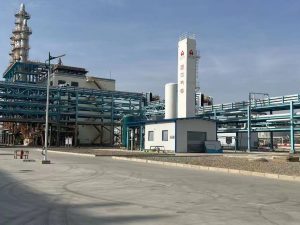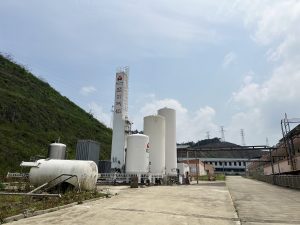
Introduction:
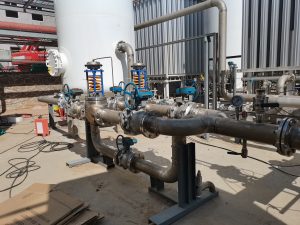
Cryogenic air separation units (ASUs) produce oxygen, nitrogen, and argon by cooling air to very low temperatures and distilling the liquid air. This process is inherently energy-intensive: separating gases near their boiling points requires substantial refrigeration and compression. In practice, a modern ASU typically consumes on the order of 200–250 kWh of electricity per metric ton of O₂ produced. Large, highly optimized plants can approach ~170 kWh/t. These values are roughly four times the thermodynamic minimum (~50–60 kWh/t) because real compressors, heat exchangers, and expanders are not ideal. Therefore, identifying and optimizing the key factors affecting power consumption in cryogenic air separation is critical for efficiency.
The biggest power consumers in a cryogenic ASU are the air compressors and the refrigeration system, followed by product pumps/compressors and various auxiliary loads. Major factors include:
- Air compression design: number of stages, intercooling effectiveness, and final discharge pressure
- Heat exchanger (cold box) efficiency: temperature approach, pressure drops, and insulation quality
- Refrigeration (expander) performance: turbo-expander efficiency and number of expansion stages
- Process configuration: single vs. dual-column distillation, argon side-column, and column pressures
- Operating conditions: throughput (flow rate), product purity targets, ambient temperature and pressure
- Electrical/mechanical losses: motor efficiency, gearbox and bearing losses, vacuum pumps, etc.
Air Compression and Purification:
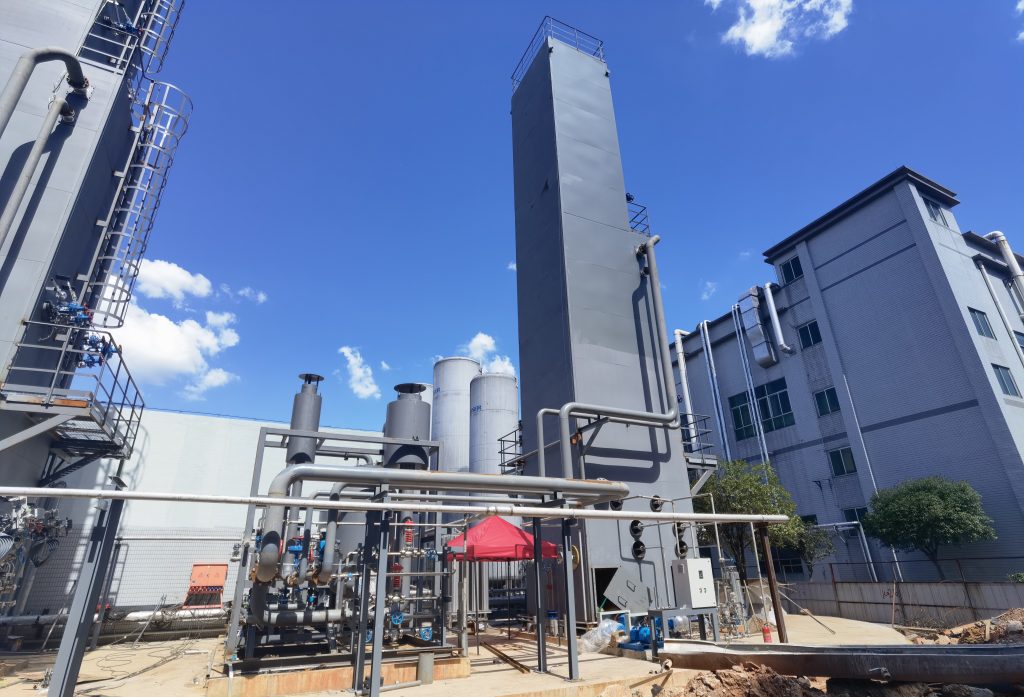
The main air compressor is often the single largest power user in a cryogenic ASU. Ambient air is drawn in and compressed, typically in multiple stages up to about 5–10 bar for the high-pressure distillation column. Multi-stage compressors with intercooling remove heat between stages, making compression closer to isothermal and reducing required work. Compressor isentropic efficiency (often 75–85%) has a big impact: lower efficiency means more input power is consumed as heat loss. Higher discharge pressure (for high product purity or delivery pressure) also directly increases energy use. After compression, air is purified (CO₂ and H₂O removal) before cooling. This purification introduces a small pressure drop, which adds slightly to compressor load but is essential to avoid freezing.
Key design points in the compression train include:
- Multi-stage with intercooling: More stages and effective cooling minimize compressor power per unit pressure rise.
- High-efficiency drivers: Using premium-efficiency electric motors or gas turbines reduces losses.
- Pressure ratio: Optimizing column pressures (for example, a 6 bar high-pressure column vs. a 1.2 bar low-pressure column) balances compression work against refrigeration needs.
- Pre-purification: Dry, CO₂-free air prevents frost and allows tight approach temperatures in the cold box.
These factors underscore why compressor design is one of the key factors affecting power consumption in cryogenic air separation. In a typical large ASU, over half of the plant’s electrical energy may be consumed by the main air compression and interstage cooling.
Heat Exchanger and Cold Box Efficiency:
The cryogenic coldbox (a multi-stream plate-fin heat exchanger) is where the compressed, purified air is precooled by colder outgoing product streams. The efficiency of this heat exchanger strongly affects power use. A tight temperature approach between the hot and cold streams (often just a few degrees) maximizes heat recovery. If the approach temperature is larger, the ASU must either compress more (to achieve colder inlet air) or supply extra external refrigeration. Pressure drops through the cold box must also be minimized: every additional kilopascal of pressure loss means the compressor must work harder to achieve the same outlet flow.
Key considerations for cold-box design include:
- Approach temperature: Smaller ΔT in the heat exchanger reduces the need for additional compression or refrigeration.
- Pressure drop: Multi-pass or parallel channels can limit flow resistance, cutting compressor load.
- Thermal insulation: Good insulation (vacuum jackets, multiple layers) reduces heat leaks into the cold box, lowering the refrigeration duty.
- Cleanliness: Avoiding ice or particulate buildup prevents extra pressure drop.
For example, improving the heat-exchanger approach by just a few degrees can reduce the ASU’s overall power draw by several percent. Thus, cold-box effectiveness is also among the key factors affecting power consumption in cryogenic air separation.
Expansion Turbines and Refrigeration:
The ASU’s refrigeration (to liquefy air) is generated chiefly by turbo-expanders. Part of the high-pressure air is expanded through turbines to very low pressure, producing cold gas. High turbo-expander efficiency is crucial: efficient expanders convert more of the compressed air’s energy into useful cooling (and sometimes mechanical work). Typical expander isentropic efficiencies range 80–90%. Lower efficiency means more work is dissipated internally, forcing compressors to make up the difference.
Important refrigeration factors include:
- Expander efficiency: Higher efficiency yields more refrigeration per kilogram of expanded air.
- Number of expansion stages: Multiple expanders in series allow stepwise cooling to very low temperatures with better energy recovery.
- Energy recovery design: Expanders often drive compressors or generators; inefficiencies here reduce net power savings.
- Use of JT valves: If expanders are bypassed (using Joule–Thomson throttling instead), the plant requires more compression to achieve the same temperatures.
- Argon recovery: Extracting argon requires additional expansion or compression (an argon loop), adding to total power use.
Turbo-expander performance and refrigeration circuit design are key factors affecting power consumption in cryogenic air separation. For instance, improving expander efficiency by just a few percent can noticeably lower the ASU’s specific energy.
Process Configuration (Column Setup and Products):
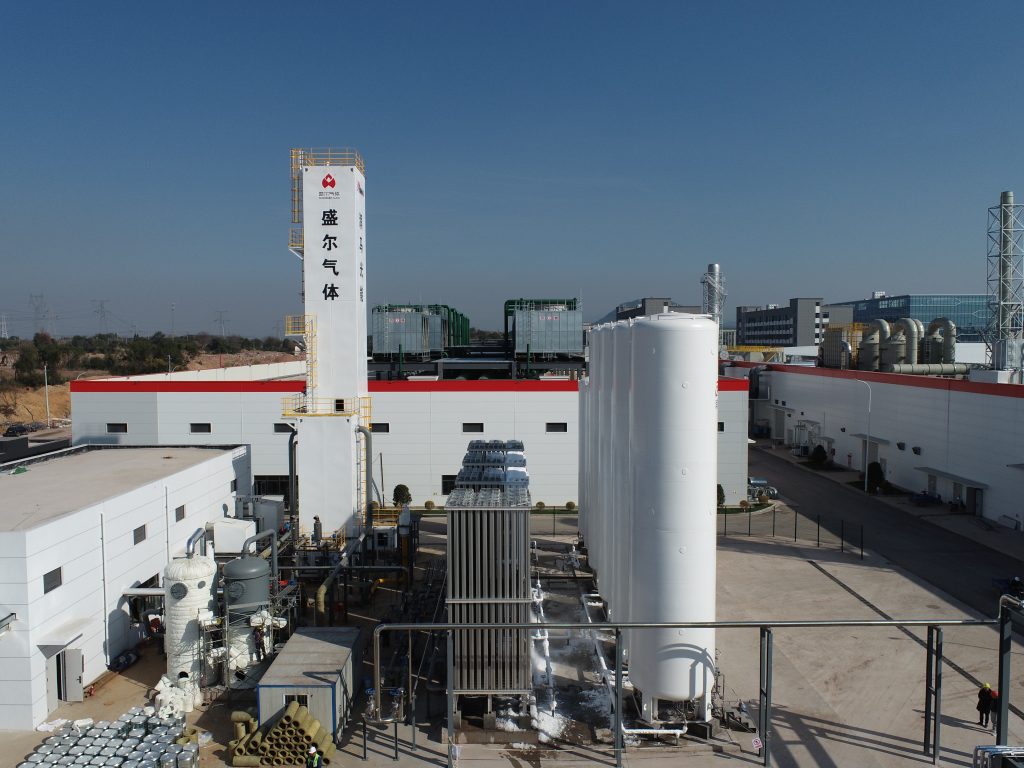
The distillation arrangement also influences energy use. Most large ASUs use a dual-column system: a high-pressure (HP) column (e.g. 5–6 bar) and a low-pressure (LP) column (~1.0–1.3 bar). The HP column’s condenser (cooled by reboiling from the LP column) provides reflux to the LP column, greatly improving energy integration. Operating at higher internal pressure generally increases compressor work but can reduce the amount of external reflux needed. Single-column designs (operating near atmospheric pressure) are simpler but typically less energy-efficient, so they are used mainly for small-scale plants or moderate-purity oxygen.
Other configuration issues:
- Argon side column: Recovering argon via an intermediate-pressure column requires extra reflux and refrigeration; adding an argon column generally increases power consumption.
- Subcooling loops: Some ASUs incorporate external refrigerant loops (e.g. using helium) to pre-cool the air. These loops have their own compressors or pumps, which add to energy use but can improve overall efficiency.
- Product compression/pumping: Delivering liquid oxygen (LOX) or liquid nitrogen (LIN) involves cryogenic pumps (minor load). Compressing gaseous products to high pressure can add 5–15% to total power.
In summary, the choice of column pressures and configurations is another key factor affecting power consumption in cryogenic air separation. For example, shifting from a single-column to a dual-column design can cut specific power by enabling better internal heat recovery.
Operating Conditions and Load:
Actual operating conditions have a significant effect on specific energy. Scale: Large plants (thousands of tons of O₂ per day) benefit from scale; their specific power (kWh/t) is lower than for small units. Turn-down: ASUs are most efficient near design throughput. At partial load, parasitic losses (e.g. from running purge flows or controls) remain roughly constant, so kWh per ton rises. Ambient conditions: Hot, humid intake air increases compressor power and can raise dew points, slightly increasing refrigeration demand. In some climates, air is pre-cooled or scrubbed to reduce this effect. Product specifications: Higher purity targets (e.g. ≥99.9% O₂) demand more reflux and column stages, boosting power use. Lower purity (e.g. ~95%) can be achieved with simpler distillation and typically consumes ~230 kWh/t or less. Delivery pressure: If gas must exit at high pressure, either the ASU must run at higher internal pressure or additional product compression is needed.
Thus, factors like throughput, purity, and ambient temperature are also key factors affecting power consumption in cryogenic air separation. Engineers must account for these when estimating energy use or scheduling plant operation.
Electrical and Mechanical Losses:
Beyond the main process, miscellaneous inefficiencies add to the power bill. Motor efficiency: Compressors and pumps use electric motors, which are usually 90–95% efficient. Specifying premium-efficiency motors can save several percent of energy. Drives and gears: Variable-frequency drives (VFDs) help with part-load control but have conversion losses. Gearboxes or belt drives between turbines/compressors introduce frictional losses (a few percent). Bearings and seals: Oil-lubricated bearings in expanders or compressors consume some power through viscous drag. Auxiliaries: Vacuum pumps (for adsorbing CO₂ or maintaining argon loop vacuum), cooling-water pumps, fans, and control-blower systems each draw power. These auxiliary loads might only be 5–10% of total, but they are part of the plant’s electricity consumption.
Minimizing these losses (high-efficiency motors, optimized piping and bearings, advanced drives) is also a key factor affecting power consumption in cryogenic air separation, since even small percentage savings here reduce total energy use.
| Subsystem | Typical Power Use (kWh per 1000 Nm³ of feed air) |
|---|---|
| Main Air Compression (multi-stage) | ~25–40 |
| Refrigeration (expanders and JT valves) | ~10–20 |
| Product Compression / Pumping | ~5–15 |
| Auxiliary Systems (vacuum pumps, controls) | ~3–10 |
Conclusion:
Cryogenic air separation is powered mostly by the mechanical work of compression and refrigeration. In practice, the key factors affecting power consumption in cryogenic air separation are the efficiency and design of the compressors, heat exchangers, and expanders, the column configuration and operating pressures, and the plant’s load and purity requirements. By improving compressor isentropic efficiency, minimizing heat-exchanger pressure drops, using high-performance expanders, and choosing optimal column schemes, engineers can significantly reduce energy use. Attention to auxiliary equipment (efficient motors and pumps) further lowers consumption. Modern large-scale ASUs, with optimized designs, can approach the practical minimum energy use, but ongoing advances in component performance and process integration continue to improve efficiency in this energy-intensive process.