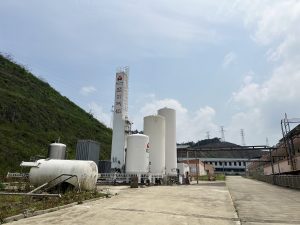
Cryogenic air separation is an industrial process for separating the major components of atmospheric air by cooling it to extremely low temperatures and distilling the liquid air. This method takes advantage of the fact that each constituent of air has a different boiling point. By liquefying air at cryogenic temperatures (below about –180 °C) and feeding it into distillation columns, the process can efficiently produce high-purity oxygen, nitrogen, and argon in large volumes. Cryogenic air separation units (ASUs) are the workhorses of modern industrial gas production, supplying critical gases to industries ranging from steelmaking and oil refining to electronics fabrication and healthcare.Because the technology can deliver several industrial gases from one feed stream at high purity and large scale, cryogenic air separation has become the dominant solution wherever continuous oxygen and nitrogen demand is critical.
Principles of Cryogenic Air Separation
The principle behind cryogenic air separation is straightforward: cool the air until it liquefies, then use fractional distillation to separate the liquid into its components based on their boiling point differences.In practical plant design, the cryogenic air separation process is arranged so that each compression, heat-exchange and distillation step preserves as much refrigeration as possible, reducing the specific power consumption of the unit. At ambient pressure, nitrogen boils at about –196 °C, oxygen at –183 °C, and argon at –186 °C. These distinct boiling points (see Table 1) mean that when air is liquefied and allowed to boil, nitrogen will vaporize first, oxygen last, with argon in between. By controlling temperature and pressure, an ASU can collect each gas at a different stage of evaporation or condensation.
Table 1: Boiling Points of Main Components of Dry Air at 1 atm Pressure
| Component | Approx. Volume % in Air | Boiling Point (°C) |
|---|---|---|
| Nitrogen (N<sub>2</sub>) | ~78% | –196 °C |
| Oxygen (O<sub>2</sub>) | ~21% | –183 °C |
| Argon (Ar) | ~0.9% | –186 °C |
In a typical ASU, the air is first converted into a liquid mixture and then distilled. Within the distillation column(s), repeated cycles of evaporation and condensation enrich nitrogen in the rising vapor and oxygen in the descending liquid. Argon, whose boiling point lies between oxygen and nitrogen, is drawn off from an intermediate stage of the distillation system and often sent to a separate argon purification column. This multi-stage distillation arrangement produces streams of nearly pure oxygen (often 99.5% or higher), pure nitrogen (up to 99.999% for electronics use), and argon (typically 99.9% or higher).
To achieve these separations, a cryogenic air separation unit goes through several key process stages:
- Air Compression – Ambient air is filtered and compressed to a higher pressure (usually around 6–10 bar). Compressing the air not only reduces its volume but also raises the saturation temperature, making it easier to later condense the air into a liquid.
- Purification – The compressed air is passed through a purification system to remove water vapor, carbon dioxide, and any hydrocarbons or other contaminants. Commonly, a pair of molecular sieve adsorbers is used in alternation: one bed traps moisture and CO₂ while the other is regenerated. This step is critical to prevent ice or dry ice formation in the cold sections and to avoid introducing flammable impurities into an oxygen-rich environment.
- Cooling and Liquefaction – The clean, pressurized air is cooled to cryogenic temperatures using heat exchangers and expansion refrigeration. It is first pre-cooled by exchanging heat with outgoing product streams in a multi-pass heat exchanger (often a brazed aluminum plate-fin exchanger). To reach liquefaction, a portion of the air (or a separate cycle gas) is expanded through a turboexpander. The expansion turbine drops the gas temperature dramatically (while doing useful work), yielding a cold liquid-rich air stream typically near –180 °C.
- Fractional Distillation – The cold liquefied air enters the distillation column system. Most ASUs use a double-column design: a high-pressure column and a low-pressure column stacked together, with a heat exchanger (condenser/reboiler) coupling them. In the high-pressure column, the air starts to separate: oxygen accumulates in the liquid at the bottom and nitrogen concentrates in the vapor at the top. The oxygen-enriched liquid from the bottom of the high-pressure column is then fed into the low-pressure column for further refinement. There, it is distilled at near atmospheric pressure to produce a bottom liquid that is almost pure oxygen and an overhead nitrogen gas that is pure. Argon is typically extracted from an intermediate tray in the low-pressure column where the concentration of argon is highest, and it is sent to a dedicated argon distillation column to produce high-purity argon. Through this cascading distillation process, the different gases are separated to the desired purities.
- Product Collection – Separated gases are withdrawn from the columns and delivered as products. Nitrogen and oxygen gas streams are warmed back to ambient temperature through the heat exchangers and then sent to pipelines or onsite consumers at the required pressure. If liquid products are needed, some or all of the output is kept in liquid form and stored in insulated cryogenic tanks. Argon, once purified, is typically stored as a liquid or compressed for filling cylinders. Modern cryogenic air separation plants usually operate continuously, with product storage providing a buffer to handle fluctuations in demand or to supply backup oxygen/nitrogen during maintenance.
Major Components of a Cryogenic ASU
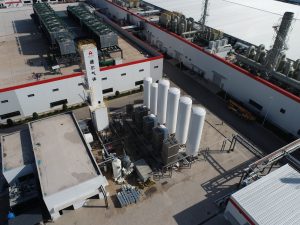
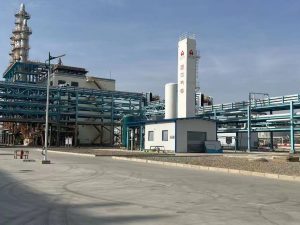
A large cryogenic air separation plant consists of several integrated components, each fulfilling a specific role in the process:
- Intake and Compression System: This includes air intake filters and multi-stage air compressors (with intercoolers) that raise the pressure of the incoming air to the required level (on the order of 6–8 bar for the distillation system). Compressors provide the driving force for the process and typically account for the bulk of the unit’s energy usage.
- Pre-Purification Unit (PPU): Downstream of the compressor, the PPU cleans the air. It usually contains dual molecular sieve beds that alternately absorb impurities (H₂O, CO₂, and trace hydrocarbons) from the high-pressure air. Without this purification, moisture would freeze into ice and CO₂ into dry ice in the cold box, clogging equipment, while hydrocarbons could accumulate and pose explosion hazards in an oxygen-rich environment.Proper matching of the compressor train, pre-purification unit and cold box is essential for efficient cryogenic air separation, since unnecessary pressure drop or temperature loss directly increases operating cost.
- Cryogenic Heat Exchangers: The purified, pressurized air is routed through cryogenic heat exchangers where it is progressively cooled against returning cold product gases (oxygen, nitrogen, argon). The most common design is the plate-fin heat exchanger, made of aluminum alloy, which offers high surface area in a compact form. By the time the air leaves the cold end of these exchangers, it is just a few degrees above its liquefaction point.
- Expansion Turbine (Cold Production): To produce the necessary refrigeration, a turboexpander (expansion turbine) is employed. In this unit, a portion of the cooled, pressurized gas expands to a lower pressure, converting pressure energy into cold. The expansion drops the gas temperature sufficiently for a large fraction to condense into liquid. The work extracted by the expander is often used to drive an alternator or booster compressor within the ASU, recovering energy that offsets some electrical load.
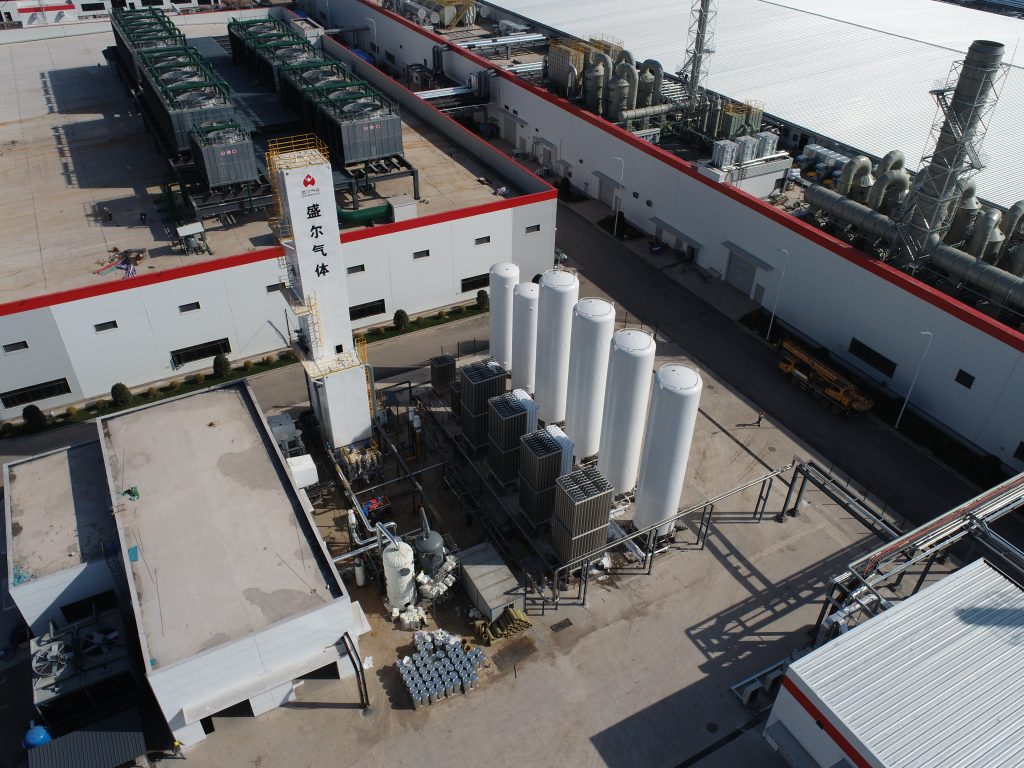
- Distillation Columns (Cold Box): The heart of a cryogenic air separation unit (ASU) is the distillation system housed in a large insulated cold box. Typically a high-pressure column sits atop a low-pressure column, with the two thermally coupled (the condenser of the high-pressure column acts as the reboiler for the low-pressure column). Multiple internal trays or packing provide ample contact between rising vapors and falling liquids, effecting the separation of nitrogen, oxygen, and argon by fractional distillation. An argon side column may be integrated to extract high-purity argon since its boiling point is close to oxygen’s.
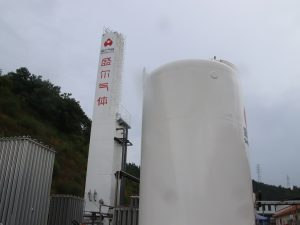
- Product Storage and Delivery: Once separated, the product gases leave the cold box. Oxygen and nitrogen intended for gaseous use are reheated to ambient temperature through the main heat exchangers and then sent out at pressure (for example, oxygen might be delivered at ~5–10 bar to a pipeline for a steel mill). Argon gas can be compressed for cylinder filling or further use. In many plants, a portion of the output is taken as liquid (liquid oxygen, liquid nitrogen, liquid argon) and stored in on-site cryogenic tanks. These liquids serve as backup supply and allow the plant to accommodate demand swings (for instance, by producing extra liquid during low demand periods, which can be vaporized to gas during peak demand or when the ASU is down).
Industrial Applications
Cryogenic air separation plays a vital role in numerous industries by providing large volumes of industrial gases:
- Steel and Metals: Steelmakers rely on vast quantities of oxygen from ASUs for processes like the basic oxygen furnace (to decarburize molten iron) and in oxy-fuel burners. Nitrogen is used for purging and blanketing in steel production, and argon is injected into molten steel for stirring and removing impurities. These gases are also used for metal cutting and welding operations, where oxygen supports combustion and argon shields hot metal from air.
- Chemical and Refining: Many chemical processes depend on cryogenic air separation for feedstock gases. For example, ammonia production requires nitrogen (combined with hydrogen to make ammonia), typically supplied by an ASU. Refineries and petrochemical plants use oxygen for gasification of coal or heavy oil residues and for oxidative processes (like partial oxidation reactions). High-purity oxygen can also enhance combustion efficiency in incinerators and boilers.
- Energy and Environmental: In power generation, particularly for Integrated Gasification Combined Cycle (IGCC) plants or oxy-fuel combustion systems, cryogenic air separation supplies the oxygen needed for combusting fuels in a controlled way to enable carbon capture. The growing clean energy sector also uses ASUs; for instance, large-scale hydrogen production via gasification or certain chemical looping processes requires oxygen.
- Electronics and Semiconductor Manufacturing: Ultra-high-purity nitrogen (99.999% or “five nines” purity) is essential for creating inert atmospheres in semiconductor fabrication, preventing oxidation and contamination during chip production. Similarly, argon from ASUs is used in processes like silicon crystal growth and for sputtering in manufacturing of electronics and specialty materials.
- Healthcare and Medical Gases: Hospitals and medical facilities depend on a stable supply of medical-grade oxygen. Large cryogenic air separation plants produce liquid oxygen which is delivered to hospitals and then vaporized on-site to supply patient breathing oxygen. ASUs also provide gaseous nitrogen for medical device manufacturing and liquid nitrogen for cryopreservation and medical research.
- Food and Beverage: The food industry utilizes nitrogen from air separation for food packaging (to displace oxygen and prolong shelf life) and for flash freezing of foods using liquid nitrogen.
Efficiency and Energy Considerations
Cryogenic air separation is an energy-intensive process. The need to compress large volumes of air and produce cryogenic refrigeration means that ASUs consume substantial electrical power. In fact, the electric motors driving the air compressors and cooling equipment often make an ASU one of the largest power consumers in a plant complex. A typical modern ASU might require on the order of 200–250 kWh of electricity to produce one ton of oxygen (and co-produce nitrogen and argon), which is several times above the theoretical minimum work of separation (~50 kWh/ton for oxygen). Higher product purity or producing products in liquid form further increases the specific energy consumption. For example, liquefying the gases (instead of supplying them as ambient-temperature gas) can roughly double the energy requirement per unit of product, due to the extra refrigeration needed.
Over the years, engineering advancements have steadily improved the energy efficiency of this process. Large cryogenic air separation plants tend to be more energy-efficient than small ones, benefiting from economies of scale and more advanced cycle designs. Process improvements such as better heat exchanger design (achieving closer temperature approaches), use of structured packing instead of trays in distillation (reducing pressure drop and improving separation efficiency), and more efficient turboexpanders have all contributed to lowering energy consumption. Additionally, modern ASUs employ sophisticated process control systems and optimization algorithms to minimize power draw—adjusting column operating conditions and compressor loads in real-time to match demand with the least energy usage. Integration with other processes can also enhance efficiency; for instance, waste heat from a nearby system or gas turbine can be used to regenerate the PPU adsorbers or to provide part of the reboil heat for the distillation columns, thereby reducing the standalone energy load of the ASU.
Challenges and Developments
Despite being a mature and reliable technology, cryogenic air separation faces several challenges and continues to evolve:
- High Energy Consumption: Power usage is the primary operating cost for an ASU. The dependence on electricity means that the cost and carbon footprint of production are directly tied to the power source. In an era of rising energy costs and focus on sustainability, there is pressure to reduce the energy intensity of air separation. Research is ongoing into cycle optimizations and new technologies to cut energy use, but any new approach must still contend with the fundamental thermodynamic limits of gas separation.
- Capital Investment and Scale: Cryogenic ASUs are complex, large installations with significant capital cost. They become economically favorable mostly at large scales (hundreds to thousands of tons per day of product). The need for heavy equipment (compressors, heat exchangers, distillation towers) and extensive refrigeration infrastructure means project lead times are long and require specialized engineering. This also makes it challenging to scale down the technology for small or modular applications—alternatives like adsorption (PSA) or membranes are often chosen for lower volumes despite lower purity, because a full cryogenic plant would not be cost-effective at small scale.
- Operational Rigor: These plants are generally designed to run continuously for long periods (often years between major turnarounds) and are not well-suited to frequent starts and stops. A cryogenic air separation process can take several hours to cool down and start producing on-spec products from a warm start. Therefore, operators strive to keep ASUs running steadily. Sudden changes in demand can’t be easily followed by a cryogenic unit without losses in efficiency. This inflexibility is a challenge when integrating with processes that have variable oxygen demand or with power grids where electricity pricing may fluctuate (for example, due to variable renewable energy input).
- Safety Considerations: Handling very cold liquids and high-purity oxygen requires stringent safety measures. Materials for equipment must maintain toughness at –200 °C to avoid brittle fractures. Oxygen-rich environments inside the plant (especially in the lower sections of distillation columns and associated piping) can cause organic materials to combust violently; thus, all lubricants, seals, and construction materials are carefully selected for oxygen service, and hydrocarbon contaminants are rigorously excluded. Nitrogen, while inert, poses an asphyxiation risk if it leaks into work areas, as it can displace oxygen in the air. ASUs are designed with multiple layers of safety systems and require well-trained operators following strict protocols to manage these hazards.
- Argon Recovery Complexity: Recovering argon is a secondary objective in air separation (since argon is less abundant in air), but doing so adds complexity. Because argon’s boiling point is only a few degrees different from oxygen’s, achieving high-purity argon requires additional distillation steps and careful control of column conditions. The argon side column increases energy usage and equipment count, so operators must balance the value of argon production against the added cost. Nevertheless, argon is a valuable industrial gas, and most large ASUs are designed to extract it efficiently.
- Emerging Technologies: While cryogenic distillation is currently unrivaled for large-scale air separation, other methods are being explored. Advanced membrane separation and pressure swing adsorption systems can handle smaller-scale needs or produce moderately pure O₂/N₂ with potentially lower energy consumption at small scale, but they cannot yet match the volume or purity output of cryogenic plants for big users. Another development area is ion transport membranes (ITM), which use ceramic materials at high temperature to generate oxygen by ionic diffusion; these are being researched for integration with power plants to supply oxygen for combustion or gasification with higher efficiency. If such technologies mature, future air separation might supplement or partially replace cryogenic methods in certain niches. In the meantime, continuous improvements in cryogenic ASU design – from more efficient compressors and expanders to automation and AI-driven optimization – are ensuring this century-old process remains state-of-the-art.
Conclusion
Cryogenic air separation is a foundational technology in the industrial world, enabling the bulk production of oxygen, nitrogen, argon, and other gases that underpin modern manufacturing, healthcare, and energy industries. Its core principle of low-temperature distillation of air has proven highly effective and scalable, making cryogenic ASUs the standard for high-volume and high-purity gas supply. Ongoing innovations aim to address its challenges – particularly energy consumption and operational flexibility – ensuring that cryogenic air separation continues to meet the needs of advanced industrial processes in a more energy-conscious future. In summary, this process remains an indispensable workhorse, and its evolution will likely integrate new efficiencies (and possibly hybridize with emerging technologies), but its ability to reliably deliver large quantities of industrial gases will keep it central to many key sectors for years to come.