1. Introduction
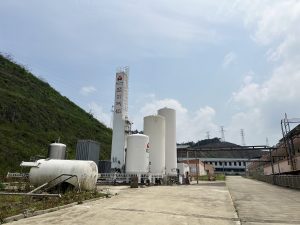
Decarbonizing the power sector increasingly depends on technologies that can tighten control over combustion and concentrate CO₂ for capture. Oxy-fuel combustion, oxygen-enriched firing, and Integrated Gasification Combined Cycle (IGCC) concepts all rely on a stable and scalable source of high-purity oxygen. For utility-scale plants, that role is overwhelmingly played by Cryogenic Air Separation units (ASUs), which can deliver continuous oxygen flows from a few thousand up to well over 100,000 Nm³/h at purities above 95%. This article looks at cryogenic air separation for power plants and the practical issues engineers face when they add oxygen into real boiler and gasifier designs.delion+1
In day-to-day power plant design work, nobody doubts the value of oxygen anymore. The real challenge is how to bring an oxygen supply for power plants into the process without paying too high a price in energy, uptime, or operational flexibility. The sections that follow take a practical look at how cryogenic air separation units are built and operated, which parameters matter most for power applications, and how these units can be tied into boilers, gasifiers, and carbon-capture systems to support cleaner combustion.

2. Oxygen and Cleaner Combustion in Power Plants
In a standard air-fired boiler or gas turbine, most of the gas entering the burner is actually nitrogen, not oxygen. This nitrogen passes through the flame more or less inert, carries heat, and increases the total flue-gas flow rate. The result is a limited peak flame temperature and a large stack gas volume with relatively low CO₂ concentration. If part or all of the combustion air is replaced by a controlled oxygen stream, usually mixed with recycled flue gas, power plants can:
- Increase flame temperature and improve thermal efficiency, then re-moderate it with flue gas recirculation.
- Produce a CO₂-rich flue gas that is much easier and cheaper to treat in downstream capture units.
- Reduce the total volumetric flow through the boiler and back-end equipment, enabling more compact or retrofitted designs.
To realize these benefits, however, the plant must have access to an oxygen source that is both pure and reliable. This is where Cryogenic Air Separation becomes central: it couples high purity (typically 95–99.5% O₂) with large, Once cryogenic air separation for power plants is available on site, operators can run oxy-fuel or oxygen-enriched firing with much tighter control over flame temperature and flue-gas composition.steady flows and long on-stream factors that match baseload power plant operation. jgt.irangi.org+1
3. Process Fundamentals of Cryogenic Air Separation
3.1 Front-end compression and purification
In most projects, cryogenic air separation for power plants follows the same basic sequence: air compression, purification, cryogenic cooling, and double-column distillation.In a typical ASU, ambient air is first drawn through filters and compressed to 5–7 bar in multi-stage centrifugal or reciprocating compressors. After inter-stage cooling, the compressed air passes through a pre-purification unit (PPU) where molecular sieves remove water vapor, CO₂, and trace hydrocarbons. This step is essential; without it, these impurities would freeze out in the cold box and block the heat exchangers or distillation columns. engj.org+1
3.2 Cryogenic cooling and main heat exchanger
Purified air then enters the main heat exchanger, where it is cooled close to its liquefaction temperature by counter-current exchange with cold product and waste streams leaving the distillation system. The exchanger is usually a brazed aluminum plate-fin design, chosen for its high surface area and low pressure drop at cryogenic temperatures. Thunder Said Energy+1
A fraction of the cold, high-pressure air is expanded in a turbine to provide the refrigeration needed to maintain cryogenic conditions. The balance of the stream is partially liquefied and sent to the distillation columns.
3.3 Double-column distillation system
The heart of Cryogenic Air Separation is the double-column system:
- A high-pressure (HP) column operates at ~5–6 bar, where the incoming air is partially separated into a nitrogen-rich overhead and an oxygen-rich bottom.
- A low-pressure (LP) column operates around 1.2–1.4 bar. Condensing nitrogen from the HP column provides the reflux to the LP column, while boiling oxygen-rich liquid at the LP bottom provides reboil duty.
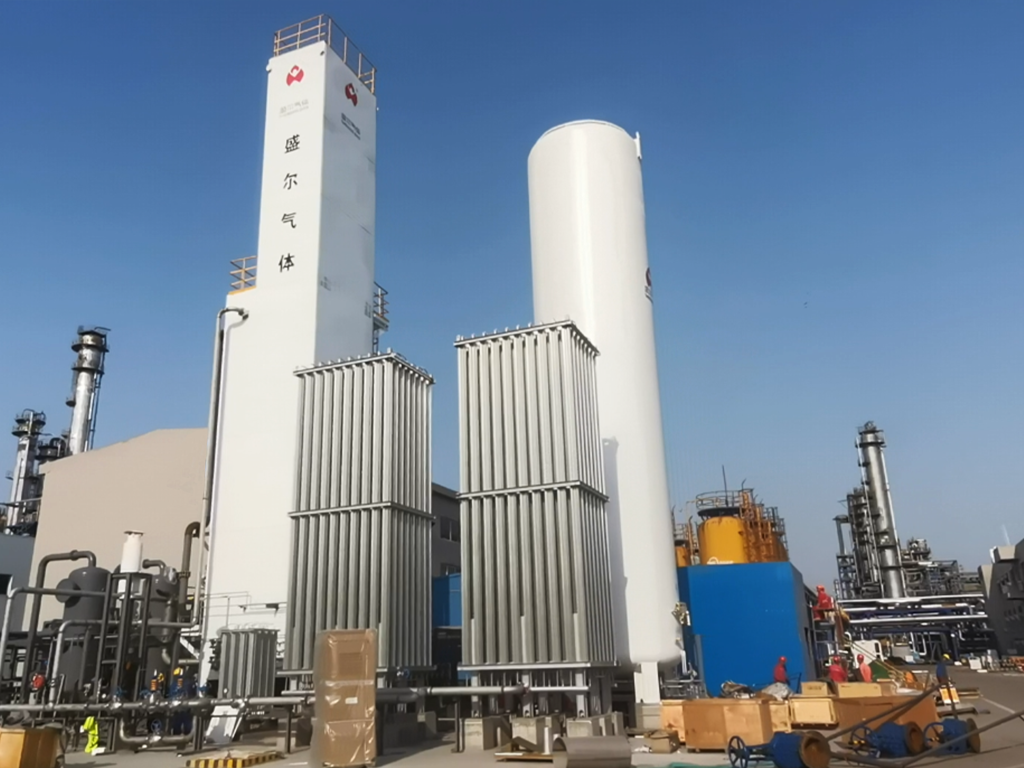
By stacking these columns thermally (typically inside a common cold box), the process recovers refrigeration efficiently. Depending on the plant’s goals, the LP column can be configured to co-produce argon and nitrogen or be optimized specifically for oxygen production. Typical gaseous oxygen purities for power applications range from 95% (for some oxygen-enrichment schemes) up to 99.5% and above for oxy-fuel or IGCC projects. jgt.irangi.org+1
3.4 Internal vs external compression
For oxygen supply for power plants, two delivery strategies are common:
- Gaseous oxygen (GOX) at low pressure from the cold box, boosted by external compressors to the required pipeline pressure.
- Liquid oxygen (LOX) pumped at cryogenic temperature to high pressure and then vaporized, known as “internal compression.” This approach reduces compressor power because pumping a liquid is less energy-intensive than compressing a gas. engj.org+1
The choice affects both energy consumption and dynamic response, and is typically optimized during early FEED studies.
4. Typical Performance Parameters for Power-Plant ASUs
When engineers compare different options, cryogenic air separation for power plants is usually judged on specific energy use, achievable purity, reliability, and turndown capability.Modern low-pressure ASUs designed for utility service are highly optimized in terms of specific power consumption and availability. Literature and vendor data indicate that plants producing ~99.5% oxygen can reach specific energy consumption levels around 0.35–0.5 kWh/Nm³ O₂, corresponding to approximately 350–500 kWh per ton of oxygen. ResearchGate+2jgt.irangi.org+2
A rough benchmark for cryogenic oxygen plants serving power applications can be described without going into vendor-specific guarantees. For a medium-size ASU used for oxy-enrichment, oxygen purity is typically in the range of about 95–97 vol%. Nominal flow is often on the order of 5,000 to 20,000 Nm³/h, with the gaseous product delivered at 3–10 bar after a separate compression stage. For plants in this size range, specific energy consumption usually falls around 0.40–0.55 kWh per Nm³ of oxygen, with overall availability in the 97–99% range and yearly on-stream time roughly between 7,500 and 8,200 hours.
For a large ASU designed for full oxy-fuel firing or IGCC, the numbers scale up. Oxygen purity is usually specified at 99.5–99.8 vol%, with nominal capacities between roughly 40,000 and 120,000 Nm³/h. Delivery pressures of 10–30 bar are common when the oxygen is sent by pipeline directly to the boiler island or gasifier. Thanks to more optimized low-pressure cycles and modern machinery, specific energy consumption can be reduced to about 0.35–0.50 kWh per Nm³ of oxygen, while availability still targets 97–99% and annual operating hours often reach 7,800–8,400.
These figures are best viewed as a practical range rather than fixed rules. Site elevation, cooling water and ambient temperature, the required product pressure, and whether nitrogen or argon is also recovered all have a noticeable impact on the final performance. Seen from the power plant side, the main question is how much of the gross electrical output is consumed by the oxygen plant. In many oxy-fuel and IGCC configurations, the cryogenic air separation unit draws only a few percent of the total generated power, and that penalty has to be balanced against higher boiler efficiency and the much simpler route to CO₂ capture.
5. Integration of Cryogenic ASUs with Power Plants
5.1 Oxy-fuel combustion systems
For baseload units, cryogenic air separation for power plants is normally sized around the minimum continuous rating of the boiler or gasifier, with some headroom for transients and maintenance.In oxy-fuel boilers, the ASU supplies nearly all of the oxidant as oxygen. The flue gas, largely composed of CO₂ and water vapor, is partially recycled to the boiler to control flame temperature and heat transfer profiles. The oxygen supply for power plants in this configuration is essentially a base-load service: frequent start-stop operation is undesirable, and the ASU is usually designed to match the boiler’s minimum continuous rating with some margin.
Integration aspects include:
- Oxygen pipeline routing and redundancy.
- Tie-ins to the boiler windbox or burner manifolds.
- Control coordination between ASU output and boiler load, often via master-follower strategies.
- Safety systems for oxygen handling, including material selection, velocity limits, and cleanliness standards.
5.2 IGCC and gasification-based concepts
For IGCC plants and coal/biomass gasification units, Cryogenic Air Separation supplies oxygen to the gasifier rather than directly to the burner. The syngas is then cleaned, conditioned, and burned in a gas turbine combined cycle. Here, the oxygen flow is strongly coupled to fuel feed and syngas composition, so both flow stability and turndown capability of the ASU matter.
Some projects adopt multi-train ASU configurations, allowing partial turndown by taking one train offline while others continue at higher load. Co-produced nitrogen can be used as a turbine diluent to control NOx emissions and firing temperature, giving additional integration value.
5.3 Dynamic operation and grid interaction
As power systems add more variable renewable energy, there is growing interest in using the ASU as a flexible load. Because compressors dominate power consumption, operators can modulate ASU load within certain bounds to absorb excess electricity or reduce consumption during peak pricing, without compromising the continuity of oxygen supply thanks to intermediate storage (LOX tanks) and pipeline buffering. Thunder Said Energy+1
6. Comparison with Non-Cryogenic Oxygen Technologies
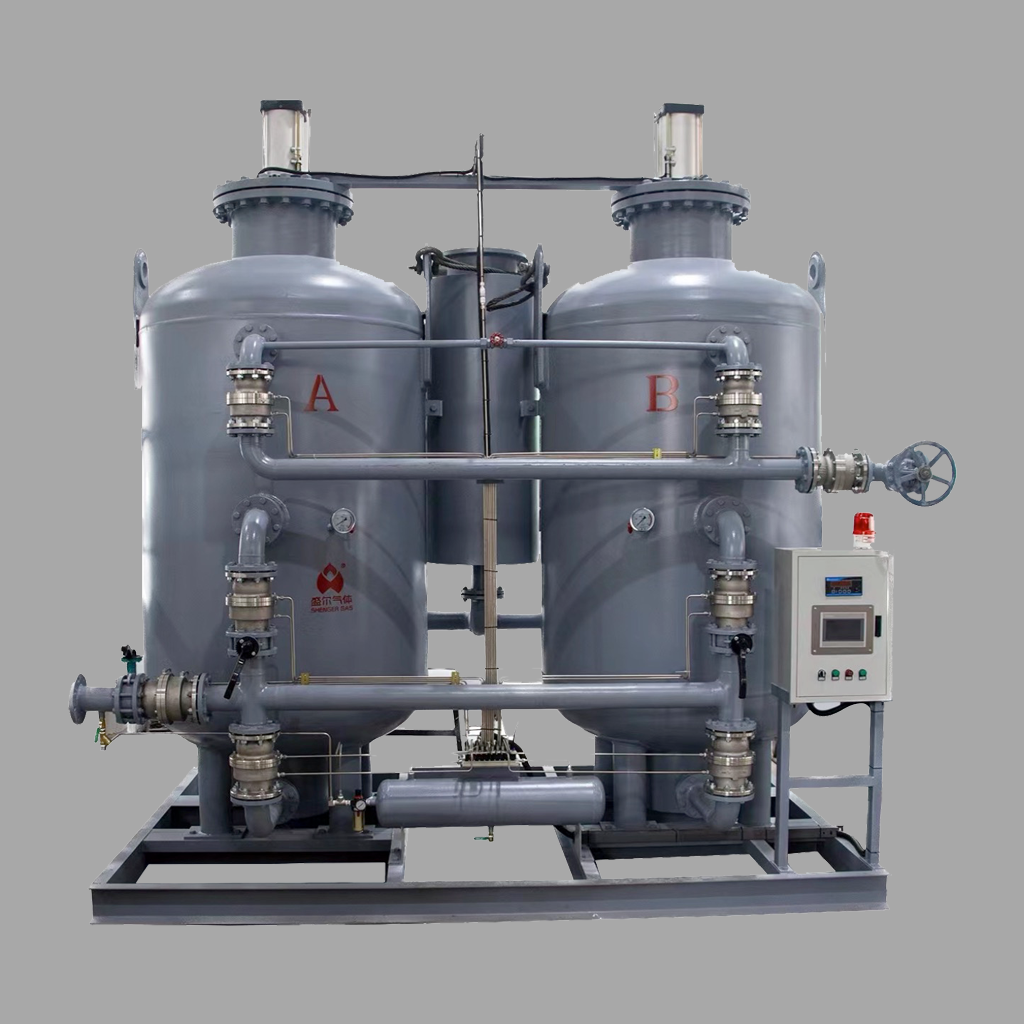
Non-cryogenic technologies such as Pressure Swing Adsorption (PSA/VPSA) and membrane oxygen systems provide alternatives for smaller or lower-purity applications. PSA oxygen plants typically deliver 90–95% O₂ at capacities from a few Nm³/h up to about 5,000 Nm³/h, while membrane systems usually enrich air to 30–45% O₂. 维基百科+1
For utility-scale oxygen supply for power plants, these options face limitations:
- Capacity: Power-plant oxy-fuel or IGCC concepts often require tens of thousands of Nm³/h of oxygen, which is at the upper edge or beyond the efficient range of modular PSA systems.
- Purity: High CO₂ capture efficiency and stable combustion control favor purities above ~95%, where Cryogenic Air Separation is more economical on a per-ton basis despite higher complexity.
- By-products: Cryogenic ASUs naturally produce nitrogen (and optionally argon), which can be monetized or used onsite for sealing, purging, and inerting. Non-cryogenic systems generally lack this co-product flexibility.
As a result, PSA or membrane technologies are more common in smaller industrial facilities, medical oxygen generation, or partial enrichment schemes, whereas cryogenic plants dominate the large-scale, high-purity segment relevant to central power stations.
7. Design and Optimization Considerations
7.1 Process configuration
Within Cryogenic Air Separation itself, there is considerable room for optimization:
- Column pressure levels are chosen to minimize compressor work while maintaining adequate driving forces in the main heat exchanger and distillation stages.
- Argon recovery may be included or omitted depending on whether the additional energy and capital are justified by argon revenues.
- Internal compression vs external compression is selected according to the required delivery pressure, grid electricity pricing, and the plant’s flexibility requirements.
Advanced designs use low-pressure cycles, high-efficiency expanders, and structured packing in columns to cut energy consumption while maintaining separation performance. jgt.irangi.org+1
7.2 Reliability and maintainability
For baseload power service, ASUs are engineered for multi-year continuous operation with scheduled outages aligned to major power block maintenance. Typical strategies include:
- Redundancy in critical instruments and control systems.
- Parallel trains of PPU adsorbers and rotating machinery.
- Online monitoring of cold box performance, including ΔT profiles in the main exchanger and column temperature/pressure profiles.
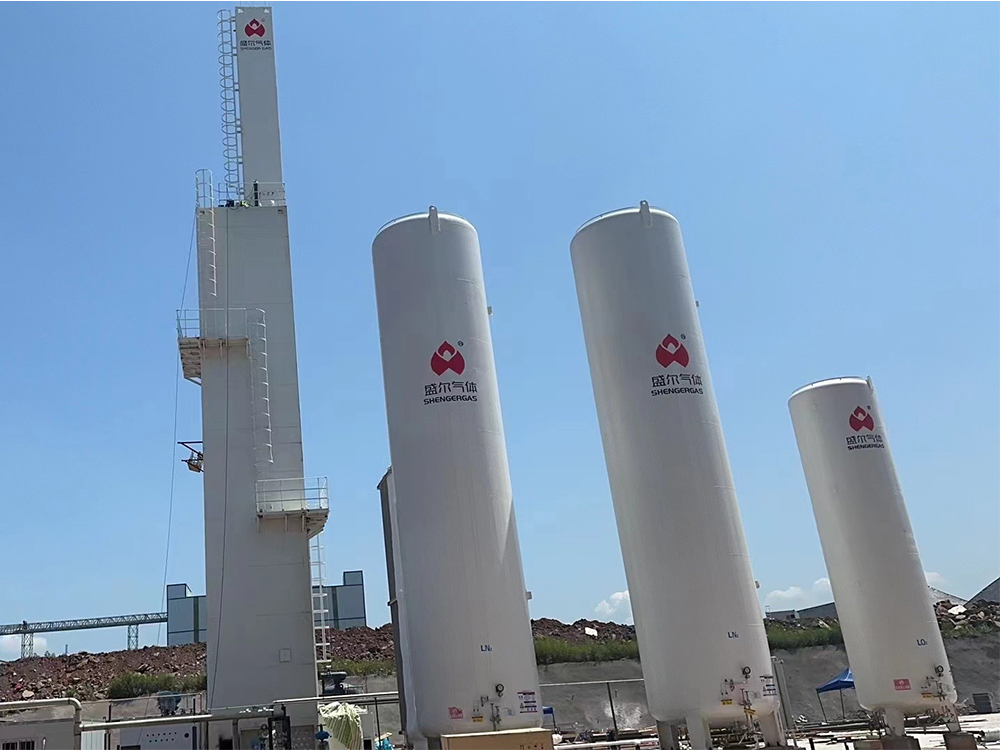
Because an unexpected loss of oxygen can trip the boiler or gasifier, many sites also install liquid oxygen storage sufficient for several hours of full-load operation, covering short ASU disturbances.
7.3 Safety in oxygen service
Handling large quantities of oxygen at elevated pressure demands strict attention to materials compatibility, cleanliness, and flow velocities. Hydrocarbon contamination, particulate matter, and sharp changes in line geometry can raise the risk of ignition. International guidelines specify maximum velocities in oxygen pipelines, the use of non-combustible materials, and degreasing procedures for components in oxygen service. These considerations must be integrated early in the layout and specification work for any ASU-to-boiler connection.
8. Outlook and Conclusion
As more projects move toward CO₂ capture, cryogenic air separation for power plants is likely to remain one of the standard choices for supplying large oxygen blocks to the power sector.As utilities face tighter CO₂ limits and a growing share of renewables, demand for a stable oxygen supply for power plants is more likely to increase than disappear. Oxy-fuel upgrades on existing coal units, new IGCC projects with pre-combustion capture, and various hybrid schemes that couple gas turbines with high-temperature processes all require oxygen at a scale that only a few technologies can realistically provide.
For large baseload units, Cryogenic Air Separation is still the practical choice when continuous, high-purity oxygen is needed. It combines proven hardware, established safety practice, and predictable performance, and it can be engineered to match the load profile of the boiler or gasifier. Work now underway on better cycle integration, more flexible compressor operation, and model-based control is aimed at trimming specific power consumption and making the ASU a more responsive part of the overall plant.
For engineers and researchers, the open questions are less about basic feasibility and more about configuration, integration, and control: how to size and arrange ASU trains, how to link them to the power block and CO₂-capture unit, and how to operate the whole system against a changing grid. As carbon constraints tighten and more projects move from pilot to commercial scale, well-designed cryogenic ASUs are likely to remain a standard tool for delivering reliable, lower-emission power.