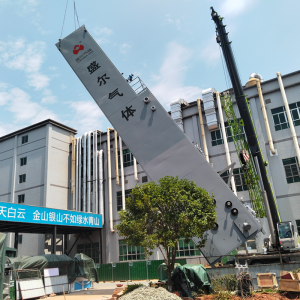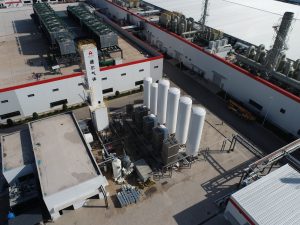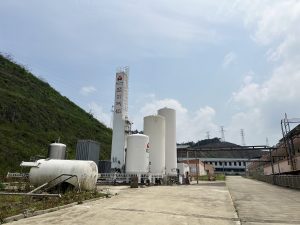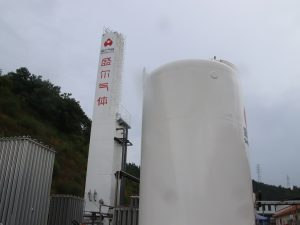
is a fundamental industrial process used to produce high-purity gases from air. This process is based on low-temperature distillation, where air is cooled and liquefied to exploit the different boiling points of its components. Researchers and engineers rely on this process to obtain large volumes of nitrogen, oxygen, and argon at high purity levels for use in industries ranging from steelmaking to electronics. The following sections detail the basic principles of this technology, the thermodynamic underpinnings of low-temperature distillation, the typical process flow and key equipment, as well as the industrial relevance and advantages of cryogenic air separation over alternative methods.
Basic Principles of Cryogenic Air Separation
Atmospheric air is a mixture primarily composed of nitrogen (~78% by volume), oxygen (~21%), and argon (~1%), with trace amounts of other gases. The basic principle of cryogenic air separation is to separate these components by cooling the air to extremely low temperatures until it liquefies, and then distilling the liquid air into its constituents. This method is essentially a fractional distillation performed at cryogenic conditions. Nitrogen has the lowest boiling point among the major components (approximately –196 °C), oxygen boils at about –183 °C, and argon at around –186 °C. These boiling point differences, although relatively small, form the basis for separating the gases: as liquid air is warmed, nitrogen tends to vaporize first (being more volatile), while oxygen remains in the liquid phase longer. By carefully controlling temperature and pressure, cryogenic air separation units (ASUs) can selectively evaporate and condense components to yield separate streams of nitrogen, oxygen, and argon.
The concept of low-temperature distillation of air dates back to the early 20th century, pioneered by Carl von Linde and others during the development of air liquefaction processes. In modern ASUs, the principle remains the same – utilize low-temperature distillation to achieve separation – but the process has been refined with efficient heat exchangers, multi-stage distillation columns, and advanced refrigeration cycles. The result is the ability to produce extremely high purity gases (oxygen often >99.5%, nitrogen >99.999%, argon ~99.99%) in large quantities. The basic principle is elegant: cool, liquefy, and distill the air so that each component can be drawn off at different points in the distillation system once its boiling point is reached. This low-temperature distillation method yields a continuous supply of high-purity gases in industrial operation.
Thermodynamic Background of Low-Temperature Distillation
Low-temperature distillation is fundamentally driven by phase equilibrium and the thermodynamic properties of the air components. When air is cooled below about –180 °C at sufficiently high pressure, it condenses into a liquid mixture. Distillation at cryogenic temperatures takes advantage of the slight differences in volatility between nitrogen, oxygen, and argon. The relative volatility of nitrogen to oxygen at these temperatures allows separation, but because the difference is not large, achieving high purity requires many theoretical stages (equilibrium contact steps) and a high reflux ratio. In practice, this means that the distillation columns in these units are designed with dozens of trays or packed bed sections to allow repeated vapor–liquid contact, gradually enriching nitrogen in the vapor phase and oxygen in the liquid phase.
Thermodynamically, the process operates near the boiling points of the gases, and significant refrigeration energy is required to reach and maintain these low temperatures. Air must be pressurized and then expanded to produce cooling (often using the Joule–Thomson effect or, more efficiently, an expansion turbine) as part of a refrigeration cycle. Modern cryogenic air separation units (ASUs) use turboexpanders to generate the cold temperatures needed for low-temperature distillation. The work extracted by expanding part of the pressurized air can even be recycled to assist in driving compressors, improving overall efficiency. All of the cooling power in an ASU ultimately comes from the energy invested in compressing the air and then recovering it as cold through expansion and heat exchange.
A notable design feature in cryogenic air separation is the use of a double-column system operating at different pressure levels, which provides a thermodynamic advantage. Typically, a high-pressure distillation column (operating around 5–6 bar) and a low-pressure column (near 1.2 bar, just above atmospheric) are thermally linked. The higher pressure in the first column means nitrogen will condense at a higher temperature than it would at atmospheric pressure. This condensed nitrogen at the top of the high-pressure column is used to provide boil-up (reboiling heat) for the low-pressure column by heat exchange. In essence, the latent heat released by condensing nitrogen in the high-pressure column is used to vaporize oxygen-rich liquid in the low-pressure column. This clever heat integration (a kind of built-in heat pump effect) significantly reduces external refrigeration needs and is a key thermodynamic feature of modern low-temperature distillation units. Thanks to such innovations, cryogenic distillation of air can approach close to theoretical efficiency limits, although the cryogenic air separation process remains energy-intensive compared to ambient-temperature separation techniques.
Process Flow and Key Equipment in Cryogenic Air Separation
A typical industrial ASU follows a series of well-defined steps, each involving specialized equipment to handle the low temperatures and high purity requirements. The overall process flow from ambient air to product gases involves:
- Air Compression: Ambient air is first filtered to remove dust and then compressed to a higher pressure (usually around 5 to 10 bar). Multi-stage air compressors with inter-cooling are used to achieve this. Compressing the air not only prepares it for efficient heat exchange but also provides the basis for the refrigeration cycle (since expansion of this high-pressure air will later generate the needed cooling).
- Purification: The compressed air is passed through purification units to remove water vapor, carbon dioxide, and other contaminants. Typically, twin-tower molecular sieve adsorbers are employed to trap moisture and CO₂, which would otherwise freeze at cryogenic temperatures and block equipment. This step ensures that only clean, dry air enters the cryogenic section.
- Heat Exchange and Cooling: The purified, pressurized air is cooled to near its dew point via regenerative heat exchangers (often brazed aluminum plate-fin heat exchangers). These exchangers use returning cold product and waste streams to precool the incoming air, recovering cold energy. To achieve final liquefaction temperatures, a portion of the air is expanded through an expansion turbine (turboexpander) or Joule–Thomson valve. The expansion cools the air drastically (often to around 100 K, or –173 °C, or lower), producing liquid air. The main heat exchanger and expander are typically housed in an insulated cold box to minimize heat leaks from the environment.
- Low-Temperature Distillation: The heart of the process is the distillation system, often comprising two main distillation columns. First, a high-pressure column (~6 bar) partially separates the air: nitrogen-rich vapor rises and oxygen-enriched liquid falls to the bottom. That oxygen-enriched liquid is then fed to a low-pressure column (~1.2 bar) for final separation. In the low-pressure column, further distillation produces high-purity liquid oxygen at the bottom and high-purity nitrogen gas at the top. The two columns are thermally linked by a condenser–reboiler: as nitrogen from the high-pressure column condenses, it provides boil-up heat to vaporize oxygen in the low-pressure column, greatly improving energy efficiency. Multiple distillation stages (trays or packing) are employed in these columns to reach the required purities. An argon side column is often included as well, fed by an intermediate stream from the low-pressure column where argon concentrates (~10%). This side column yields crude liquid argon, which can be further purified to >99.9% (often via catalytic oxygen removal).
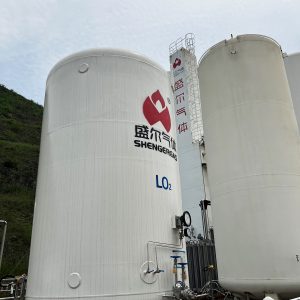
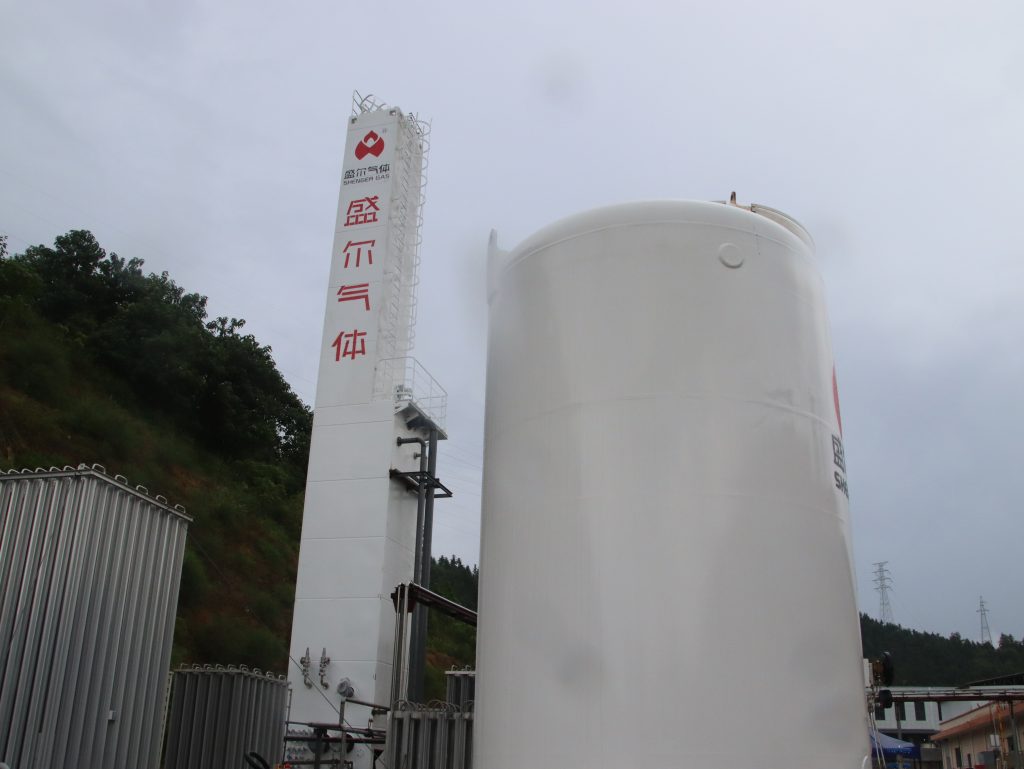
- Product Extraction and Storage: Once separation is achieved, the products are withdrawn. Oxygen is typically removed as a liquid from the bottom of the low-pressure column and pumped to storage or evaporated through heat exchangers to supply gaseous oxygen at pipeline pressure. Nitrogen is often taken as a gas from the top of the low-pressure column; some may be liquefied in the process for storage. Argon, if produced, is extracted as a liquid from the argon column. The product gases can be delivered either as cryogenic liquids in insulated tanks or as compressed gases in pipelines or cylinders, depending on the needs. The ability to produce and store liquid products is a unique feature of this cryogenic method, providing flexibility for transportation and backup supply.
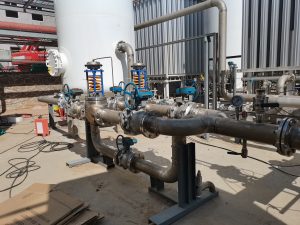
Throughout this process flow, key equipment includes large air compressors, purification skids (molecular sieve driers), brazed aluminum plate-fin heat exchangers, expansion turbines, distillation columns with trays or structured packing, integrated condenser-reboiler units linking the columns, and cryogenic storage tanks. All equipment in the cold box is specially designed to handle low-temperature operation and to maintain contaminant-free conditions so that ultra-high purities can be achieved.
Industrial Relevance and Typical Applications
Cryogenic air separation plants are of immense industrial importance because they produce the essential gases that drive many processes. Some key applications and industries relying on this technology include:
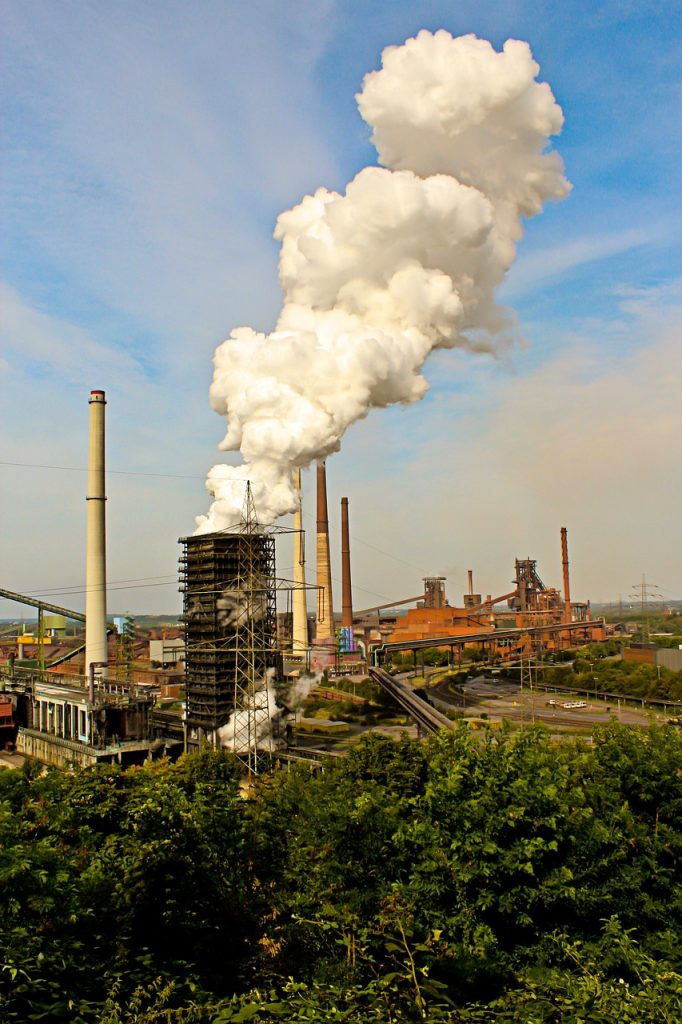
- Steel and Metals Production: High-purity oxygen is used in basic oxygen furnaces and electric arc furnaces to boost temperatures and refine steel. Nitrogen is used for inerting and stirring in metallurgical processes, and argon is used to prevent oxidation and in specialty steelmaking (e.g. as a stirring gas in argon-oxygen decarburization).
- Chemical and Petrochemical Industry: Many large-scale chemical processes require substantial quantities of oxygen or nitrogen. For instance, oxygen is used for oxidation reactions (such as ethylene oxide production or coal gasification), and nitrogen is used as an inert gas for blanketing reactive systems, purging equipment, and providing pressure transfer. Ammonia production needs nitrogen feedstock, which is often supplied by an air separation unit. Argon is also used in certain chemical processes and as a carrier gas in analytical instruments.
- Energy and Propulsion: In power generation and fuel processing, oxygen from air separation is used for oxy-fuel combustion in power plants and gasifiers to improve efficiency and reduce emissions. The aerospace and rocket industry depends on liquid oxygen (LOX) as a rocket oxidizer, and liquid nitrogen is used for cooling, testing, and purging of fuel systems.
- Healthcare and Medical Gases: Medical-grade oxygen for hospitals and clinics is often produced in large ASUs and then distributed either as liquid or gas. The ability to produce and store liquid oxygen ensures a reliable supply for medical use. Nitrogen is also used in medical environments for preserving biological samples.
- Electronics and High-Tech Manufacturing: Semiconductor fabrication plants require ultra-high-purity nitrogen to create inert atmospheres for processes like wafer production. Cryogenic air separation is the only viable source of the extremely pure nitrogen (and argon) needed in electronics manufacturing. The gases produced are free of moisture and hydrocarbons, meeting the stringent purity standards of the electronics industry.
- Food and Beverage: Liquid nitrogen from air separation units is widely used for flash-freezing foods and for cold storage logistics. Gaseous nitrogen is used in food packaging to displace oxygen and prolong shelf life of packaged foods. Breweries and beverage producers also use nitrogen or oxygen depending on the process (for example, nitrogen for purging oxygen from beer tanks, and oxygen to aid yeast fermentation in brewing).
In summary, cryogenic air separation underpins many sectors by providing a steady supply of industrial gases through low-temperature distillation. The scalability of cryogenic plants—from small units for medical oxygen up to gigantic ASUs supporting steel mills—means this technology can be adapted to various demands. The reliability of these plants (often running continuously for years with minimal shutdowns) further cements their role in industrial infrastructure.
Advantages of Cryogenic Air Separation over Alternative Technologies
Several alternative technologies exist for separating air, primarily pressure swing adsorption (PSA) and membrane separation systems, which operate at or near ambient temperature. While these methods are useful for certain applications, the cryogenic approach offers distinct advantages in many scenarios:
- Higher Purity and Multiple Products: Cryogenic air separation can achieve much higher purity levels for oxygen and nitrogen than PSA or membrane systems. For example, PSA oxygen generators typically produce ~90–95% O₂ (suitable for some medical or industrial uses), whereas low-temperature distillation easily produces >99.5% O₂. Similarly, nitrogen from membranes might reach 95–99% purity, but cryogenic plants can deliver 99.999% N₂ if needed. Additionally, only low-temperature distillation can economically co-produce argon and recover rare gases like neon, krypton, and xenon; alternative technologies cannot separate these valuable components from air.
- Large Capacity and Efficiency at Scale: For large gas volumes (e.g. thousands of tons of oxygen per day as required in a major steelworks or petrochemical complex), low-temperature distillation is far more economical. PSA and membrane units are typically used for smaller to medium scales, and their efficiency drops or becomes impractical at very high flow rates. In contrast, cryogenic plants benefit from economies of scale – the specific energy consumption per unit of gas tends to improve in bigger plants due to better heat integration and more efficient turbines. Thus, for any substantial industrial gas demand, a cryogenic ASU is usually the technology of choice.
- Liquid Products and Storage: In low-temperature distillation plants, liquid oxygen, nitrogen, or argon can be produced and stored in insulated tanks. This is a major advantage for backup supply and distribution. Facilities can liquefy excess product during low demand and store it, then vaporize and supply it during peak demand or during any ASU maintenance outages. Neither PSA nor membrane systems can directly produce liquid products without additional liquefaction equipment.
- Argon and Rare Gas Recovery: A unique advantage of low-temperature distillation is the ability to extract argon and other noble gases present in air (albeit in small concentrations). Argon is nearly always recovered in large cryogenic ASUs because it adds commercial value. Recovery of neon, krypton, and xenon is also possible in very large units with special design. Alternative technologies simply vent these components to the atmosphere, as they cannot separate them.
- Process Integration and Reliability: ASUs can be integrated with industrial processes for enhanced efficiency, such as using waste heat or power from a facility to assist in the ASU operations. They are complex but robust systems, often designed to run continuously with high on-stream factors (over 98% uptime). PSA units, while simpler, involve many cyclic valve operations and may require more frequent maintenance. Membrane systems are straightforward, but membranes can degrade over time and typically require periodic replacement. In contrast, the core low-temperature distillation equipment is long-lasting. For plants that demand absolute reliability and a constant high-volume gas supply, cryogenic ASUs are generally preferred.
Table 1: Comparison of Air Separation Technologies
| Aspect | Cryogenic Air Separation (Low-Temperature Distillation) | Pressure Swing Adsorption (PSA) | Membrane Separation |
|---|---|---|---|
| Purity Achievable | O₂ >99.5%; N₂ >99.999%; Ar >99.9% | O₂ ~90–95%; N₂ ~95–99.9% | O₂ ~40%; N₂ ~95–98% (limited) |
| Typical Capacity Range | Medium to very large (up to thousands of tons per day) | Small to medium (up to a few hundred tons per day) | Small (portable or niche units) |
| Products | Multiple: O₂, N₂, Ar (and rare gases in large plants); gas or liquid output | Usually single gas (O₂ or N₂); gas output only | Single gas (usually N₂); gas output only |
| Energy Consumption | Higher per unit at small scale; improves at large scale (energy-intensive cooling) | Moderate (compression and purge requirements) | Low (only compression) |
| Capital & Maintenance | High capital cost; complex but very reliable long-term continuous operation | Moderate capital; simpler system, adsorbent needs periodic replacement | Low capital; very simple, but membranes require regular replacement |
| Use Case Suitability | Best for high volume and ultra-high purity needs; essential for argon/rare gas production and liquid products | Best for moderate purity and smaller demand when cryogenic is not economical (e.g. small on-site O₂ or N₂ generators) | Niche use for moderate-purity N₂ or portable systems where simplicity is paramount |
As shown above, cryogenic air separation excels when high purity, large quantities, or liquid storage are required, despite its higher complexity and energy usage. Alternative methods have their place for lower volume or lower purity needs due to lower upfront cost and simpler operation. However, the fundamentals of cryogenic air separation make it indispensable for the large st and most demanding industrial applications.
Conclusion
The fundamentals of cryogenic air separation and low-temperature distillation combine classical thermodynamics with advanced engineering to achieve something remarkable: the liquefaction of air and its separation into pure components. This low-temperature distillation technology remains the cornerstone for producing industrial gases at scale. By levera ging low-temperature distillation, cryogenic air separation plants supply vital oxygen, nitrogen, and argon to countless industries with reliability, efficiency, and high purity. Ongoing improvements in heat integration, materials, and process control continue to enhance the performance of these systems.