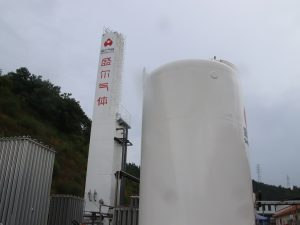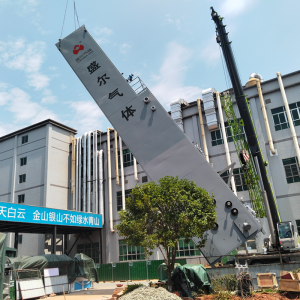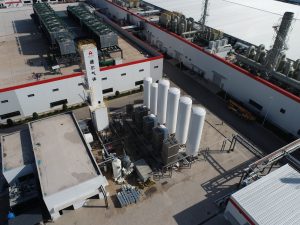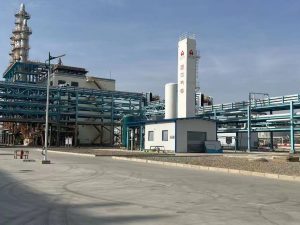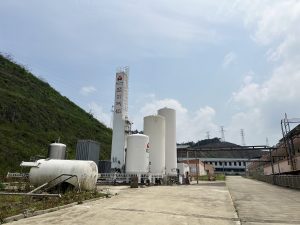
Cryogenic air separation nitrogen is a foundational process in the industrial gas industry, producing high-purity oxygen and nitrogen on a large scale. Ambient air is compressed and then cooled to cryogenic temperatures (below –150°C) so that its components liquefy. A series of distillation columns exploits the boiling points of nitrogen (–196°C) and oxygen (–183°C) to separate them continuously. Modern cryogenic Air Separation Units (ASUs) can output thousands of normal cubic meters per hour (Nm³/h) of pure nitrogen, making them ideal for very large continuous demands. Cryogenic air separation nitrogen systems are widely used in industry to meet such demands. By co-producing oxygen and even argon, cryogenic plants achieve high overall efficiency.Cryogenic air separation nitrogen supports the highest-volume industrial gas supply.
Cryogenic Air Separation Process
The cryogenic air separation nitrogen process can be broken into several key stages:
- Air compression and purification: Ambient air is compressed to moderate pressure (often 4–10 atm) and cleaned of moisture and CO₂ via filters and molecular sieves. Removing impurities prevents freezing and blockages in the cold sections.
- Multi-stage cooling: The purified, pressurized air is cooled in stages. It passes through heat exchangers and expansion turbines or valves. Progressive Joule–Thomson expansion (throttling) rapidly lowers the temperature close to the liquefaction point of air (around –190°C).
- Cryogenic distillation: Once a portion of the air liquefies, it enters distillation columns. A common setup uses two linked columns. In the lower (higher-pressure) column, the higher-boiling oxygen concentrates at the bottom, while nitrogen-rich vapors rise to the upper column. Through continuous reflux and reboiling, ultra-pure nitrogen is drawn off at the top of the upper column.
- Product extraction and recompression: High-purity gaseous nitrogen (typically 95–99.999%, depending on design) is withdrawn from the column top at the desired pressure. Some plants also chill and withdraw a liquid nitrogen stream. Meanwhile, the oxygen-rich liquid or vapor is collected and purified, and side draws produce argon if desired.
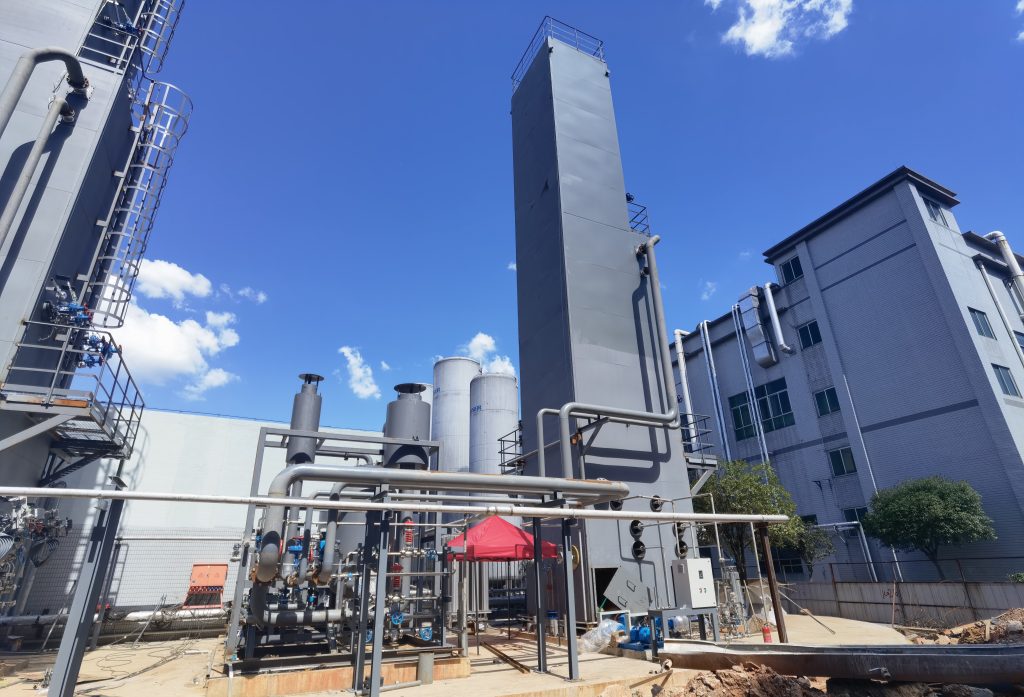
Modern cryogenic air separation nitrogen systems are optimized for both high purity and large-scale output. The tradeoff is complexity and cost: cryogenic plants require large compressors, heat exchangers, insulated cold boxes, and tall distillation towers. Equipment must withstand extreme cold. Typically, a commercial ASU will handle tens of thousands of Nm³ of air per hour. Because cooling large flows of air to cryogenic temperature is energy-intensive, cryogenic ASUs have relatively high operating costs compared to simpler systems.
Performance and Economics
Cryogenic air separation nitrogen generators are optimized for very high capacity and purity. A modern ASU can deliver nitrogen flow from a few hundred up to tens of thousands of Nm³/h. Purity levels are adjustable by controlling reflux and pressure. In practice, cryogenic ASUs routinely achieve nitrogen purities of 95%–99.9%, and specialized units can reach ≥99.99% for niche needs. This ultra-high purity is essential for industries like electronics and specialty chemicals. Large integrated plants often operate with 99.5–99.9% N₂ purity, while producing liquid oxygen or argon as byproducts to improve overall efficiency. Cryogenic air separation nitrogen installations often serve integrated industrial complexes, co-producing oxygen and argon to improve overall efficiency.
However, cryogenic nitrogen production demands substantial energy. Cooling vast volumes of air to cryogenic levels requires a powerful refrigeration cycle, mostly driven by the air compressor. As a rough estimate, producing very high-purity N₂ (~99.9%) via cryogenic ASU uses on the order of 0.6–0.8 kWh per Nm³ of N₂. In absolute terms this is several hundred kWh per ton of nitrogen. Lower purity or smaller units reduce this slightly, but cryogenic ASUs are always higher-energy than PSA or membranes at comparable output.
Cryogenic air separation nitrogen achieves significant efficiency gains at large capacity.
The economics favor scale. Capital cost: Cryogenic ASUs have very high CapEx. Large installations often cost tens of millions of dollars. A rough rule of thumb is around $200–300 per annual ton of oxygen capacity. This is substantially higher per Nm³ than for PSA or membrane plants at small scales. For small flows (e.g. <3,000 Nm³/h), cryogenic ASUs may cost 20–50% more per unit of capacity than PSA systems. However, as size grows, economies of scale kick in. At very large scale (≫10,000 Nm³/h) a cryogenic plant’s per-unit capital cost can become lower. In other words, a multi-hundred-ton-per-day cryogenic plant may be justified by its large throughput and multiple products. Large steel, chemical or power complexes often accept the high CapEx because the same ASU also supplies oxygen and argon, offsetting costs.
Operating cost: Electricity is the dominant expense. Because the air compressor and refrigeration systems run continuously at high load, cryogenic ASUs consume more power per Nm³ of N₂ than PSA or membrane plants. As noted, a cryogenic plant might use ~0.7 kWh/Nm³ for very pure N₂, whereas a PSA unit might use ~0.3 kWh/Nm³ at 95–99% purity. Maintenance and labor costs are also higher, since cryogenic equipment needs specialist technicians. In summary, if a site has moderate nitrogen demand or fluctuating load, simpler PSA/membrane generators usually give lower total cost. But if demand is massive and steady, cryogenic ASUs become competitive due to scale.
Another way to gauge cost is to compare on-site generation vs. buying gas. For large consumers, on-site cryogenic N₂ might cost only a few cents per Nm³ (including amortized CapEx). By contrast, purchased liquid nitrogen or cylinder gas typically runs 2–4 times higher per Nm³ once you include delivery, storage, and handling. On-site cryogenic production also supplies liquid products and other gases that add value.
Comparison with PSA/VPSA and Membrane Systems
Aside from cryogenic ASUs, common nitrogen generation technologies are PSA/VPSA and membrane units. Each has its strengths and limits:
- PSA/VPSA (Pressure-Swing Adsorption): These use adsorbent beds (like carbon molecular sieves) to preferentially adsorb O₂, leaving N₂-enriched product. They can produce 95–99.5% (up to ~99.9% in optimized designs) N₂ and are offered in modular skids. PSA plants start up in minutes and are relatively compact. Their operating power (~0.25–0.4 kWh/Nm³) is lower than cryogenic for similar N₂ purity. Capital cost is moderate. However, PSA systems are typically used up to a few thousand Nm³/h – beyond that scale cryogenic units are more economical.
- VPSA (Vacuum PSA): A variant of PSA that uses vacuum to improve recovery. It has similar purity limits (~95–99%) and shares many characteristics with PSA.
- Membrane Separation: These use polymer membranes that let oxygen permeate faster than nitrogen. Membrane units are very simple, have near-instant start-up, and low maintenance. However, they usually max out at ~95–98% N₂ purity (higher purity requires multi-stage systems) and limited flow (a few hundred Nm³/h per bank). Energy use is low for moderate purities (comparable to PSA at low flows). Membranes shine in small, simple applications but can’t reach the ultra-high purities or flow rates of cryogenic plants.
The table below summarizes key differences:
| Parameter | Cryogenic ASU | PSA / VPSA | Membrane |
|---|---|---|---|
| N₂ Purity Range | 95%–99.9% (up to ≥99.99% in special units) | ~95%–99.5% (up to 99.99% in optimized PSA) | ~90%–98% (practical max ~99%) |
| Capacity Range | Very large (hundreds to >100,000 Nm³/h) | Small to medium (10–5,000 Nm³/h) | Small (1–500 Nm³/h typical) |
| Startup Time | Very long (hours to a day) | Short (minutes to an hour) | Very short (seconds to minutes) |
| Capital Cost | High (large dedicated plant) | Moderate (skid-mounted units) | Low (compact systems) |
| Operating Power | High (0.5–0.8+ kWh/Nm³ for high purity) | Medium (0.2–0.4 kWh/Nm³) | Low (similar to PSA at low flow) |
| Maintenance | Complex (specialized cryogenic upkeep) | Moderate (standard valves/towers) | Simple (few moving parts) |
| Flexibility | Low (designed for steady operation) | High (easy to modulate output) | High (very flexible, plug-and-play) |
| Typical Applications | Bulk supply (steel mills, petrochemicals, bulk gas terminals) | Varied (pharma, food, electronics, mid-scale chemical) | Point-of-use (labs, laser cutting, small shops) |
This comparison shows why cryogenic air separation nitrogen generation is chosen when a plant needs ultra-high purity or very large volumes that PSA/membrane can’t economically match. In practice, large facilities sometimes use hybrid systems (cryogenic ASU plus PSA/booster) to balance high capacity with flexibility.
Cost Analysis
Given the large scale of these plants, cryogenic air separation nitrogen facilities involve significant capital investment. CapEx is driven by big compressors, refrigerated heat exchangers, and tall distillation columns. A modern ASU sized for a big chemical or fertilizer complex can cost tens of millions of dollars. On a per-unit basis, that is far higher than a similar PSA system. For example, industry data suggest that for demands below a few thousand Nm³/h, a cryogenic unit might cost 20–50% more (per Nm³ of capacity) than a PSA unit. Above that scale, cryogenic ASUs gain economies of scale and can ultimately be cheaper per Nm³. In large plants, the cost is justified because the ASU also produces oxygen/argon, improving overall economics.
Operating expenses are also dominated by electricity. The air compressor is the primary energy user, and the refrigeration load adds more power draw. In a cryogenic ASU, specific energy consumption is higher than for PSA or membrane at similar N₂ output. It is common for a cryo-ASU to use ~0.6–0.8 kWh/Nm³ of N₂ when producing ~99.9% purity. By contrast, a comparable PSA might only need 0.25–0.4 kWh/Nm³ (depending on purity). Maintenance costs are higher too, since cryogenic systems require specialized technicians.
In summary, if electricity is very expensive or nitrogen demand is relatively small or intermittent, a PSA or membrane generator will usually have a lower total cost. But if a facility requires very large continuous N₂ flow (often >5,000–10,000 Nm³/h) at high purity, then a cryogenic ASU can be more economical on a per-unit basis. On-site cryogenic generation also lets companies avoid the high price of delivered liquid nitrogen. Rough estimates indicate that fully-loaded on-site cryogenic N₂ can cost only a few cents per cubic meter, whereas buying bulk liquid N₂ (including delivery and handling) often costs several times more.
Industrial Applications
Cryogenic air separation nitrogen thus becomes the primary bulk supply for the highest-volume, highest-purity demands. Key sectors include:
- Chemical and Petrochemical Plants: Large chemical complexes (especially fertilizer/ammonia and refineries) use nitrogen for purging, stripping, and blanketing. Ammonia synthesis, for example, requires very pure nitrogen feed (often supplied by an ASU). Refineries and petrochemical units employ N₂ as an inert or sweep gas in reactors like hydrocrackers and reformers. Large on-site cryogenic air separation nitrogen plants co-located with refineries or chemical parks supply stable, high-flow nitrogen (often 99.9%+ purity) along with oxygen for other processes.In steel production, cryogenic air separation nitrogen provides stable inert atmospheres for continuous casting and heat treatment.
- Steel and Metallurgy: Integrated steel mills consume huge gas volumes. High-purity N₂ provides an inert atmosphere in continuous casting, ladle stirring, and annealing furnaces to prevent oxidation of the hot steel. For rolling and heat-treatment, nitrogen or nitrogen/argon mixtures are used to control atmospheres. Cryogenic plants at steelworks routinely deliver thousands of Nm³/h of ultra-pure N₂. In contrast to the oxygen used in basic oxygen furnaces, this nitrogen helps with temperature control and steel refining without introducing oxygen.
- Energy Sector: In oil & gas, nitrogen plays a major role. Enhanced Oil Recovery (EOR) projects inject large volumes of nitrogen into reservoirs to maintain pressure. Offshore platforms or onshore blocks may install cryogenic N₂ generators to meet this constant demand instead of shipping in liquid N₂. In power generation and utilities, nitrogen is used for purging gas pipelines, blanketing fuel tanks, and cooling components. Cryogenic air separation nitrogen is also integral to emerging technologies like liquid-air energy storage (where air is liquefied and expanded for power) and to gasification processes (which use high-purity oxygen and vent the N₂ byproduct).
- Other Industries: Bulk nitrogen from cryogenic ASUs is used in glass-making (preventing oxidation in furnaces), semiconductor fabrication (ultra-clean N₂ environments), and food processing (bulk packaging gas). In many of these, smaller PSA units or purchased gas may suffice; cryogenic nitrogen is typically reserved where scales or purity exceed what those alternatives can handle.
In summary, cryogenic air separation nitrogen generation is chosen when capacity or purity needs exceed the practical limits of PSA or membrane. Typical scenarios involve very large, continuous demands (often >5,000–10,000 Nm³/h at >99% purity). The ability of cryogenic ASUs to co-produce oxygen and argon further enhances their value in integrated chemical, steel, and energy facilities.
Conclusion
Cryogenic air separation nitrogen remains the benchmark for high-capacity, high-purity nitrogen production. By liquefying and distilling air, it delivers nitrogen (along with oxygen and argon) at purity levels and volumes unattainable by other methods. The main trade-offs are significantly higher capital and power costs, and longer startup times. However, in chemical, steel, and energy industries where ultra-large, steady N₂ supplies are critical, cryogenic ASUs are often the preferred choice. They offer unmatched volume and multi-gas flexibility that PSA or membrane systems cannot match, making cryogenic systems indispensable for modern heavy industry.