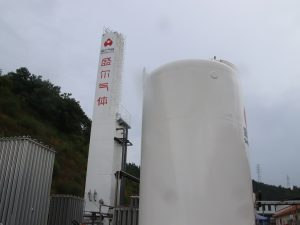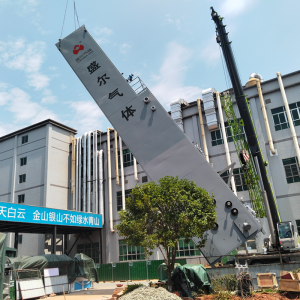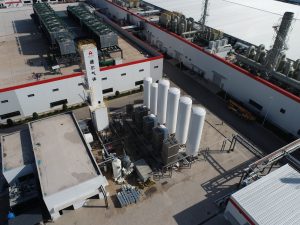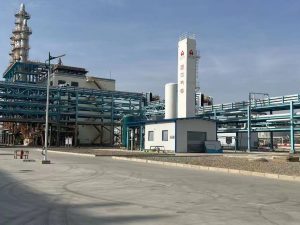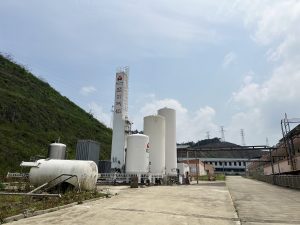
Cryogenic air separation is the leading technology for producing industrial gases like oxygen, nitrogen, and argon in large volumes. Modern Air Separation Units (ASUs) chill air to cryogenic temperatures and use distillation to separate it into pure components based on their boiling points. This process remains the most energy-efficient method for high-purity gas production at an industrial scalecold-facts.org. In this article, we’ll explore how a cryogenic ASU works step by step – from air filtration and compression to purification, heat exchange, and low-temperature distillation – highlighting the design features and efficiency improvements that define today’s high-performance ASUs. We’ll also discuss how these plants supply critical gases to the steel, chemical, and energy sectors.In large-scale industrial gas production, cryogenic air separation remains the benchmark for achieving both high purity and stable continuous output.Compared with PSA or membrane systems, cryogenic air separation is uniquely suited for steel, chemical, and energy complexes requiring large and continuous gas supply.
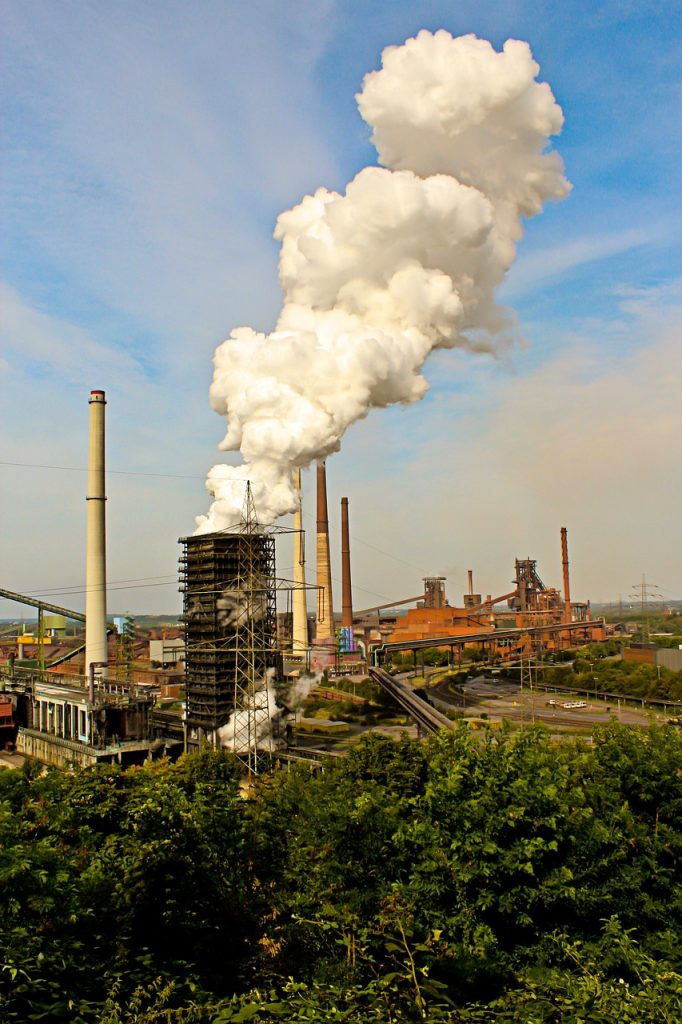
Principles of Cryogenic Air Separation
An ASU separates atmospheric air into its primary components (mainly oxygen and nitrogen, with argon as a valuable byproduct)cryospain.com. The principle of cryogenic air separation hinges on the different boiling points of these gases. Air is first cooled until it liquefies, then distilled in stages to extract each component. At atmospheric pressure, nitrogen boils at about –195.8 °C, argon at –185.8 °C, and oxygen at –182.9 °Ccryospain.com. This means nitrogen is the most volatile (turns to gas at the lowest temperature) and oxygen the least volatile of the major components. By cooling and distilling liquid air, ASUs can isolate nitrogen, oxygen, and argon with high purity. Table 1 summarizes the key properties of air’s main constituents that make this separation possible.This vapor–liquid behavior under controlled pressure forms the thermodynamic basis of modern cryogenic air separation systems.Because of its strong phase selectivity, cryogenic air separation consistently achieves oxygen and nitrogen purities above 99.9%.
Table 1: Major Components of Air and Their Boiling Points
| Component | Symbol | Volume in Dry Air (%)* | Boiling Point (°C at 1 atm) |
|---|---|---|---|
| Nitrogen | N₂ | ~78.1 | –195.8 °C |
| Oxygen | O₂ | ~20.9 | –182.9 °C |
| Argon | Ar | ~0.9 | –185.8 °C |
*Approximate volume percentages of dry airispatguru.com. (Trace gases like neon, helium, krypton, etc. make up the remainder.)
By exploiting these boiling point differences under carefully controlled low temperatures and pressures, a cryogenic ASU can cleanly separate air into nitrogen (which concentrates in the top of distillation columns as a vapor) and oxygen (which collects as a liquid at the bottom), while also extracting argon from the intermediate stages of the processispatguru.comispatguru.com. The entire operation is conducted inside a heavily insulated cold box to maintain cryogenic conditions.
Key Stages of a Cryogenic ASU Process
Modern air separation units consist of several integrated components that work in sequence to produce pure gasescryospain.com. The major stages include air filtration and compression, purification, heat exchange (cooling), cryogenic distillation, and product storage or delivery. Each stage is optimized to maximize efficiency and product purity:
- Air Filtration and Compression in Cryogenic Air Separation: Ambient air is first drawn through filters to remove dust and pollutants, protecting downstream equipmentcold-facts.org. Clean air then enters the main air compressor, which is typically an oil-free, multi-stage centrifugal compressorcold-facts.org. The compressor raises the air to a pressure of about 5–10 bar (gauge)cryospain.com, with intercoolers removing heat of compression at each stage. Compressing the air has two benefits: it enables higher throughput of air into the distillation system and elevates the saturation temperature of air, making subsequent cooling and liquefaction more effective. The compressor is the largest energy consumer in an ASU, so modern designs use efficient aerodynamic stages and strict oil filtration (to prevent any oil from entering the cold box and causing hazards)cold-facts.orgcold-facts.org. By controlling compressor output, operators regulate the airflow and pressure that feed the cryogenic columns.
- Air Purification: After compression, the air must be purified to remove components like water vapor, carbon dioxide, and hydrocarbons. If not removed, these impurities would freeze solid at cryogenic temperatures and clog the equipmentcryospain.com. Most high-efficiency ASUs use a front-end purification unit with dual activated alumina and molecular sieve adsorberscold-facts.org. The compressed air passes through one adsorber vessel, which traps virtually all moisture and CO₂, while the alternate vessel is regenerated using a flow of dry waste nitrogen from the ASU. The vessels switch periodically (every several hours) to provide continuous cleaning. This temperature swing adsorption (TSA) system yields ultra-clean, CDA (Clean Dry Air) at pressurecold-facts.org. (Older ASU designs sometimes used reversing heat exchangers to freeze out moisture/CO₂, but this method is noisy and less efficientcold-facts.org, so modern plants favor molecular sieve purifiers for energy efficiency and reliability.)
- Cooling and Heat Exchange for Cryogenic Air Separation: The dried, pressurized air then enters the cold box for cooling to cryogenic temperatures. Heat exchangers bring the air down to around –150 °C or colder by transferring heat to the outgoing product and waste streamscold-facts.orgcold-facts.org. Brazed aluminum plate-fin heat exchangers are commonly used because they allow multiple gas streams to exchange heat in counterflow with minimal temperature difference. In a typical ASU, the incoming air is cooled in stages: a “warm” heat exchanger precools it against returning warm nitrogen/oxygen, and a “cold” heat exchanger further cools it against the cold product streamscold-facts.org. By the cold end of the exchanger, most of the air is near liquefaction (around –170 °C to –175 °C, depending on pressure). To reach ultralow temperatures and produce sufficient liquid, modern ASUs employ an expansion turbine (turbo-expander) as part of a modified Claude cyclecold-facts.org. A portion of the air (or sometimes nitrogen) is expanded through a turbine from an intermediate pressure down to low pressure, producing additional refrigeration. This cold expanded gas is fed into the cold box, boosting the liquefaction of incoming air. The expander also converts some energy from the gas into useful work (often driving a booster compressor or generator)ispatguru.com, recapturing what would otherwise be wasted as pressure drop. The result is a highly energy-efficient cooling cycle that provides the necessary low temperatures for distillation. Efficient heat integration is key: as the waste gases leave the cold box and warm back to ambient, they pre-cool the incoming air, drastically reducing overall refrigeration dutyispatguru.com. This kind of heat recovery minimizes power consumption and is a hallmark of high-efficiency ASU design.
- Distillation Core of Cryogenic Air Separation: Once the air is liquefied (or partially liquefied) and chilled to near its boiling range, it enters the distillation column system. Most large ASUs use a classic double-column arrangement invented by Carl von Lindeassets.linde.comassets.linde.com – essentially two distillation columns operating at different pressures and thermally linked by a heat exchanger. The first column (called the high-pressure column, HP, or sometimes “medium-pressure column”) operates at about 5–6 barassets.linde.com. The feed air (a cold vapor-liquid mixture) enters near the bottom of this column. As it rises through successive trays or structured packing, the vapor is progressively enriched in nitrogen (the lowest-boiling component). At the top of the HP column, nearly pure nitrogen gas is obtainedcold-facts.org. Meanwhile, oxygen (with some argon and nitrogen) concentrates in the liquid that collects at the bottom (often called “rich liquid” with ~35–40% O₂)cold-facts.orgassets.linde.com. This oxygen-enriched liquid from the base of the high-pressure column is expanded and fed into the second column, the low-pressure column (operating around 1.2–1.5 bar)assets.linde.com. In the low-pressure column, further distillation occurs at lower pressure, which improves oxygen purity. The overhead of the low-pressure column provides a vapor reflux to the high-pressure column: the HP column’s nitrogen product is liquefied in a condenser and sent back down as a cold liquid reflux to the top of the LP columnassets.linde.com. This integrated heat exchanger acts as the condenser for the HP column and the reboiler for the LP column simultaneously, linking the two columns thermally. As a result, the latent heat released by condensing nitrogen in the HP column is used to boil oxygen in the LP column. The low-pressure column then produces two primary outputs: high-purity nitrogen gas is drawn from its top, and high-purity liquid oxygen is drawn from the bottomassets.linde.com. The liquid oxygen can be pumped as a liquid and vaporized to gaseous product or stored as bulk liquid. By the end of this double-column distillation, oxygen purity can reach 99.5+% and nitrogen purity 99.9+%, typical for industrial specifications. Column pressure control and reflux balance are essential for high-efficiency cryogenic air separation.With optimized column internals, cryogenic air separation minimizes energy losses while maximizing oxygen recovery.Argon Recovery: Argon, which makes up ~0.9% of air, has a boiling point very close to oxygen (only a few degrees lower). In the distillation process, argon tends to accumulate in the middle of the low-pressure column, since it is slightly more volatile than oxygen but less so than nitrogen. Without special measures, most of the argon would remain mixed with oxygen. In modern ASUs, a side draw is taken from the low-pressure column at the point of highest argon concentration (around 15%–30% argon)cold-facts.org. This stream (often called crude argon, containing argon plus oxygen) is fed to a separate argon distillation column for purificationispatguru.comispatguru.com. In older designs, crude argon (which still contains a few percent oxygen) was purified by first reacting oxygen out with a small hydrogen bleed (in a catalytic de-oxo unit) and then removing nitrogen in a distillation columnispatguru.com. However, today’s high-efficiency ASUs often use an all-cryogenic argon column that is tall and finely optimized to directly separate argon from oxygen without requiring a de-oxo stepispatguru.com. This column yields argon product (typically 99.999% pure) which is usually extracted as a liquid. The ability to recover argon adds to the economic efficiency of the ASU, since argon is a valuable gas for industry. It’s important to note that including argon recovery slightly increases the complexity and height of the distillation system, but design advances (like better column internals and packing) have made this feasible with minimal impact on oxygen production.
- Product Collection and Delivery: The outputs from the distillation columns are then warmed back to ambient temperature (if drawn as gases) or sent to storage tanks (if drawn as cryogenic liquids). High-purity oxygen may be drawn as a gas at low pressure (near 1 atm) and then compressed by product compressors to whatever delivery pressure is needed by the end userispatguru.com. In many modern plants, oxygen is instead withdrawn as cold liquid oxygen (LOX) which is pumped to high pressure as a liquid (a far more energy-efficient method than compressing gas) and then vaporized through heat exchangers to produce high-pressure gaseous O₂ for pipelines or industrial use. Nitrogen can be delivered as gas (often at ambient temperature) for inerting and purging applications, or as liquid (LIN) for cryogenic uses. Argon is typically stored and shipped as a liquid (LAR) in insulated containers. Throughout the process, the cooling duty of vaporizing product liquids or warming gas streams is often recovered and recycled within the heat exchangers to improve overall efficiency. The final product streams are extremely pure – oxygen is commonly 99.5% or higher, nitrogen 99.9% or higher, and argon 99.99% or higher – meeting stringent industry standards.
Distillation Column Design and Efficiency Enhancements
The heart of a cryogenic ASU is the distillation system, so its design greatly influences efficiency. Each distillation column contains either trays or structured packing to promote contact between rising vapor and falling liquid, enabling effective mass transfer. Traditional columns used sieve or valve trays; each tray creates a stage where liquid and vapor equilibrate, incrementally increasing purity. Proper tray design ensures that as cold liquid oxygen-rich mixture flows downward and nitrogen-rich vapor bubbles upward, oxygen continually condenses into the liquid and nitrogen vaporizes into the vapor, sharpening the separationispatguru.com. One drawback of trays is the pressure drop they introduce across each stageispatguru.com – higher pressure drops force the air compressor to work harder. Modern high-efficiency ASUs utilize structured packing in place of trays for some services. Packing provides a very high surface area for contact with much lower pressure drop per stage, allowing taller columns (more separation stages) and improved energy efficiency. For example, argon columns often use packed sections because the oxygen-argon separation requires many theoretical stages and benefits from the low pressure drop of packing. By reducing internal resistance in the columns, packing technology directly cuts the power required for compression, yielding significant energy savings in large ASUs.Lower internal pressure drop directly enhances the overall specific power of cryogenic air separation units.As a result, structured packing has become standard in high-efficiency cryogenic air separation designs, particularly for argon service.
Another innovation is the use of advanced heat integration techniques. The classic Linde double-column design itself is an elegant heat integration: the high-pressure column’s condenser is the low-pressure column’s reboilerassets.linde.com, ensuring no refrigeration is wasted. Modern ASUs have further improved heat integration by carefully optimizing the approach temperatures in plate-fin exchangers (getting the warm-end and cold-end temperature differences as small as economically feasible)cold-facts.org. A smaller temperature difference means less exergy loss and higher efficiency. However, there is a tradeoff – closing the temperature approach too much can make the heat exchanger larger and more expensive. Designers find an optimal balance, and they often rely on turbo-expanders (as mentioned earlier) to help achieve close temperature approaches at both ends of the main heat exchangercold-facts.org. Additionally, the use of falling film reboilers in some new ASUs has improved efficiency. In this design, liquid oxygen flows in a thin film over the reboiler tubes instead of boiling in a pool, which enhances heat transfer and stabilitycold-facts.org. This results in a more reliable operation and better energy efficiency, since the driving temperature difference can be smaller for the same duty.
Energy efficiency is a critical metric for ASU performance. Large industrial ASUs typically consume between 0.3 to 0.6 kWh per cubic meter of O₂ produced (which translates to roughly 200–600 kWh per ton of O₂, depending on plant size and purity requirements). To minimize this, today’s ASUs are highly automated.Large units benefit from scale, allowing cryogenic air separation to achieve exceptionally low kWh/Nm³ performance. and optimized for steady, long-term operation. Maintaining an optimal HP/LP pressure ratio is central to cryogenic air separation efficiency.They often run continuously for 2–4 years between maintenance turnarounds, ensuring that the equipment stays cold and efficient. Advanced control systems adjust valves, recycle streams, and column pressures to keep the plant at its optimal operating point (for example, maintaining the optimal pressure ratio between the HP and LP columns to match the condenser/reboiler heat balancecold-facts.org). Operating the low-pressure column as close to atmospheric pressure as possible is beneficial for efficiency, as it reduces the required compression workispatguru.com. In summary, decades of incremental improvements – from better compressors and expanders to improved column internals and heat exchangers – have made modern cryogenic air separation units far more efficient than early designs. A new ASU today produces more oxygen per kilowatt of electricity than those from even a couple of decades ago, all while maintaining high reliability and safety.
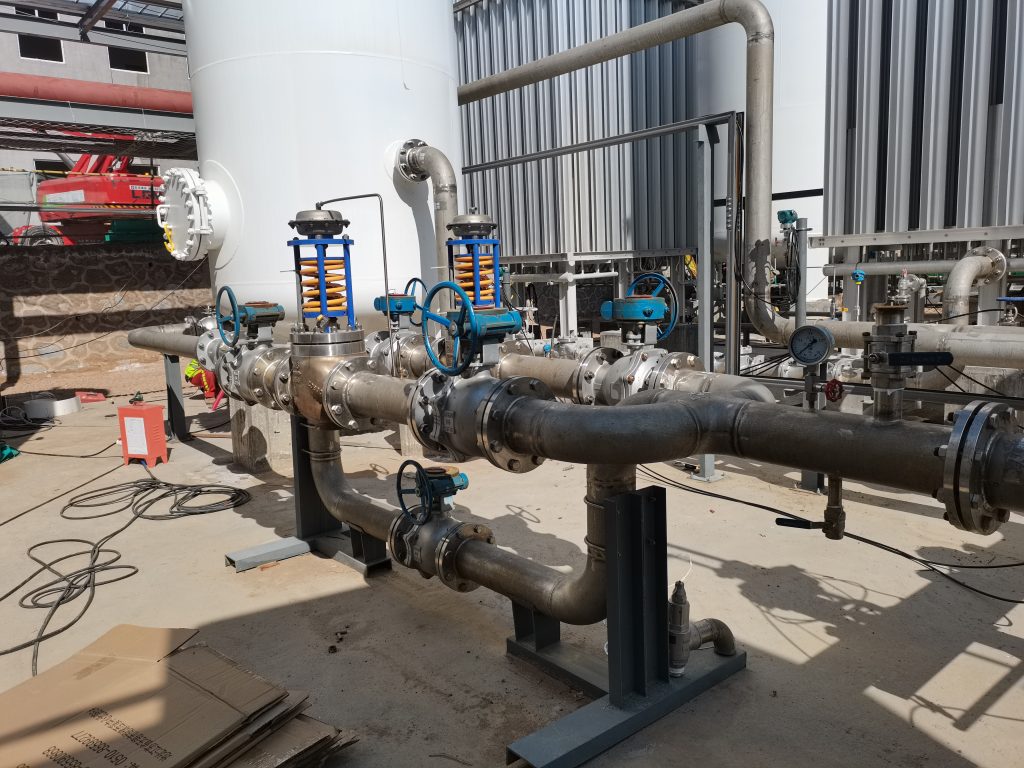
Industrial Applications of Cryogenic ASUs
Cryogenic air separation enables the massive scale of oxygen and nitrogen use in today’s industries. The following are key application areas in the steel, chemical, and energy sectors, which rely on ASUs for a stable supply of gases:
- Steel Industry: Steel mills are major consumers of oxygen. Cryogenic air separation plants onsite provide oxygen for basic oxygen furnaces (BOF) in steelmaking, where purging molten iron with high-purity O₂ removes carbon and impurities in the conversion to steel. Oxygen from ASUs is also used in electric arc furnaces and blast furnace enrichment to boost combustion temperatures. Nitrogen and argon from the ASU find uses in steel production as well – for example, argon is injected into molten steel (argon stirring) during secondary metallurgy to homogenize composition and remove impurities. Nitrogen is used to inert furnaces or purging lines. The availability of low-cost oxygen via cryogenic separation was instrumental in advancing modern high-productivity steelmaking processes.
- Chemical and Petrochemical Industry: Many chemical processes depend on large volumes of nitrogen and oxygen. Cryogenic ASUs supply nitrogen for inert blanketing of reactive chemicals, purging of equipment, and creating oxygen-free atmospheres for safety. Nitrogen is indispensable in ammonia production (as the source of N₂ for the Haber process) and is used to purge and pressure-test pipelines and vessels. Oxygen from ASUs is used in processes like ethylene oxide production, propylene oxide, synthesis gas (syngas) generation via partial oxidation of hydrocarbons, and in sulfur recovery units. In refineries and petrochemical plants, oxygen can enhance combustion in Claus reactors or gasifiers to improve efficiency. Argon, while a smaller player in volume, is crucial for specialty chemicals and the electronics industry (e.g. providing an inert atmosphere for silicon crystal growing and semiconductor fabrication). The chemical sector values the high purity of ASU-derived gases – for instance, moisture- and CO₂-free nitrogen from an ASU is essential for blanketing moisture-sensitive reagents and products.
- Energy Sector: The energy industry increasingly uses cryogenic air separation for processes that require oxygen. Integrated Gasification Combined Cycle (IGCC) power plants and coal gasification facilities use large ASUs to supply oxygen for gasifying coal or heavy residues into syngas, which can then be cleaned and burned in turbines or used to produce fuels. Oxy-fuel combustion in power generation, a technology aimed at carbon capture, requires nearly pure oxygen (instead of air) to combust fuel, and ASUs are used to provide that O₂. The resulting flue gas from oxy-combustion is rich in CO₂ and easier to capture for sequestration. Additionally, emerging technologies like oxygen-blown biomass gasifiers or waste-to-energy plants depend on ASU oxygen. On the nitrogen side, gas turbines sometimes use nitrogen from ASUs for NOx control or as a diluent in combustion when firing pure oxygen streams. Furthermore, ASUs produce liquid oxygen which is used as a rocket oxidizer in the aerospace sector and liquid nitrogen for energy storage (liquid air energy storage cycles) and grid cooling applications. In summary, from boosting power plant efficiency to enabling low-carbon technologies, ASUs play a growing role in the energy field.
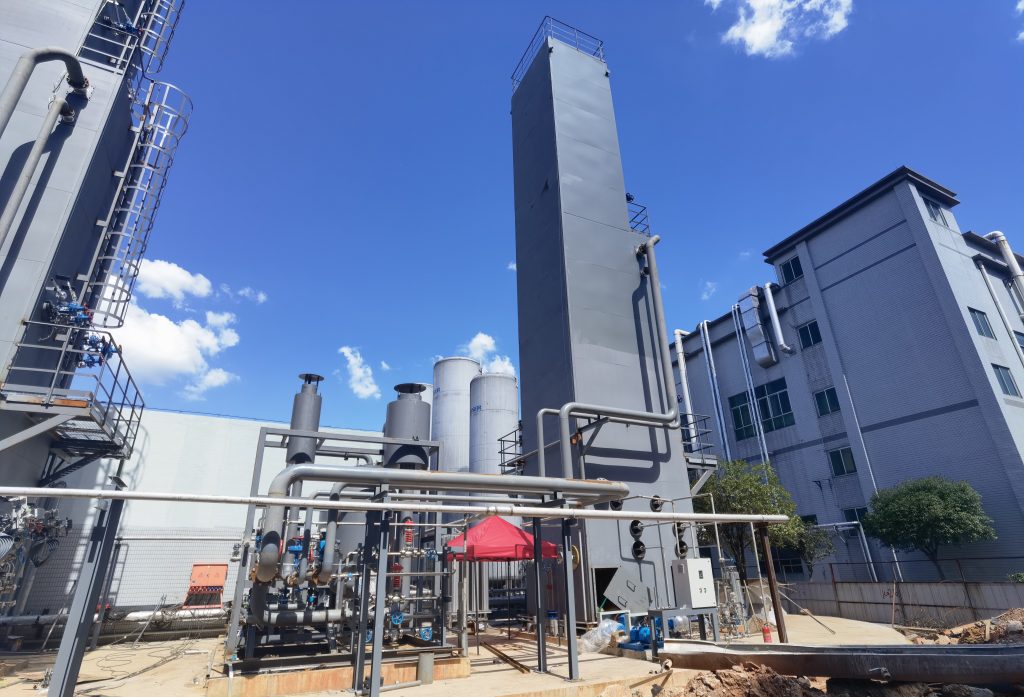
Conclusion
From the moment air is sucked in from the atmosphere to the point ultra-cold liquid oxygen pours into a storage tank, cryogenic air separation is a marvel of engineering and thermodynamics. Modern ASUs exemplify the synergy of clever process design and advanced engineering – filters, compressors, purifiers, heat exchangers, distillation columns, and expansion turbines all synchronized to distill air into its pure components efficiently. The double-column distillation process, pioneered over a century ago, has continually evolved with improvements like better materials, packed columns, and heat integration that push efficiency closer to theoretical limits. The result is that today’s high-efficiency ASUs can produce thousands of tons of oxygen and nitrogen per day at purities above 99.9%, fueling the needs of steelmakers, chemical plants, energy projects, and more. As industries drive towards cleaner and more efficient operations, cryogenic air separation remains a foundational technology – reliably delivering the breath of life for modern manufacturing and energy production, one cold distillation drop at a time.With ongoing advances in controls and turbomachinery, cryogenic air separation will continue improving efficiency and reliability.For any industry requiring high-purity oxygen or nitrogen, cryogenic air separation remains the most capable solution.
References: High-efficiency ASU designs and operations are informed by industry standards and publications, including guidelines from the European Industrial Gases Association (EIGA), technical documentation from leading industrial gas companies (Air Liquide, Linde Engineering), and decades of operational experience in large air separation installationsassets.linde.comispatguru.com. The descriptions above align with established principles outlined in these reference materials and reflect the state-of-the-art in cryogenic air separation technology.